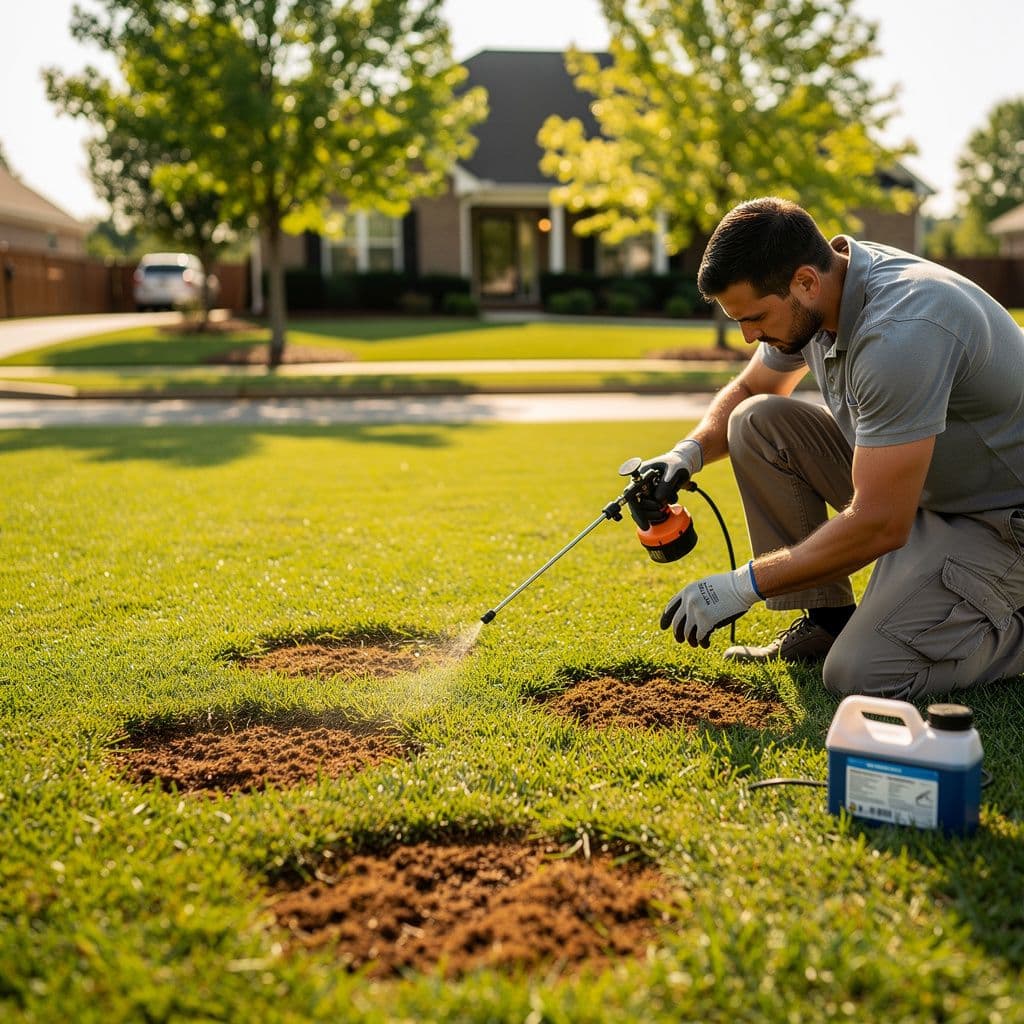
Summer Lawn Fungus Treatment: How to Stop Brown Patch and Lawn Disease in Henry County
Published: July 2, 2026
You've been watering correctly. You mow at the right height. Your fertilizer applications are on schedule. And yet, almost overnight, circular brown patches have appeared across your lawn — and they're getting bigger every day.
If this sounds familiar, you're likely dealing with summer lawn fungus. And you're not alone. Across Locust Grove, McDonough, Stockbridge, and throughout Henry County, fungal diseases are the most misdiagnosed lawn problem homeowners face in July and August. The symptoms look exactly like drought stress, heat damage, or insect damage — which means most homeowners reach for the wrong treatment and watch their lawn get worse.
Fungal lawn diseases are different from pest problems like fall armyworms or grub worms. Insects eat your grass. Fungi infect it. The treatment approach is completely different, and using insecticide on a fungal problem won't do anything except waste your money.
This guide covers the most common summer lawn diseases affecting Henry County lawns, how to identify each one, and the professional treatment options that stop fungal damage before it destroys your turf. If you're seeing suspicious brown patches right now, call Hedgecoth Property Solutions at 770-490-9519 for a professional assessment.
Why Henry County Lawns Get Fungus in Summer
Georgia's summer climate is essentially a fungal paradise. Understanding the conditions that trigger lawn disease helps you prevent outbreaks before they start.
The Humidity-Heat-Dew Triangle
Fungal spores need three things to activate and spread: warmth, moisture, and a susceptible host. Henry County delivers all three in abundance from June through September:
- Daytime temperatures consistently above 85°F push warm-season grasses into their peak growing season — but also stress them, making them more vulnerable to infection
- Nighttime temperatures staying above 68°F mean fungal pathogens never slow down. Brown patch fungus, in particular, becomes aggressive when nights are warm and humid
- Afternoon thunderstorms are a Henry County staple. They dump water on your lawn at 4 PM, the sun sets at 8:30 PM, and your grass stays wet for 14+ hours straight — the exact conditions fungi need to reproduce
- Heavy morning dew coats grass blades with moisture that doesn't evaporate until mid-morning, giving fungal spores hours of contact time with your turf
Henry County Soil Makes It Worse
Our region's heavy Georgia clay soil compounds the fungal problem. Clay drains slowly, meaning water from thunderstorms sits near the surface for extended periods. This creates pockets of constantly moist soil — exactly what fungal pathogens need.
Lawns with poor drainage, compacted soil, or heavy thatch buildup are especially vulnerable. If you've noticed standing water in your yard after storms, your lawn is at higher risk for fungal disease.
The Big Four: Common Summer Lawn Fungi in Henry County
Different fungal diseases require different treatments. Here's how to identify the ones most likely to damage your Henry County lawn this summer.
1. Brown Patch (Rhizoctonia solani)
What it looks like: Circular or irregular patches of brown, thinning grass ranging from a few inches to several feet in diameter. The patches often have a distinctive "smoke ring" — a grayish-purple border around the outer edge where the fungus is actively spreading. In the morning dew, you might see cobweb-like fungal threads on the grass blades.
Grasses affected: Tall Fescue is most susceptible, but Bermuda, Zoysia, and Centipede grasses all get brown patch in Henry County. If you have a fescue lawn — common in shaded Locust Grove and McDonough neighborhoods — brown patch is your biggest summer threat.
When it hits: Peak activity is June through August when nighttime temperatures stay above 68°F and humidity is high. The fungus thrives in lawns that stay wet for more than 10 hours at a stretch.
Key identifier: Brown patch usually starts as a small circle (6-12 inches) and expands outward. The center may recover while the ring continues to expand, creating a donut-shaped pattern. Grass blades in the affected area will have tan lesions with dark brown borders.
2. Dollar Spot
What it looks like: Small, silver-dollar-sized spots of bleached white or tan grass — about 2-6 inches in diameter. In the morning dew, a fine white cobweb-like fungus may be visible. Multiple spots can merge into larger irregular patches.
Grasses affected: Bermuda and Zoysia are most commonly affected in Henry County. Lawns that are under-fertilized or drought-stressed are especially vulnerable.
When it hits: Late spring through early fall, with peak activity in humid summer conditions. Dollar spot loves lawns with low nitrogen levels — one reason why consistent professional fertilization matters.
Key identifier: Individual spots are small and distinctly bleached (almost white). Grass blades will have hourglass-shaped lesions with brown borders. The spots look like someone poured bleach on the lawn in coin-sized splashes.
3. Zoysia Patch (Large Patch)
What it looks like: Large circular patches of orange, yellow, or brown grass — often 3-10 feet in diameter. The patches may have an orange halo at the edges. In active growth, affected grass feels soft and slimy when pressed.
Grasses affected: Primarily Zoysia grass, though Centipede can also be affected. If you have a Zoysia lawn in Stockbridge, McDonough, or Hampton, watch for this disease carefully.
When it hits: Spring and fall transitions are peak seasons, but summer flare-ups happen during extended wet periods. Zoysia patch is especially active when soil temperatures hover around 70°F with high moisture.
Key identifier: The orange border is the tell-tale sign. Unlike brown patch, zoysia patch affects the lower portions of the grass plant first, so the base of affected stems will be brown and rotten while the leaf tips may still look green.
4. Fairy Rings
What it looks like: Dark green circles of rapidly growing grass, sometimes with mushrooms growing around the perimeter. The grass inside the ring may eventually turn brown and die. Rings expand outward year after year.
Grasses affected: All turf grasses. Fairy rings are caused by various fungi breaking down organic matter in the soil.
When it hits: Most visible during summer when lawns are actively growing and moisture is abundant.
Key identifier: The combination of dark green grass (from nitrogen released by the fungus) and mushroom formation makes fairy rings easy to identify. The circles can be anywhere from 3 feet to 50 feet in diameter.
How to Prevent Lawn Fungus: 7 Strategies That Work in Henry County
Preventing fungal disease is significantly easier and cheaper than treating an active outbreak. These strategies are most effective when combined.
1. Water at the Right Time
Water between 4 AM and 8 AM. This gives your grass time to absorb moisture while allowing blades to dry before nightfall. Watering in the evening is the single biggest mistake Henry County homeowners make — it leaves grass wet for 12+ hours, creating perfect fungal conditions.
If you have an irrigation system, set it to start before dawn. If you water manually, do it first thing in the morning — never after 5 PM.
2. Improve Air Circulation and Drainage
Fungi need still, moist air. Prune trees and shrubs that block airflow across your lawn, especially in backyard areas where landscaping may have overgrown. If your yard has drainage problems — areas where water pools after rain — addressing those issues will dramatically reduce fungal pressure.
3. Dethatch When Necessary
Thatch is the layer of dead grass and organic matter between the soil surface and living grass blades. A thin layer (less than ½ inch) is normal and healthy. But when thatch builds up beyond ½ inch, it traps moisture against the grass plants and becomes a breeding ground for fungal spores.
Annual core aeration helps manage thatch naturally by introducing air into the soil profile and speeding up decomposition.
4. Don't Over-Fertilize
Too much nitrogen makes grass grow rapidly but weakly — producing the soft, succulent leaf blades that fungi love to attack. This is especially true for brown patch in fescue lawns. If you're applying fertilizer during summer heat, you may be feeding the fungus as much as the grass.
Professional lawn treatment services use slow-release fertilizers and calibrated application rates that feed your lawn without triggering disease outbreaks.
5. Mow at the Correct Height
Mowing too short stresses the grass plant and removes leaf surface area needed for photosynthesis. Stressed grass is susceptible grass. For Henry County lawns:
- Bermuda: 1-2 inches
- Zoysia: 1-2.5 inches
- Tall Fescue: 3-4 inches (taller in summer)
- Centipede: 1.5-2 inches
Never remove more than ⅓ of the grass blade in a single mowing. Professional mowing services maintain the right height consistently.
6. Sharpen Mower Blades
Dull mower blades tear grass instead of cutting it cleanly. Torn grass blades have ragged edges that lose moisture rapidly and provide entry points for fungal spores. Sharp blades create clean cuts that heal quickly. If your mower blade hasn't been sharpened this season, it's overdue.
7. Apply Preventive Fungicide (When Appropriate)
For lawns with a history of fungal disease, preventive fungicide applications in late spring can stop outbreaks before they start. This is most effective when applied by professionals who can identify the specific disease pressure in your lawn and select the right product. Not all fungicides work on all fungi — using the wrong one is ineffective and wasteful.
How Professional Lawn Treatment Stops Fungal Disease
If your lawn already has active fungal patches, DIY treatments are often too little, too late. Fungal diseases spread rapidly — a small brown patch on Monday can be a 10-foot circle by Friday. Professional intervention stops the spread and starts the recovery process.
Professional Diagnosis
The first step is accurate identification. Many lawn problems look similar but require completely different treatments. A professional lawn care technician can tell the difference between brown patch fungus, drought stress, chinch bug damage, and grub damage — because the treatment for each is different.
Targeted Fungicide Applications
Professional fungicide programs use commercial-grade products applied at the correct rate and timing for the specific disease affecting your lawn. Most fungicides work preventively (stopping new infections) rather than curatively (curing existing damage), so timing matters enormously.
For brown patch in Henry County, applications typically begin in late May or early June and repeat every 21-28 days through August. The exact schedule depends on weather conditions, disease pressure, and grass type.
Recovery and Repair
After the fungus is controlled, the damaged areas need to recover. Depending on the severity of the damage, recovery may involve:
- Fertilization adjustments to encourage regrowth without triggering new outbreaks
- Overseeding dead areas with disease-resistant grass varieties (for fescue lawns)
- Soil amendments to improve drainage and reduce conditions that favor fungal growth
- Adjusted mowing and watering schedules to maintain healthier turf going forward
At Hedgecoth Property Solutions, we handle the full cycle: diagnosis, treatment, and recovery. Our property maintenance programs keep your lawn healthy year-round, reducing the risk of future fungal outbreaks.
Lawn Fungus Myths That Cost Henry County Homeowners Money
Myth 1: "Brown patches mean my lawn needs more water"
Reality: Overwatering is one of the leading causes of fungal disease. If brown patches are caused by fungus, adding more water will make the problem dramatically worse. Always diagnose before treating.
Myth 2: "Fungicide will fix any brown patch"
Reality: Only fungal diseases respond to fungicide. If the brown patch is caused by insects, soil compaction, chemical burn, or drought, fungicide won't help. Correct diagnosis is essential.
Myth 3: "Lawn fungus only affects neglected lawns"
Reality: Some of the worst fungal outbreaks happen on well-maintained, heavily fertilized lawns. Over-fertilization with quick-release nitrogen actually increases disease susceptibility. Even professionally maintained lawns can experience fungal pressure during extended periods of heat and humidity.
Myth 4: "Once the fungus is gone, the grass will grow back"
Reality: Depending on the severity of the damage, the grass may need to be reseeded or resodded. Fungal damage kills the crown of the grass plant in severe cases, meaning recovery won't happen without intervention.
When to Call a Professional for Lawn Fungus
Not every brown patch requires professional treatment. But you should call a professional if:
- Brown patches are expanding rapidly (more than an inch per day)
- Multiple patches are appearing across different areas of the lawn
- You've treated with fertilizer or water and the problem is getting worse
- The patches have a distinctive ring or halo pattern
- Your lawn has a history of fungal disease
- You're unsure whether the problem is fungus, insects, or drought
The sooner you get an accurate diagnosis, the less damage your lawn will sustain. Fungal diseases are far easier to prevent than to cure, and early treatment can mean the difference between a quick recovery and a full lawn renovation.
Serving All of Henry County
Hedgecoth Property Solutions provides professional lawn fungus treatment and comprehensive lawn care services throughout Henry County, including:
- Locust Grove — Neighborhoods near Atlanta Motor Speedway, Tussahaw Creek, and downtown Locust Grove
- McDonough — Communities around Heritage Park, the Square, and East Lake
- Stockbridge — Eagle's Landing, Flippen Road, and throughout the Stockbridge area
- Hampton, Jonesboro, Morrow, and Forest Park — Full Henry County and south Clayton County coverage
Our team understands the local soil conditions, drainage patterns, and microclimates that make each Henry County neighborhood unique. We know which lawns near the Cotton Fields Golf Club struggle with drainage, which McDonough neighborhoods have heavy clay compaction, and which Stockbridge properties are prone to fungal pressure.
Don't Let Lawn Fungus Destroy Your Summer Lawn
Lawn fungus is a race against time. Every day you wait, the patches get bigger, the damage gets deeper, and the recovery gets more expensive. If you're seeing brown patches that don't respond to watering — or that seem to get worse when you water — you need a professional diagnosis before the damage becomes permanent.
Call Hedgecoth Property Solutions today at 770-490-9519 or contact us online for a free lawn assessment. We'll identify the problem, recommend the right treatment, and get your lawn back to healthy, green, and fungus-free.
Your neighbors will notice the difference. So will you.
Frequently Asked Questions About Lawn Fungus in Henry County
How do I know if my brown patches are fungus or drought?
Fungal patches typically have a circular or ring shape with a defined border, and they spread even when you're watering correctly. Drought damage is more uniform across the lawn and improves with proper watering. If a brown patch has a grayish-purple "smoke ring" border or visible fungal threads in the morning dew, it's almost certainly a fungal infection.
Can I treat lawn fungus myself?
You can purchase fungicide at home improvement stores, but there are significant limitations. Consumer-grade products are often less effective than professional formulations, and selecting the right product requires knowing which specific fungus you're treating. Misdiagnosis leads to wasted product and continued damage. For active outbreaks, professional treatment is usually more cost-effective.
How long does it take for fungicide to work?
Most fungicides stop new infections within 24-72 hours, but existing damage won't heal immediately. Damaged grass typically takes 2-4 weeks to recover after the fungus is controlled. In severe cases where the grass crown is damaged, recovery may require overseeding or resodding — which is best done in early fall for fescue lawns or late spring for warm-season grasses.
Will lawn fungus come back next year?
Fungal spores survive in soil and thatch year-round, so yes — lawns that had fungus this year are likely to have issues again next year if conditions are favorable. Preventive fungicide applications in spring, combined with good cultural practices (proper watering, mowing, and fertilization), significantly reduce recurrence risk.
Is lawn fungus harmful to pets or children?
Most lawn fungi are not directly harmful to humans or pets, but some mushrooms associated with fairy rings can be toxic if ingested. The bigger concern is the fungicide treatment itself — keep pets and children off the lawn until any professional application has been watered in and has dried completely, typically 24 hours.
Does Hedgecoth Property Solutions offer lawn fungus treatment in my area?
We serve all of Henry County including Locust Grove, McDonough, Stockbridge, Hampton, Jonesboro, Morrow, and Forest Park. Call 770-490-9519 to schedule a free assessment and learn about our lawn care service plans that include fungal prevention and treatment.