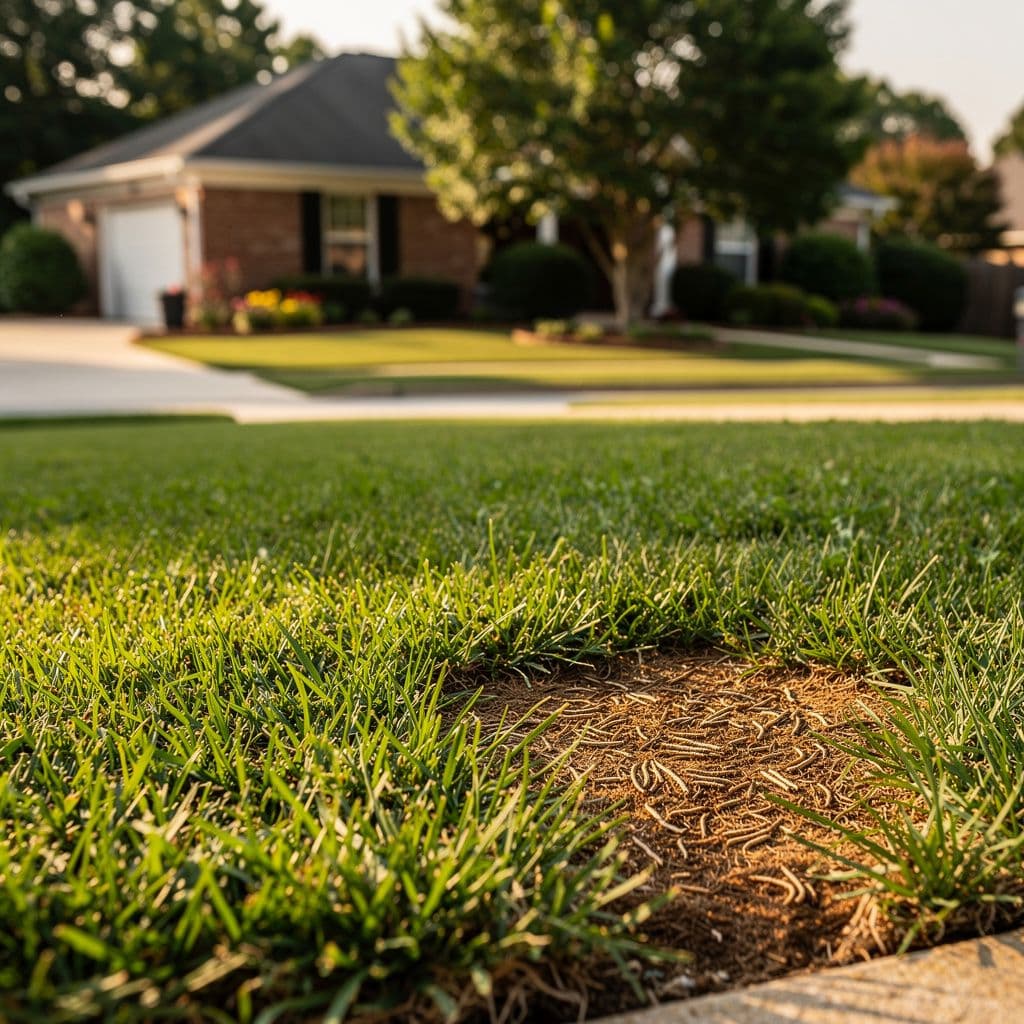
Fall Armyworm Protection: How to Save Your Henry County Lawn From Destruction
Published: July 2, 2026
It starts subtly. A small brown patch appears in your lawn — maybe the size of a dinner plate. You assume it's the summer heat, a dry spot, or maybe the sprinkler isn't hitting that section. You make a mental note to check the irrigation and go about your day.
Two days later, that dinner plate is the size of a car. And it's spreading.
That's how fast fall armyworms work. By the time most Henry County homeowners notice the damage, the caterpillars have already consumed hundreds of square feet of turf. A lawn that was lush and green on Monday can look scalped and dead by Friday.
If you're reading this in early July, you're ahead of the curve. Fall armyworm season in Georgia typically runs from late July through September, with peak activity hitting in August. Right now — before the first wave arrives — is your best opportunity to prepare your lawn, understand the threat, and know exactly what to do when (not if) armyworms show up.
This guide covers everything Henry County homeowners need to know about fall armyworms: how to identify them, how to prevent them, how to treat an active infestation, and how to repair the damage they leave behind. If you need professional help, call Hedgecoth Property Solutions at 770-490-9519 or reach out through our contact page.
What Are Fall Armyworms (And Why Should Henry County Homeowners Care)?
Fall armyworms (Spodoptera frugiperda) are the larval stage of a moth that arrives in Georgia every summer. They don't survive our winters — the population rebuilds each year as adult moths fly north from the Gulf Coast and Florida, laying eggs across the southeastern United States.
The name "armyworm" comes from their behavior: these caterpillars move across lawns in large groups, consuming everything green in their path like a marching army. A single female moth can lay up to 1,000 eggs in one night, and a full-grown larva eats roughly 93% of its body weight in grass daily after its fourth growth stage.
Why Henry County Is Prime Armyworm Territory
Several factors make Locust Grove, McDonough, Stockbridge, and the rest of Henry County especially vulnerable to fall armyworm damage:
- Warm-season grass dominance: Bermuda, Zoysia, and Centipede grasses — the most common lawn grasses in Henry County — are all preferred hosts for fall armyworms
- Late summer heat: July through September temperatures in the 90s create ideal conditions for rapid armyworm development (the entire life cycle completes in just 30 days)
- Afternoon thunderstorms: Summer storms drive moths to the ground where they lay eggs on grass blades and nearby structures
- Prolonged growing season: Our long warm season means multiple generations of armyworms can develop in a single year — three or more cycles are common
The University of Georgia Cooperative Extension monitors armyworm activity statewide and has noted that in recent years, infestations have been arriving earlier and more intensely than historical averages. For 2026, entomologists are predicting an active season based on Gulf Coast population reports.
How to Identify Fall Armyworms: The Four Warning Signs
Catching an armyworm infestation early is the difference between a quick treatment and a full lawn renovation. Here's what to look for.
Sign 1: Rapidly Expanding Brown Patches
The first sign most homeowners notice is brown or straw-colored patches that expand quickly — sometimes visibly larger from morning to evening. Early on, the damage looks like drought stress or heat damage, which is why it's so easy to dismiss.
How to tell the difference: Drought damage affects the entire lawn evenly and responds to watering within a few days. Armyworm damage appears in irregular patches, spreads rapidly, and does not respond to irrigation. If you water a brown patch and it keeps getting bigger, you're not dealing with drought.
Sign 2: Birds Feeding Heavily on Your Lawn
If you notice a sudden increase in bird activity — especially flocks of starlings, grackles, or robins congregating on your lawn — they may be feeding on armyworms. Birds are excellent early warning systems. They can detect armyworm larvae before the damage becomes obvious.
A lawn full of feeding birds in the early morning isn't always a welcome sign of nature. Sometimes it means your grass is hosting an all-you-can-eat caterpillar buffet.
Sign 3: Visible Caterpillars on Grass Blades
Fall armyworm larvae are most active during early morning and late evening hours when temperatures are cooler. During the heat of the day, they retreat into the thatch layer or burrow into the soil.
What to look for:
- Caterpillars ranging from light green to dark brown or nearly black
- Three prominent white or yellowish stripes running along the body
- A distinctive inverted "Y" shape on the head — this is the definitive identification marker
- Body length from ¼ inch (newly hatched) to 1½ inches (fully grown)
- Eggs masses that appear cream or grayish with a fuzzy, mold-like coating on grass blades, fence posts, or siding
Sign 4: The "Scalped" Look
Once armyworms reach their later growth stages (instars 4-6), they consume massive amounts of foliage. The lawn takes on a scalped appearance — grass stems are visible because all the green blades have been eaten away. At this stage, the damage looks like someone took a mower set far too low across patches of your yard.
The Soap Flush Test: Confirm Armyworms in 10 Minutes
If you suspect armyworms but can't see them, use this simple test:
- Mix 1-2 tablespoons of lemon-scented liquid dish soap into 1-2 gallons of water
- Pour the soapy solution slowly over a 3-foot by 3-foot section of green grass immediately adjacent to the damaged area
- Wait 5-10 minutes
- Armyworms (and other turf caterpillars) will irritate from the soap and emerge to the surface
If you see multiple caterpillars surface after the soap flush, you have an active infestation that needs immediate treatment.
Armyworm Prevention: What to Do Before They Arrive
While you can't completely prevent moths from flying over your property and laying eggs, you can make your lawn more resilient and set up early detection systems.
Maintain a Healthy, Dense Lawn
Armyworms target stressed and thinning turf first. A dense, healthy lawn is less attractive to egg-laying moths and recovers faster from any damage that does occur. This means:
- Consistent lawn care: Regular mowing at the correct height, proper fertilization, and adequate watering keep grass strong
- Weed control: Weeds create openings for armyworms by thinning out your turf canopy
- Soil health: Aerating compacted Georgia clay soil improves root depth and grass vigor
Monitor Starting in Late July
Begin checking your lawn weekly for signs of armyworm activity starting in late July. Pay special attention to:
- Areas near outdoor lights (moths are attracted to light and lay eggs nearby)
- Low-lying or poorly drained sections of the yard
- Lawn edges bordering tall grass, weeds, or wooded areas
- Areas where you've seen heavy bird activity
Consider Preventative Treatments
For lawns with a history of armyworm damage, preventative insecticide applications in late July can create a protective barrier. This is particularly effective for properties in Locust Grove and McDonough where armyworm pressure has been intense in recent years.
A professional lawn treatment service can apply the right product at the right time — too early and it breaks down before the moths arrive, too late and the caterpillars are already feeding.
How to Treat an Active Armyworm Infestation
If you confirm armyworms in your lawn, time is critical. A moderate infestation can consume an entire lawn in 3-5 days.
Step 1: Assess the Severity
Use the soap flush test in several areas of your lawn to gauge population density. As a general rule:
- 1-3 caterpillars per square foot: Low pressure — monitor closely but treatment may not be urgent
- 4-8 caterpillars per square foot: Moderate pressure — treat within 24-48 hours
- More than 8 per square foot: Severe infestation — treat immediately
Step 2: Choose Your Treatment Approach
Professional Insecticide Application (Recommended)
Professional-grade products are more effective, longer-lasting, and applied with equipment that ensures proper coverage. A licensed technician can also identify whether you're dealing with fall armyworms or another turf pest like sod webworms or cutworms — the treatment approach varies.
At Hedgecoth Property Solutions, we offer targeted lawn treatment services for armyworms and other turf pests throughout Henry County. Our treatments are designed to eliminate active infestations while minimizing impact on beneficial insects.
DIY Insecticide Options
If you're treating yourself, look for products containing bifenthrin, zeta-cypermethrin, or spinosad. Follow label instructions exactly — these products are most effective when applied in the late afternoon or early evening when armyworms are actively feeding.
Organic and Biological Controls
For homeowners who prefer natural approaches:
- Beneficial nematodes (Steinernema species) attack armyworm larvae in the soil
- Bacillus thuringiensis (Bt) is a microbial insecticide that targets caterpillars specifically
- Encouraging natural predators: Ground beetles, earwigs, and certain wasp species prey on armyworms. Minimizing broad-spectrum insecticide use helps these beneficial insects thrive
Note: Organic options work best as preventative or early-intervention treatments. For severe infestations, conventional insecticides are typically necessary.
Step 3: Apply at the Right Time
Armyworms feed most actively in the early morning and late evening. Apply treatments during these windows for maximum contact. Avoid treating during the heat of the day — the sun degrades active ingredients and reduces effectiveness.
Step 4: Water Lightly After Treatment
A light irrigation (about ¼ inch of water) after applying granular insecticides helps move the product into the soil and thatch layer where armyworms hide during the day. For liquid sprays, avoid watering for 24 hours to let the product dry and absorb.
Repairing Armyworm Damage: Restoring Your Henry County Lawn
Even with prompt treatment, armyworms leave behind damaged areas that need attention. The good news: most warm-season grasses (Bermuda, Zoysia, Centipede) can recover from armyworm damage if the crowns and roots are still alive.
Assess Recovery Potential
Wait 5-7 days after treatment, then check the damaged areas:
- Green tissue at the base of grass stems: The crown is alive and the grass will recover with proper care
- No green visible, soil exposed: The grass in that area is dead and will need to be reseeded or resodded
Recovery Care for Surviving Grass
For areas where the crown is still alive:
- Water deeply but infrequently: 1 inch of water per week, applied in 2-3 sessions
- Apply a light fertilizer application: A balanced fertilizer (such as 16-4-8) at half the normal rate helps accelerate regrowth without pushing excessive top growth
- Hold off on mowing: Let the grass grow slightly taller than normal to encourage recovery. When you resume mowing, raise the deck height by half an inch for the first few cuts
- Monitor for secondary pests: Stressed grass is more susceptible to disease and additional pest problems. Keep an eye on the recovering areas for any new issues
Renovation for Severely Damaged Areas
For sections where the grass has been killed:
- Small patches (under 12 inches): The surrounding grass will spread and fill in over 4-8 weeks with proper watering and fertilization
- Medium areas (1-3 feet across): Consider overseeding or plugging with the same grass variety
- Large areas: Sod installation is the fastest solution for extensive damage. This is especially relevant for properties in Hampton, Jonesboro, and Stockbridge where large, open lawns are common
Professional property maintenance can handle all of these repairs — from soil preparation to sod installation to the ongoing care that prevents future problems.
Why Professional Lawn Care Is Your Best Defense Against Armyworms
Fall armyworms are one of those pests where professional intervention genuinely makes a difference. Here's why:
Detection Expertise
Most homeowners don't recognize armyworm damage until it's severe. Professional lawn care technicians are trained to spot early signs — increased bird activity, subtle color changes in the turf, early instar feeding patterns — before the caterpillars reach their destructive final growth stages.
Access to Better Products
Professional-grade insecticides are typically more concentrated, longer-lasting, and formulated for better soil penetration than consumer products. They're also applied with commercial equipment that ensures even coverage at the correct rate.
Comprehensive Treatment Plans
Armyworm control isn't just about killing caterpillars. A professional approach includes:
- Preventative monitoring during peak season
- Targeted treatment when armyworms are detected
- Fertilization adjustments to support recovery
- Soil amendments to strengthen root systems
- Ongoing lawn care to prevent future infestations
Local Knowledge
Armyworm pressure varies by location, grass type, and microclimate. A Henry County-based company like Hedgecoth Property Solutions understands the local conditions that contribute to infestations — from the clay soil composition in McDonough to the drainage patterns common in Locust Grove neighborhoods.
The Cost of Armyworm Damage vs. Prevention
Here's the math most homeowners don't think about until it's too late:
| Scenario | Typical Cost | Time to Recover |
|----------|-------------|-----------------|
| Preventative treatment | $50-100 per application | N/A — lawn stays healthy |
| Early intervention (first 48 hours) | $75-150 treatment + recovery care | 2-4 weeks |
| Severe infestation (lawn destroyed) | $200-500 treatment + $500-2,000 sod/seed | 4-12 weeks |
| Full lawn renovation after infestation | $1,500-5,000+ | 3-6 months |
The difference between a $100 preventative treatment and a $5,000 lawn renovation is about 72 hours — the time it takes for a moderate infestation to become a total loss.
Fall Armyworm FAQ: Henry County Homeowners' Top Questions
Are fall armyworms harmful to pets or children?
No. The caterpillars themselves are not toxic or dangerous to humans or pets. However, the insecticides used to treat them should be applied carefully. Keep children and pets off treated areas until the product has dried completely — typically 24 hours. Professional applications include clear safety instructions.
Will my lawn grow back after armyworm damage?
In most cases, yes — if the grass crowns are still alive. Warm-season grasses like Bermuda and Zoysia have deep root systems that survive even when the top growth is destroyed. With proper watering, fertilization, and care, most lawns recover within 4-8 weeks. For areas where the crown is dead, you'll need to reseed, plug, or install sod.
How fast can armyworms destroy a lawn?
Under ideal conditions (warm temperatures, dense caterpillar populations, actively growing grass), a severe infestation can consume a 5,000-square-foot lawn in 2-3 days. The speed of destruction is what catches homeowners off guard — there's rarely time to "wait and see."
When should I start watching for armyworms in Henry County?
Begin monitoring in late July each year. The first moths typically arrive in our area between late July and mid-August, with egg-laying occurring immediately. Early detection during the first generation prevents the population explosions that happen with second and third generations in August and September.
Can I prevent armyworms entirely?
No — adult moths fly and can lay eggs on any property. However, you can dramatically reduce the risk of significant damage through preventative lawn care, regular monitoring, and early treatment when caterpillars are first detected. A healthy, dense lawn is your best natural defense.
What's the difference between armyworms and grubs?
Both damage lawns, but differently. Armyworms are caterpillars that feed on grass blades and stems above ground, creating rapid brown patches. Grubs are beetle larvae that feed on grass roots underground, creating slowly expanding dead patches that peel up like carpet. The treatment for each is completely different, which is why proper identification matters.
Don't Wait Until It's Too Late
Fall armyworms are one of the most destructive lawn pests in Georgia, and Henry County is squarely in their crosshairs every summer. The homeowners who avoid catastrophic damage are the ones who:
- Know what to look for
- Start monitoring before the first wave arrives
- Act fast when damage appears
- Have a professional they can call
If you're in Locust Grove, McDonough, Stockbridge, Jonesboro, Hampton, Morrow, or anywhere in Henry County, Hedgecoth Property Solutions is your local expert for armyworm prevention, treatment, and lawn repair.
Call us at 770-490-9519 or contact us online to schedule a lawn inspection, discuss preventative treatment options, or get emergency help with an active infestation. Don't let armyworms turn your beautiful lawn into a brown wasteland — let's protect your property together.
Hedgecoth Property Solutions provides professional lawn care, landscaping, tree service, and property maintenance throughout Henry County, GA. Serving Locust Grove, McDonough, Stockbridge, Jonesboro, Hampton, Morrow, and surrounding areas. Licensed, insured, and locally owned.