Yard Drainage Solutions: How to Fix Standing Water on Your Henry County Property
Published: May 15, 2026
You know the scene. A thunderstorm rolls through Locust Grove, dumps two inches of rain in forty-five minutes, and within an hour your backyard looks like a duck pond. The water sits there for days. Your grass turns yellow, then brown. Mosquitoes move in. And every time it rains, the same thing happens all over again.
If this sounds familiar, you're not alone. Standing water is one of the most common — and most frustrating — yard problems facing homeowners in Locust Grove, McDonough, Stockbridge, and throughout Henry County. Georgia's heavy clay soil, flat terrain in many developments, and intense seasonal rainfall create the perfect conditions for poor yard drainage.
But here's what most homeowners don't realize: standing water isn't just an eyesore. It's actively destroying your lawn, threatening your home's foundation, and creating a breeding ground for pests. Every day that water sits on your property, it's doing damage.
The good news? Yard drainage problems are fixable. At Hedgecoth Property Solutions, we've helped hundreds of Henry County homeowners solve their drainage issues — from simple fixes to comprehensive drainage systems. This guide covers everything you need to know about why your yard floods, what it's costing you, and exactly how to fix it.
Why Henry County Yards Have Standing Water Problems
Georgia Clay Soil: The Root Cause
If you've lived in Henry County for any length of time, you know about our red clay soil. What you might not realize is just how dramatically clay affects drainage.
The science is straightforward: Clay soil particles are microscopic — roughly 1,000 times smaller than sand particles. When these particles pack together, they create a dense, nearly impermeable layer that water struggles to pass through. While sandy soil might drain an inch of water per hour, Georgia clay can take 24 to 72 hours to drain the same amount.
What this means for your yard:
- Rainwater sits on the surface instead of soaking in
- Water flows across the surface instead of absorbing
- Low spots collect and hold water for days
- Even moderate rain creates pooling problems
- Your grass literally drowns
Henry County's Rainfall Makes It Worse
Georgia doesn't just have clay soil — we have heavy, concentrated rainfall that overwhelms even well-draining properties.
Average annual rainfall for Henry County: 48-52 inches per year — significantly more than the national average of 38 inches.
The problem isn't the total — it's the intensity. Henry County thunderstorms routinely dump 1-3 inches of rain in a single afternoon. Tropical storm remnants can deliver 4-6 inches in 24 hours. This concentrated rainfall overwhelms clay soil's already-slow absorption rate.
Seasonal patterns that worsen drainage:
- Spring (March-May): Frequent thunderstorms saturate already-wet soil from winter rains
- Summer (June-August): Pop-up thunderstorms dump heavy rain on baked, compacted clay
- Fall tropical systems: Remnants of Gulf hurricanes can deliver extreme rainfall events
New Construction Compounds the Problem
Many Henry County neighborhoods — particularly in McDonough, Stockbridge, and Locust Grove — were built in the last 15-20 years. New construction creates specific drainage challenges:
Construction compaction:
- Heavy equipment compresses clay soil to near-concrete density
- Natural drainage paths are destroyed during grading
- Topsoil is often stripped and not adequately replaced
- Fill dirt settles unevenly, creating low spots
Altered drainage patterns:
- Developers redirect natural water flow to accommodate roads and lots
- Your property may receive runoff that previously went elsewhere
- Storm water systems may be inadequate for the development's density
The result: Homes that are 5-20 years old in Henry County are prime candidates for drainage problems — exactly when the construction settling has finished but the soil hasn't recovered.
Specific Drainage Challenges by Area
Different parts of Henry County face unique drainage issues based on terrain and soil conditions:
Locust Grove and South Henry County:
- Flatter terrain means water has nowhere to go
- Heavy red clay with extremely slow percolation rates
- Properties near Tussahaw Creek and Towaliga Creek watersheds deal with high water tables
- Mature pine forests contribute to acidic, compacted soil
McDonough and North Henry County:
- Rolling terrain can direct runoff from higher properties onto lower ones
- Newer subdivisions near J.P. Moseley Park area have compaction issues
- Some areas have better natural drainage due to elevation changes
- Commercial development has altered natural water flow patterns
Stockbridge and West Henry County:
- Mix of flat and gently sloping terrain
- Properties near Panola Mountain area have varying soil types
- Older neighborhoods may have mature landscaping that helps with drainage
- Newer developments face typical construction compaction issues
Jonesboro and Morrow:
- Flat terrain with dense clay soil
- Urban runoff from surrounding development
- Older neighborhoods with mature trees (roots can both help and hinder drainage)
- Some areas have high water tables from the Flint River watershed
What Standing Water Is Actually Doing to Your Property
Lawn Damage
Standing water kills grass — it's that simple. Here's the progression:
24-48 hours of flooding:
- Grass roots are deprived of oxygen
- Root function stops — grass can't absorb water or nutrients
- Grass appears dark green and waterlogged
- Recovery is still possible if water drains
48-96 hours of flooding:
- Root cells begin dying from oxygen starvation
- Grass turns yellow (chlorosis) as nutrient uptake fails
- Soil structure begins breaking down
- Fungal diseases take hold in saturated conditions
4-7 days of flooding:
- Grass plants die in affected areas
- Soil becomes anaerobic (produces a sour, swampy smell)
- Algae and moss begin growing
- Recovery requires replanting or sodding
Long-term saturation (repeated cycles):
- Grass thins and dies in chronically wet areas
- Weeds that tolerate wet conditions take over (nutsedge, dollar weed)
- Soil structure degrades further with each flooding cycle
- The area becomes a mud pit that never fully dries
Foundation and Structural Threats
Water pooling near your home's foundation is the most serious consequence of poor drainage:
Hydrostatic pressure:
- Saturated soil expands and pushes against foundation walls
- Creates cracks that allow water into basements and crawl spaces
- Can cause structural shifting over time
- Repairs cost thousands to tens of thousands of dollars
Soil erosion:
- Moving water erodes soil around foundation footings
- Undermines the support beneath your home
- Creates voids that lead to settling and cracking
- Gets progressively worse with each rain event
Moisture infiltration:
- Water finds its way through foundation cracks, porous concrete, and joints
- Creates ideal conditions for mold growth
- Attracts termites and other moisture-loving pests
- Damages flooring, drywall, and personal property
Pest and Health Problems
Standing water is more than a nuisance — it's a health hazard:
Mosquitoes:
- Need only a bottle cap of standing water to breed
- A persistent puddle in your yard can produce thousands of mosquitoes per week
- Carry West Nile virus, Eastern equine encephalitis, and other diseases
- Make your yard unusable during peak mosquito hours
Other pests:
- Fire ants build mounds in consistently moist areas
- Termites are attracted to moisture near structures
- Centipedes, millipedes, and roaches thrive in wet conditions
- Snakes and rodents are drawn to areas with standing water and associated prey
Lawn diseases:
- Brown patch fungus thrives in wet, humid conditions
- Pythium blight spreads rapidly in saturated soil
- Root rot diseases kill grass from below ground
- Treatment is expensive and often unsuccessful while drainage issues persist
Diagnosing Your Drainage Problem
Before you can fix standing water, you need to understand where it's coming from and why it's collecting. Here's how to diagnose your specific drainage problem.
Identify Where Water Comes From
Surface water (most common in Henry County):
- Rain falls directly on your property and doesn't absorb
- Water flows onto your property from neighboring lots or streets
- Downspouts discharge water that pools instead of draining
- Driveways and patios shed water onto lawn areas
Subsurface water:
- High water table rises during wet seasons
- Underground springs or seeps saturate low areas
- Water flows through soil layers from higher elevations
- Often appears as persistent soggy areas without obvious surface source
Combination:
- Most Henry County properties have both surface and subsurface issues
- Surface water overwhelms already-saturated soil
- Creates persistent drainage problems that worsen over time
Map Your Drainage Patterns
During the next rain event, observe:
- Where water first appears — these are collection points
- Which direction water flows — natural drainage paths
- Where water pools and stands — low spots and poor drainage areas
- How long water remains — severity of the drainage problem
- Where downspouts discharge — often a major contributor
After rain stops:
- Mark standing water areas with flags or stakes
- Note which areas drain within hours vs. days
- Photograph the problem areas for reference
- Check areas near your foundation carefully
Assess the Severity
Minor drainage issues:
- Small puddles that drain within 24 hours
- Isolated to one or two areas of the yard
- Grass recovers between rain events
- Doesn't threaten structures or hardscapes
- Typical fix: Simple grading, downspout extensions, or minor regrading
Moderate drainage issues:
- Standing water that persists for 2-3 days
- Multiple areas of the yard affected
- Grass shows damage (yellowing, thinning)
- Water approaches but hasn't reached structures
- Typical fix: French drains, dry creek beds, combined with grading
Severe drainage issues:
- Water stands for a week or more
- Large areas of lawn are consistently saturated
- Water reaches or enters structures
- Foundation damage visible (cracks, settling)
- Property is essentially unusable after rain
- Typical fix: Comprehensive drainage system with professional design and installation
Proven Drainage Solutions for Henry County Yards
Solution 1: Regrading and Surface Drainage
The simplest and often most effective drainage solution is correcting the grade — the slope of your yard — so water flows away from problem areas instead of collecting.
How regrading works:
- Soil is added to low spots to raise them above the water collection point
- The yard is shaped to create a gentle slope (minimum 2% grade) directing water away
- Swales (shallow channels) are created to guide water along desired paths
- Soil is compacted and stabilized to prevent erosion
When regrading is the right solution:
- Water collects in isolated low spots
- Yard is relatively flat without adequate slope
- Problem is primarily surface water, not subsurface
- Property has room to direct water to an appropriate outlet
Advantages:
- Relatively affordable compared to other solutions
- Addresses the root cause (water has nowhere to go)
- Can be combined with other improvements (new sod, landscaping)
- Results are immediate and visible
Considerations:
- Requires heavy equipment and professional grading
- May affect existing landscaping
- Must direct water to an appropriate location (not onto neighbor's property)
- Best performed during dry season when soil is workable
Solution 2: French Drains
French drains are the workhorse of residential drainage solutions — and for good reason. They're effective, relatively affordable, and can solve both surface and subsurface water problems.
What a French drain is:
A trench filled with gravel and containing a perforated pipe that collects and redirects water away from problem areas. Water enters the pipe through small holes, flows through the pipe, and exits at a discharge point away from your yard.
How French drains work in Henry County clay:
- Trench is dug through the problem area (typically 18-24 inches deep)
- Landscape fabric lines the trench to prevent clay soil from clogging the system
- Perforated pipe (4-6 inch diameter) is placed at the bottom
- Gravel surrounds the pipe to create a flow channel
- Surface water drains into the gravel, enters the pipe, and flows to discharge point
- Clay soil's slow drainage is bypassed entirely
When French drains are the right solution:
- Water collects along property lines or low areas
- Saturated soil stays wet for days after rain
- Multiple problem areas can be connected to one system
- There's a suitable discharge point (street, ditch, or lower elevation)
French drain installation best practices for Georgia clay:
- Use filter fabric rated for clay soil (standard fabric clogs faster in clay)
- Install clean-out access points for maintenance
- Ensure adequate slope (minimum 1% grade, 2% preferred)
- Use solid (non-perforated) pipe for transport sections
- Discharge water at least 10 feet from any structure
- Consider pop-up emitters for discharge points in lawn areas
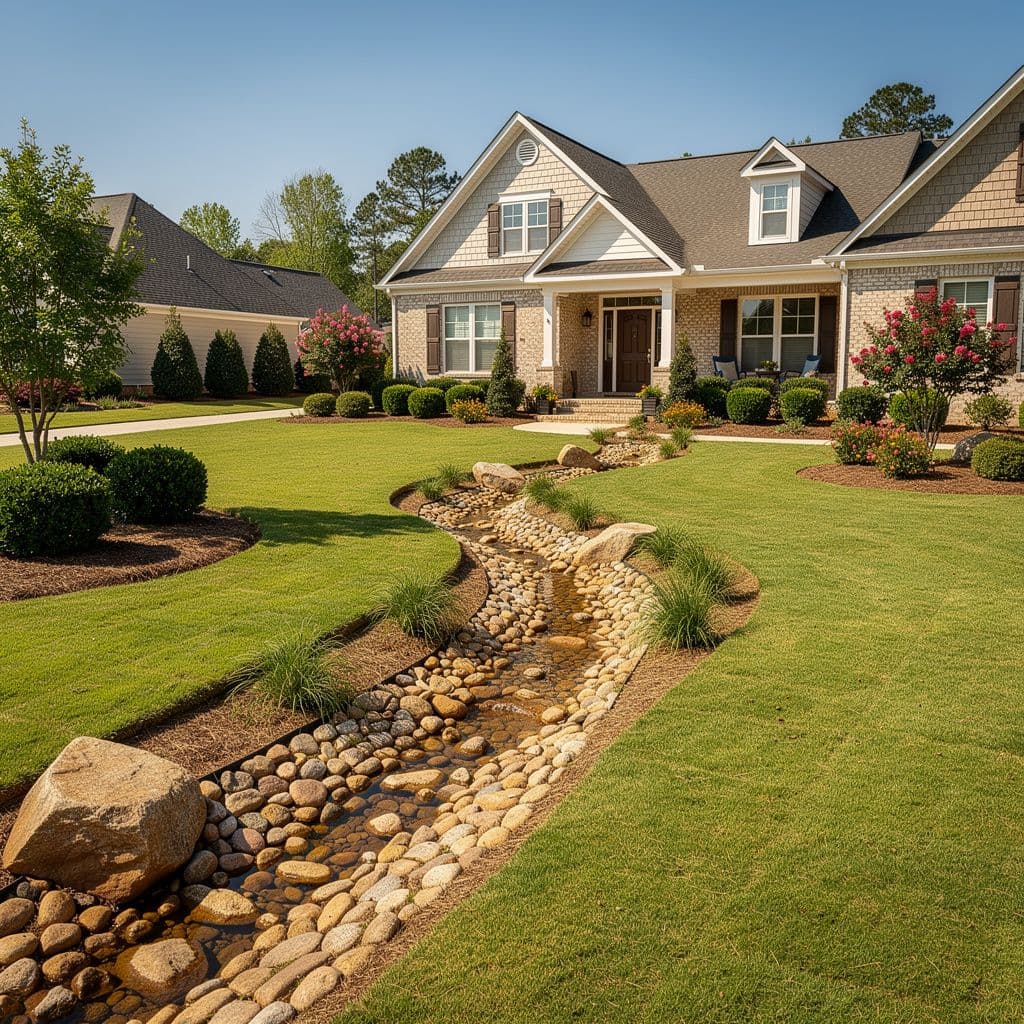
Solution 3: Dry Creek Beds
Dry creek beds combine drainage function with attractive landscaping. They're essentially decorative channels that carry water during rain and look like natural stone features when dry.
How dry creek beds work:
- A shallow channel is excavated along the natural water flow path
- Landscape fabric lines the channel
- Large stones line the edges, smaller gravel fills the bottom
- During rain, water flows through the channel and away from problem areas
- During dry weather, the stone feature adds visual interest to your landscape
Advantages for Henry County properties:
- Handles large volumes of surface water from heavy thunderstorms
- Looks attractive — enhances your landscape rather than looking like infrastructure
- Requires minimal maintenance
- Can be integrated with existing landscaping
- Adds property value through improved curb appeal
Best applications:
- Properties with natural water flow paths
- Areas where water flows from higher to lower elevation
- Along property boundaries where runoff enters your yard
- As a transition between downspouts and yard drainage
Solution 4: Downspout and Gutter Management
Sometimes the biggest drainage problem on your property is your own gutter system. A typical Henry County home sheds thousands of gallons of water from its roof during a single thunderstorm.
The problem:
- Standard downspouts discharge water right at the foundation
- Water pools at the base of the downspout and saturates surrounding soil
- Multiple downspouts can overwhelm a small yard area
- Underground downspout extensions often clog with clay soil
Solutions:
Downspout extensions:
- Simple pipes that carry water 6-10 feet from the foundation
- Above-ground extensions are inexpensive and effective
- Underground extensions look better but need proper installation to prevent clogging
- Pop-up emitters release water at ground level away from the house
Rain gutter adjustments:
- Ensure gutters are properly sized for your roof area
- Clean gutters regularly — clogged gutters overflow and dump water at the foundation
- Consider larger downspouts (3x4 inch instead of 2x3 inch) for heavy Georgia rains
- Install gutter guards to reduce maintenance
Rain barrels or cisterns:
- Capture roof water for later use in lawn care and landscaping
- Reduces volume of water hitting the ground during storms
- Especially useful for smaller properties with limited drainage options
Solution 5: Channel Drains
Channel drains (also called trench drains) are linear drains installed flush with the ground surface. They collect surface water along their length and direct it to a discharge point.
Best applications in Henry County:
- Driveways where water flows toward the garage or house
- Patios and pool decks with drainage issues
- Walkways that direct water toward structures
- Areas where hardscape meets landscape and water collects at the transition
Installation:
- Channel is set into concrete or compacted base material
- Grate sits flush with the surface
- Water enters through the grate and flows to a connected drain pipe
- Discharges at an appropriate location away from structures
Solution 6: Rain Gardens
Rain gardens are planted depressions designed to collect and absorb runoff. They're an environmentally friendly drainage solution that works well for moderate drainage problems.
How rain gardens work:
- A shallow depression is excavated in a low area where water naturally collects
- Soil is amended with compost and sand to improve absorption
- Plants that tolerate both wet and dry conditions are installed
- During rain, water collects in the garden and absorbs over 24-48 hours
- Plants filter pollutants and the water returns to the groundwater table
Advantages:
- Environmentally friendly — reduces runoff and filters pollutants
- Attractive landscape feature when properly designed
- Provides habitat for birds and beneficial insects
- Can reduce mosquito problems (water absorbs before mosquitoes can breed)
- Low maintenance once established
Best for:
- Properties with moderate drainage issues
- Homeowners who want an eco-friendly solution
- Areas where water collects naturally
- Combined with other drainage solutions as part of a comprehensive plan
Solution 7: Comprehensive Drainage Systems
For severe drainage problems, the best solution is often a comprehensive system that combines multiple drainage methods.
A typical comprehensive system might include:
- French drains around the perimeter to intercept subsurface water
- Surface grading to direct water toward drainage features
- Dry creek bed or swale to carry surface water to the discharge point
- Downspout connections to route roof water into the drainage system
- Channel drains at hardscape transitions
- Discharge system with pop-up emitters or connection to storm water system
Professional design is essential for comprehensive systems:
- Proper slope calculations ensure water flows in the right direction
- Pipe sizing handles peak rainfall volumes
- Discharge points are legal and appropriate
- System is designed to prevent clogging in clay soil conditions
- Installation avoids underground utilities
DIY vs. Professional Drainage Solutions
What You Can Do Yourself
Simple improvements:
- Extend downspouts 6-10 feet from the foundation
- Clear debris from natural drainage paths
- Add topsoil to small low spots
- Install a rain barrel to capture roof water
- Aerate lawn to improve surface water absorption
Cost: $50-300 in materials
Limitations:
- Won't solve significant drainage problems
- Can make problems worse if grading directs water improperly
- Temporary solutions that don't address underlying causes
When to Call a Professional
Any of these situations warrant professional help:
- Standing water persists for more than 48 hours
- Water is approaching or entering your foundation
- Multiple areas of your yard have drainage problems
- Your neighbor's property drains onto yours
- Previous DIY attempts haven't solved the problem
- You're planning a major landscaping project (solve drainage first)
Professional advantages:
- Proper diagnosis of the drainage problem and its causes
- Design of a solution that addresses root causes, not just symptoms
- Access to commercial equipment for grading and installation
- Knowledge of local regulations, soil conditions, and best practices
- Warranty on workmanship and materials
- Results that work long-term instead of band-aid fixes
What professional drainage service includes:
- On-site evaluation of your property's drainage patterns
- Assessment of soil conditions, slope, and water sources
- Custom drainage plan designed for your specific property
- Professional installation with proper materials and techniques
- Grading and soil stabilization
- Landscape restoration after drainage work
- Ongoing maintenance recommendations
Preventing Future Drainage Problems
Regular Maintenance That Protects Drainage
Spring maintenance (March-April):
- Clear yard debris from drainage paths and swales
- Inspect French drains and channel drains for clogs
- Check gutters and downspouts for damage or blockage
- Aerate lawn to improve surface water absorption
- Address any new low spots that developed over winter
Summer maintenance (June-August):
- Monitor drainage during heavy thunderstorms
- Clear debris from drain grates after storms
- Check discharge points for erosion
- Trim vegetation away from drainage features
- Document any new problem areas
Fall maintenance (October-November):
- Clear fallen leaves from drainage paths and gutters
- Inspect system before winter rainy season
- Address any damage from summer storms
- Schedule aeration and lawn care to maintain soil health
Landscaping Choices That Improve Drainage
Trees and shrubs that help with drainage:
- River birch — thrives in wet conditions and absorbs significant water
- Willow species — aggressive water uptake (plant away from structures)
- Sweet bay magnolia — tolerates wet soil, native to Georgia
- Inkberry holly — evergreen, tolerates wet conditions
- Virginia sweetspire — native shrub, excellent for rain gardens
Avoid planting in wet areas:
- Plants that require well-drained soil (they'll die)
- Trees with aggressive roots near drainage pipes (they'll clog the system)
- Anything that will need regular replacement due to wet conditions
Property Maintenance and Drainage
Regular property maintenance plays a critical role in preventing drainage problems from developing or worsening:
Lawn care impact on drainage:
- Regular aeration maintains soil permeability
- Proper mowing height prevents soil compaction
- Thatch management keeps water flowing to soil surface
- Healthy grass absorbs more water than thin, stressed turf
Landscape maintenance:
- Keep mulch from washing into drainage paths
- Maintain swales and drainage channels
- Trim vegetation to prevent root intrusion into drainage systems
- Monitor for erosion that can alter drainage patterns
The Cost of Ignoring Drainage Problems
What Happens If You Do Nothing
Drainage problems don't fix themselves — they get worse. Here's what happens when you ignore standing water:
Year one:
- Grass dies in wet areas
- Bare mud patches develop
- Weeds invade wet areas
- Mosquitoes become a problem
- Cost to fix: $500-2,000
Year two:
- Soil structure degrades in affected areas
- Erosion begins altering yard contours
- Foundation may show early signs of moisture damage
- Drainage area expands as soil becomes more compacted
- Cost to fix: $2,000-5,000
Year three and beyond:
- Foundation damage becomes visible (cracks, settling)
- Complete lawn renovation needed in affected areas
- Comprehensive drainage system required
- Possible structural repairs needed
- Cost to fix: $5,000-25,000+
The bottom line: A $2,000 drainage fix today can prevent a $20,000 repair bill in three years.
FAQ: Yard Drainage Solutions in Henry County
Why does water stand in my yard after rain in Georgia?
Standing water in Henry County yards is almost always caused by Georgia's heavy clay soil combined with flat terrain or improper grading. Clay soil particles are microscopic and pack tightly together, preventing water from draining through. When heavy thunderstorms dump rain faster than clay can absorb it — which is almost always — water pools on the surface. Newer subdivisions in McDonough, Locust Grove, and Stockbridge often have compacted construction fill that makes the problem worse.
How do I know if I need a French drain?
You likely need a French drain if water stands in your yard for more than 48 hours after rain, if you have consistently soggy areas that never fully dry out, or if water is approaching your home's foundation. French drains are especially effective for Henry County properties because they bypass clay soil entirely — collecting water at the surface and redirecting it through a pipe to a discharge point. If you've tried regrading or downspout extensions without solving the problem, a French drain is probably the right solution.
Can I fix yard drainage problems myself?
Minor drainage issues — small puddles that drain within 24 hours — can often be addressed with DIY solutions like downspout extensions, adding topsoil to low spots, or clearing drainage paths. However, any drainage problem involving persistent standing water, multiple areas of your yard, or water near your foundation should be evaluated and addressed by a professional. Improper grading or drain installation can actually make problems worse and damage your property. In Henry County's clay soil, professional installation ensures drainage systems won't clog or fail.
How much does yard drainage cost in Henry County?
Drainage solution costs vary based on the severity of the problem and the solution needed. Simple downspout extensions cost $50-300. Dry creek beds range from $500-3,000 depending on length and materials. French drains typically cost $1,000-4,000 depending on length and depth. Comprehensive drainage systems for severe problems range from $3,000-10,000+. While this may seem like a significant investment, consider that foundation damage from poor drainage can cost $5,000-25,000+ to repair. Fixing drainage now is always less expensive than repairing damage later.
Will fixing my drainage improve my lawn?
Absolutely — and often dramatically. If your lawn has areas where grass won't grow despite your best efforts, poor drainage is likely the culprit. Standing water suffocates grass roots, creates fungal disease conditions, and degrades soil structure. Once drainage is corrected, grass can recover in previously flooded areas. Many Henry County homeowners see their lawn transform from thin and patchy to thick and green simply by solving the underlying water problem. Professional lawn care combined with proper drainage creates the foundation for a consistently healthy yard.
How long do French drains last in Georgia clay soil?
A properly installed French drain should last 20-30 years in Henry County clay soil. The key factors for longevity are using landscape fabric rated for clay soil (standard fabric clogs faster), installing clean-out access points for periodic maintenance, and ensuring the system has adequate slope to keep water moving. French drains that fail prematurely in Georgia clay usually weren't installed with clay-specific materials or techniques. Professional installation using clay-rated components and proper design ensures maximum lifespan.
What's the best time of year to install drainage solutions in Henry County?
Late summer through fall (August-November) is ideal for drainage installation in Henry County. Soil is drier and easier to work with, the spring rainy season is past, and you'll have the system in place before winter and next spring's heavy rains. Summer installation is possible but may be delayed by frequent thunderstorms. Avoid installation during the wettest parts of spring (March-April) when saturated soil makes proper grading and installation difficult. Whenever you install, the key is having the system ready before the next heavy rain season.
Solve Your Drainage Problems with Hedgecoth Property Solutions
Standing water doesn't have to be a permanent feature of your Henry County yard. Whether you're dealing with a small puddle that won't drain or a serious flooding problem threatening your home, we have the expertise and equipment to fix it.
Our drainage services include:
- Free on-site drainage evaluation — we'll walk your property, identify problem areas, and explain exactly what's happening
- Custom drainage design — solutions designed for your specific property, soil, and water issues
- Professional installation — French drains, dry creek beds, grading, and comprehensive systems
- Landscape restoration — your yard looks great after drainage work, not like a construction zone
- Ongoing maintenance — we keep your drainage system working properly year after year
Why Henry County homeowners choose Hedgecoth:
- We understand Georgia clay soil — we work with it every day
- Local experience across Locust Grove, McDonough, Stockbridge, Jonesboro, and throughout Henry County
- Professional equipment and proper materials for lasting results
- Transparent pricing with no surprises
- We stand behind our work
Don't wait for the next thunderstorm to remind you about your drainage problem.
📞 Call 770-490-9519 for a free drainage evaluation
📍 Serving: Locust Grove, McDonough, Jonesboro, Stockbridge, Hampton, Morrow, and all of Henry County
🌐 Request a quote online: hedgecoth.pro/contact
Your yard should be something you enjoy — not something you dread after every rain. Let us help you fix it.
Hedgecoth Property Solutions has been solving drainage problems across Henry County, GA since 2018. We know Georgia clay, we know Henry County terrain, and we know how to fix standing water problems permanently. Call 770-490-9519 for a free evaluation.