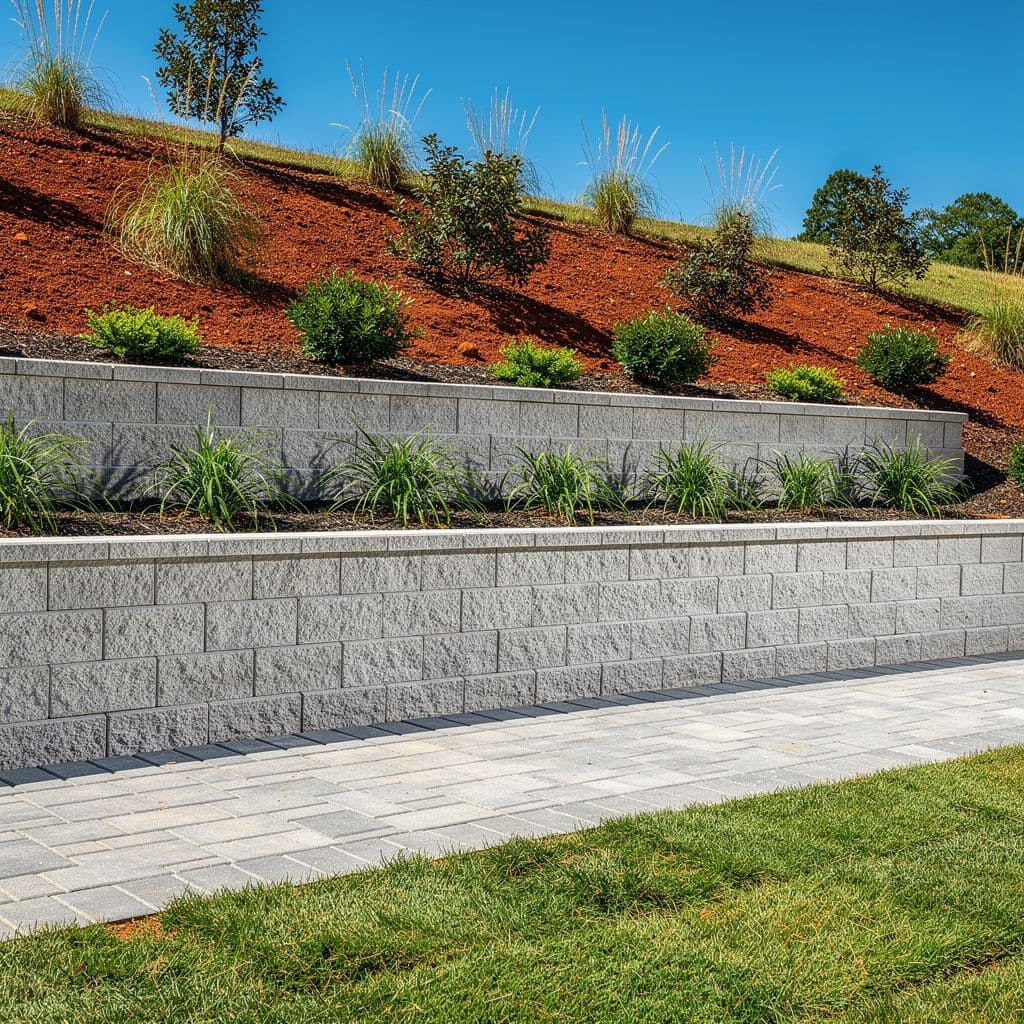
Retaining Wall Installation in Locust Grove, GA: The Complete Guide for Henry County Homeowners
Published: July 16, 2026
If your Locust Grove property has any kind of slope — and most do, given the rolling terrain throughout Henry County — you've probably dealt with soil washing into your driveway after a thunderstorm. Or maybe you've watched a section of your backyard slowly erode year after year, the mulch sliding downhill every time we get one of those Georgia gully-washers in July.
A well-built retaining wall solves these problems. But it also does something most homeowners don't expect: it completely transforms how you use your yard. That unusable slope behind your house becomes a flat, usable patio area. The eroding hillside along your property line becomes a structured landscape bed. The awkward drop-off near your driveway becomes a clean, attractive stone feature that frames your home.
Whether you're searching for "retaining wall installation near me" or specifically looking for hardscaping services in Locust Grove, McDonough, Stockbridge, or anywhere in Henry County, this guide walks you through everything you need to know — materials, costs, design, drainage, and how to choose the right contractor for the job.
Why Retaining Walls Are Essential for Henry County Properties
Henry County's geography makes retaining walls more than a luxury — for many properties, they're a necessity. The combination of Georgia's red clay soil, hilly terrain, and heavy seasonal rainfall creates constant erosion pressure that only gets worse over time.
The Red Clay Problem
If you've ever tried to dig a hole in your Locust Grove yard, you already know about Georgia red clay. It's dense, heavy, and holds water like a sponge. When that water saturates the clay during a summer storm — which can dump 2-3 inches of rain in an hour — the soil becomes heavy and unstable. On any slope, that saturated clay starts to move.
Red clay soil expands when wet and contracts when dry, creating a cycle of ground movement that cracks concrete, shifts foundations, and wreaks havoc on anything built on top of it. A properly engineered retaining wall holds that soil in place, managing the hydrostatic pressure and directing water away from your home's foundation.
Erosion Damage You Might Already Have
Drive through neighborhoods near Noah's Ark Animal Sanctuary or along the highway toward Hampton, and you'll spot the signs of erosion that a retaining wall would fix:
- Bare soil patches where grass won't grow because mulch and topsoil keep washing away
- Exposed tree roots as soil erodes from around the base of trees on slopes
- Washout marks — those streaks and channels carved into the ground after heavy rain
- Mulch in the driveway or street that migrated downhill from your landscape beds
- Cracking or tilting walkways as the ground beneath them shifts
If you're seeing any of these signs, the problem will only get worse. Erosion is cumulative — each storm removes a little more soil, destabilizing the slope a little further. For comprehensive solutions, see our guide to erosion control in Henry County.
Types of Retaining Walls: Which Is Right for Your Property?
Not all retaining walls are created equal. The right type for your property depends on the height of the wall, the slope of the grade, the soil composition, and what you want the finished space to look like.
Gravity Walls
Gravity walls rely on their own mass and weight to hold back soil. They're typically made from heavy materials like poured concrete, large stone blocks, or timber. Best for walls under 4 feet tall, gravity walls are the simplest and most common type found in residential Locust Grove neighborhoods.
Pros: Straightforward construction, wide material options, cost-effective for shorter walls
Cons: Not suitable for tall walls or extremely unstable soil without additional engineering
Cantilevered Walls
Cantilevered walls use an L-shaped footing that extends backward into the retained soil, using the weight of the soil itself to provide additional stability. These are typically made from reinforced poured concrete and can handle walls from 5 to 15 feet tall.
Pros: Extremely strong, efficient use of materials, handles taller walls
Cons: Requires professional engineering and concrete work, higher cost
Segmental Retaining Walls (SRW)
Segmental retaining walls are built from interlocking concrete blocks — companies like Belgard, Keystone, and Versa-Lok manufacture these systems specifically for landscape use. The blocks lock together without mortar, and taller walls can be reinforced with geogrid (a synthetic mesh that ties the wall back into the soil).
SRWs are the most popular choice for Henry County homeowners because they offer:
- A wide range of colors, textures, and styles that complement any home exterior
- Flexibility — they can curve, step, and follow irregular property lines
- DIY-friendliness for short walls (under 3 feet, with proper base preparation)
- Excellent drainage when installed with proper backfill
Pros: Attractive, versatile, good drainage, modular
Cons: Requires precise base preparation; taller walls need geogrid engineering
Natural Stone Walls
Built from fieldstone, flagstone, or granite boulders, natural stone walls offer a timeless, organic look that blends perfectly with Georgia landscapes. Each wall is unique — no two stone walls look exactly alike.
Pros: Unmatched aesthetics, extremely durable, increases property value significantly
Cons: Most expensive option, requires skilled stonework, limited to shorter walls without engineering
Timber Walls
Pressure-treated timber walls are the most budget-friendly option. Railroad ties or landscape timbers are stacked and anchored with rebar or deadmen. Common in rural areas around Hampton and the southern parts of Henry County.
Pros: Lowest cost, natural wood appearance, easy to work with
Cons: Shortest lifespan (15-20 years even with pressure treatment), susceptible to rot and termites, limited height
Retaining Wall Materials: What Works Best in Georgia's Climate?
Henry County's climate presents specific challenges that influence material choice. Hot, humid summers, freeze-thaw cycles in winter, and torrential rainfall all factor into the decision.
Concrete Segmental Blocks — The Henry County Sweet Spot
For most homeowners in Locust Grove and throughout Henry County, segmental concrete blocks are the ideal choice. Here's why:
Durability in Georgia heat: High-quality concrete blocks are manufactured to withstand temperature extremes. They won't warp, rot, or fade the way timber does under our relentless summer sun.
Drainage performance: The interlocking design and granular backfill create natural drainage pathways, which is critical in Georgia clay. Water that can't escape behind a wall will eventually push it over — proper drainage is non-negotiable.
Aesthetic versatility: Modern concrete landscape blocks come in styles that mimic natural stone, weathered brick, or clean contemporary lines. Colors range from warm browns and grays to reds that complement brick homes.
Availability: Concrete landscape blocks are readily available from suppliers throughout the Atlanta metro area, keeping material costs reasonable and delivery times short.
Natural Stone — Premium Choice
For homeowners who want the absolute highest-end look, natural stone — particularly Georgia granite or fieldstone — delivers unmatched character. Stone walls age beautifully, developing moss and patina that enhance their appearance over time. They're commonly used for accent walls near entryways, low border walls around landscape beds, and high-end residential projects near the golf communities around Hampton.
Retaining Wall Cost in Locust Grove and Henry County, GA
Cost is usually the first question homeowners ask. The answer depends on the wall height, length, material choice, site accessibility, and the amount of excavation and drainage work required.
Material Cost Ranges (Per Square Foot of Wall Face)
| Material | Cost Range (Materials Only) | Cost Range (Installed) |
|---|---|---|
| Pressure-treated timber | $15–$25/sq ft | $25–$40/sq ft |
| Concrete segmental blocks | $20–$35/sq ft | $40–$65/sq ft |
| Natural stone | $35–$60/sq ft | $70–$120/sq ft |
| Poured concrete (cantilevered) | $30–$45/sq ft | $55–$85/sq ft |
Typical Project Costs for Henry County Homes
Small landscape wall (2 feet tall, 20 feet long):
- Timber: $1,000–$1,600
- Concrete block: $1,600–$2,600
- Natural stone: $2,800–$4,800
Medium retaining wall (4 feet tall, 40 feet long):
- Concrete block with geogrid: $6,400–$10,400
- Natural stone: $11,200–$19,200
- Poured concrete: $8,800–$13,600
Large retaining wall (6+ feet, requires engineering):
- Concrete block with geogrid: $14,400+
- Poured concrete cantilever: $19,800+
What Drives Cost Beyond Materials?
Several factors can increase the total project cost significantly:
- Excavation and grading — If the site has deeply compacted clay, tree roots, or existing landscaping that needs removal
- Drainage systems — French drains, perforated pipe, gravel backfill, and weep holes are essential, not optional
- Engineering permits — Walls over 4 feet typically require a engineered design and county permits
- Site accessibility — If equipment can't reach the work area, materials must be hand-carried, which increases labor time
- Soil conditions — Unstable or expansive clay may require deeper footings or additional reinforcement
For a detailed breakdown of all hardscaping costs, see our complete hardscaping services guide or check our patio installation guide for related project costs.
The Retaining Wall Installation Process: What to Expect
Understanding the installation process helps you evaluate contractor proposals and know what you're paying for. A properly built retaining wall follows these steps:
Step 1: Site Evaluation and Design
A professional contractor visits your property to assess:
- Slope and grade — How much soil needs to be retained, and what's the angle of the slope?
- Soil composition — Is it compacted clay, mixed soil, or loose fill?
- Drainage patterns — Where does water currently flow during rain?
- Utility locations — Gas lines, water lines, and septic systems must be identified before digging
- Property lines and setbacks — Especially important near sidewalks, driveways, and neighboring properties
The contractor creates a design that specifies wall height, length, material, drainage plan, and any necessary engineering.
Step 2: Excavation and Base Preparation
This is where most DIY retaining walls fail. The base is everything.
- Excavate to the proper depth — typically 6-12 inches below the finished grade for the buried base course
- Dig a level trench — the first course of blocks must be perfectly level. Even a half-inch deviation compounds with each subsequent course
- Install and compact a gravel base — 6 inches of crushed stone, compacted with a plate compactor in 2-inch lifts
- Verify level — across the entire length of the wall, in both directions
A wall built on an unlevel, un-compacted base will settle unevenly within the first year. You'll see gaps between blocks, bowing in the middle, and eventually, failure.
Step 3: Base Course Installation
The first course of blocks is set directly on the compacted gravel base. This course is buried below grade to provide structural anchoring. Each block is individually leveled — front to back, side to side, and relative to adjacent blocks. This is the most time-consuming step, but it determines the quality of the entire wall.
Step 4: Additional Courses and Backfill
Subsequent courses are stacked on top, with each block offset from the course below (running bond pattern). As each course is placed:
- Sweep the top of the lower course clean before placing the next block
- Install drainage aggregate (crushed stone, not pea gravel) directly behind the wall
- Lay geogrid reinforcement at specified intervals for walls over 3 feet tall
- Compact the backfill in thin layers to prevent settling
Step 5: Drainage System
Proper drainage is what separates a wall that lasts 50 years from one that fails in 3. The drainage system includes:
- Perforated drain pipe at the base of the wall, sloped to daylight or a pop-up emitter
- Drainage aggregate (crushed #57 stone) filling the 12-inch zone directly behind the wall
- Filter fabric separating the drainage stone from the native clay soil to prevent clogging
- Weep holes or drainage outlets at regular intervals
Without this system, hydrostatic pressure from water-logged Georgia clay will push even the best-built wall outward. Water is the enemy of retaining walls, and drainage is the defense.
Step 6: Cap and Finish
The final course — the cap — is secured with construction adhesive. Caps give the wall a finished look and protect the open cores of the blocks below from water infiltration. The area behind the wall is backfilled with topsoil and graded to direct surface water away from the wall.
Common Retaining Wall Mistakes (And How to Avoid Them)
After years of building and repairing retaining walls throughout Henry County, we've seen every way a wall can fail. Here are the most common mistakes — and they almost always trace back to cutting corners on the basics.
Mistake 1: Skipping the Drainage System
This is the #1 cause of retaining wall failure. A wall without proper drainage is essentially a dam holding back saturated clay. After a few heavy Georgia thunderstorms, the hydrostatic pressure behind the wall exceeds the wall's capacity to resist it, and the wall bulges, leans, or collapses.
The fix: Every retaining wall — regardless of height or material — needs a drainage system. No exceptions.
Mistake 2: Inadequate Base Preparation
Using sand instead of crushed stone for the base. Not compacting the base. Not leveling the first course. Any of these will cause the wall to settle and shift within the first year.
The fix: Take the time to excavate properly, use the right material, compact in lifts, and level obsessively.
Mistake 3: Building Too Tall Without Engineering
Segmental block manufacturers specify maximum unreinforced wall heights — typically 3-4 feet depending on the block system and soil conditions. Walls exceeding this height without geogrid reinforcement are asking for trouble.
The fix: If your wall is over 4 feet tall, it needs engineering. Period. The cost of geogrid and professional design is far less than the cost of rebuilding a failed wall.
Mistake 4: Using the Wrong Backfill
Using native clay soil as backfill directly behind the wall guarantees drainage problems. Clay holds water, expands, and exerts tremendous pressure on the wall.
The fix: Use crushed stone (#57 or similar) for at least 12 inches behind the wall, separated from native soil with filter fabric.
Mistake 5: Not Accounting for Water Flow Above the Wall
If surface water from uphill flows toward your wall, it will saturate the backfill and overwhelm the drainage system. You need to manage water at the top of the slope, not just behind the wall.
The fix: Install a swale or surface drain above the wall to intercept and redirect runoff. Our yard drainage solutions guide covers this in detail.
DIY vs. Professional Retaining Wall Installation
The internet is full of videos showing homeowners building retaining walls over a weekend. And for a short, 2-foot-tall landscape border wall with good soil conditions? A handy homeowner can absolutely tackle that project.
But for anything taller, anything on a significant slope, or anything near a structure, the risk of DIY far outweighs the savings. Here's how to decide:
When DIY Can Work
- Wall is under 3 feet tall
- You have firm, stable soil (not loose fill or expansive clay)
- The wall is decorative or bordering a landscape bed — not holding back a critical slope
- You have access to proper tools: plate compactor, masonry saw, level, and excavation equipment
- You're willing to spend the time getting the base perfectly level
When You Need a Professional
- Wall is over 3-4 feet tall
- The wall is holding back soil near your home's foundation, driveway, or septic system
- You need engineering, permits, or HOA approval
- The site has drainage issues, surface water, or underground utilities
- You want natural stone or a complex multi-tier design
- The slope above or below the wall is steep
Professional hardscaping contractors bring engineering knowledge, proper equipment, and experience with Henry County's specific soil conditions. When a retaining wall fails, it doesn't just lean — it can collapse suddenly, damaging property and creating safety hazards. The cost of professional installation is an investment in a wall that will last decades.
Retaining Wall Design Ideas for Henry County Homes
A retaining wall should be functional AND attractive. Here are design approaches that work well for Locust Grove and Henry County properties:
Tiered Landscape Walls
Instead of one tall wall, use two or three shorter stepped walls to create a terraced landscape. This approach is visually appealing, creates planting beds between the tiers, and reduces the engineering requirements for each individual wall. Popular for properties with long slopes along the front yard or driveway.
Curved Seating Walls
Low segmental block walls can be curved to create natural seating areas around patios or fire pits. Add a smooth cap and you have built-in bench seating. This pairs beautifully with a patio installation project.
Stone Planter Boxes
Use retaining wall blocks to build raised planter boxes near your home's entrance, along walkways, or as a border for your driveway. These mini-walls add structure and elevation to your front yard landscaping — a high-impact curb appeal upgrade. See more ideas in our curb appeal guide for Stockbridge.
Mixed-Material Walls
Combine segmental block walls with natural stone accents, brick columns, or integrated lighting. Low-voltage LED lights built into the wall cap illuminate walkways and create a high-end look for evening entertaining.
Erosion Control Walls with Plantings
For slopes along property lines or near creeks, build a retaining wall and plant it with deep-rooted native Georgia plants like ornamental grasses, juniper, or creeping juniper. The wall provides structure; the plantings provide additional erosion control and visual interest. See our native plants guide for plant recommendations.
Retaining Wall Maintenance: Making Your Wall Last
A properly built retaining wall should last 25-50 years with minimal maintenance. But "minimal" doesn't mean "zero." Here's what to do:
Annual Inspection
Once a year, walk the length of your wall and check for:
- Cracks or gaps between blocks that weren't there before
- Bulging or bowing — even slight movement indicates pressure issues
- Leaning — place a level against the wall face periodically
- Water pooling at the base or behind the wall
- Erosion gaps where soil has washed out from behind or beneath the wall
Catch problems early and they're inexpensive repairs. Wait until the wall fails and you're looking at complete replacement.
Drainage Maintenance
- Keep the drainage outlet (pop-up emitter or daylight exit) clear of debris, mulch, and vegetation
- Check after heavy storms to confirm water is exiting as designed
- If water stops flowing from the drain, the pipe may be clogged and need cleaning
Surface Water Management
- Ensure gutters and downspouts direct water away from the wall area — not toward it
- Maintain the soil grade above the wall so surface water flows away, not toward the wall
- Avoid planting water-loving trees immediately behind the wall; roots can damage drainage and the wall itself
For ongoing maintenance of all your hardscape features, see our patio and hardscape maintenance guide.
How to Choose a Retaining Wall Contractor in Locust Grove
Not all contractors have the expertise to build retaining walls correctly. Here's what to look for:
Questions to Ask
- How long have you been building retaining walls in Henry County? Local experience means familiarity with our soil conditions and drainage challenges.
- Are you licensed and insured? Retaining walls are structural — you need a contractor with proper licensing and liability insurance.
- Do you provide engineering for taller walls? Walls over 4 feet require engineered designs. Make sure your contractor handles this.
- What drainage system do you install? If they don't have a detailed answer, walk away. Drainage is critical.
- Can I see examples of walls you've built locally? Ask for addresses or photos of completed projects in Locust Grove, McDonough, or Stockbridge.
- What warranty do you offer? A reputable contractor stands behind their work with a multi-year warranty.
Red Flags
- Quotes significantly below other bids — they're cutting corners on base prep, drainage, or materials
- No mention of drainage, permits, or engineering
- Pressure to start immediately without a written contract
- No local references or examples of previous work
- Asking for full payment upfront (standard is 30-50% deposit, balance on completion)
Hedgecoth Property Solutions builds retaining walls throughout Henry County with proper engineering, drainage, and craftsmanship. We're local, licensed, and insured — and we've built walls that are still standing strong in neighborhoods across Locust Grove, McDonough, and Stockbridge.
Frequently Asked Questions About Retaining Walls in Locust Grove, GA
How much does a retaining wall cost in Locust Grove, GA?
A typical residential retaining wall in Henry County costs between $40 and $65 per square foot of wall face for concrete segmental blocks (installed). A 4-foot-tall, 40-foot-long wall generally runs $6,400–$10,400. Natural stone walls cost $70–$120 per square foot. Timber walls are the least expensive at $25–$40 per square foot installed, but have a shorter lifespan.
Do I need a permit to build a retaining wall in Henry County?
Walls over 4 feet tall typically require engineered plans and a building permit from Henry County. Walls under 4 feet usually don't require permits, but it's always best to check with the Henry County Building Department. Your HOA may also have architectural review requirements for walls visible from the street.
How long does a retaining wall last in Georgia?
A properly constructed concrete segmental retaining wall lasts 25-50+ years in Georgia's climate. Natural stone walls can last a century or more. Timber walls have the shortest lifespan — typically 15-20 years before rot or termite damage requires replacement. The key factor in longevity is proper drainage and base preparation.
Can I build a retaining wall myself?
For walls under 3 feet tall with good soil conditions, a skilled DIYer can successfully build a segmental block wall. However, proper base preparation, leveling, drainage installation, and compaction are critical. For walls over 4 feet, on significant slopes, or near structures, always hire a professional hardscaping contractor. The cost of professional installation is significantly less than the cost of repairing a failed wall.
What's the best material for a retaining wall in Georgia clay soil?
Concrete segmental blocks with proper geogrid reinforcement and crushed stone backfill perform exceptionally well in Georgia's red clay. The modular design accommodates minor ground movement, and the drainage cavity behind the wall manages hydrostatic pressure. Natural stone is also excellent but significantly more expensive. Avoid timber walls in areas with poor drainage or high clay content.
How do I stop water from building up behind my retaining wall?
Every retaining wall needs a drainage system: perforated pipe at the base, 12 inches of crushed stone backfill directly behind the wall, filter fabric to prevent soil migration, and a drainage outlet. Additionally, manage surface water above the wall with grading, swales, or French drains so runoff doesn't saturate the backfill. If you notice water pooling near an existing wall, contact a professional immediately — it could indicate drainage system failure.
Get Your Retaining Wall Project Started
A retaining wall is one of the highest-value improvements you can make to your Henry County property. It stops erosion, creates usable outdoor space, improves drainage, and significantly boosts curb appeal — all while requiring minimal ongoing maintenance.
But only if it's built right. The difference between a retaining wall that lasts 50 years and one that fails in 5 comes down to base preparation, drainage engineering, and quality materials. That's where professional installation pays for itself many times over.
At Hedgecoth Property Solutions, we design and build retaining walls throughout Henry County — from Locust Grove to McDonough, Stockbridge, Hampton, and Jonesboro. We handle the engineering, the permitting, the excavation, and the construction. You get a wall that looks great and stands strong for decades.
Call us at 770-490-9519 or contact us online to schedule your retaining wall consultation. We'll evaluate your property, discuss your goals, and provide a detailed estimate — no pressure, no obligation.
Hedgecoth Property Solutions provides professional retaining wall installation, hardscaping, landscaping, property maintenance, and lawn care services throughout Henry County, Georgia — including Locust Grove, McDonough, Stockbridge, Jonesboro, Morrow, and Hampton. Licensed, insured, and locally owned. Call 770-490-9519 for a free estimate.