Native Plants for Henry County Landscapes: Why Georgia-Adapted Gardens Outperform the Rest
Published: June 11, 2026
If you've spent any time maintaining a landscape in Henry County, you already know the challenge: Georgia's red clay soil, blazing summer heat, and unpredictable rainfall make growing a beautiful yard feel like a full-time job. But what if your landscape could practically take care of itself?
That's the promise of native plants. These are the trees, shrubs, flowers, and grasses that evolved right here in the Piedmont region of Georgia over thousands of years. They're adapted to our soil, our rainfall patterns, our humidity, and our insect populations. They don't need constant fertilizer, weekly watering, or chemical pest treatments because this is home — they were designed for this environment.
At Hedgecoth Property Solutions, we've helped homeowners across Locust Grove, McDonough, Stockbridge, Jonesboro, and throughout Henry County transform high-maintenance landscapes into beautiful, sustainable outdoor spaces using native plants. Whether you're planning a full landscaping overhaul or just want to replace a few struggling shrubs, this guide will show you the best native plants for your Henry County property.
Why Native Plants Make Sense for Henry County Homeowners
Before we get to specific plants, let's talk about why going native is one of the smartest landscaping decisions you can make in Georgia.
They Survive Georgia Summers Without Babysitting
Anyone who lived through a Henry County July knows what 95°F with 80% humidity feels like. Plants that originated in cooler or drier climates struggle — they wilt, scorch, and demand constant watering. Native Georgia plants evolved for exactly these conditions. Deep root systems reach moisture that non-natives can't access, and their leaves are adapted to handle intense sun and humidity without burning.
If you've watched your landscape beds near Heritage Park in McDonough or along the roads near Noah's Ark Animal Sanctuary wilt every August, native plants are your answer. They handle the heat without turning your water bill into a second mortgage.
They Support Local Wildlife and Pollinators
Georgia's native birds, butterflies, and bees evolved alongside native plants. When you plant native species, you're creating habitat. A landscape filled with native flowers, shrubs, and trees will attract cardinals, bluebirds, swallowtail butterflies, and beneficial bees that help pollinate your entire yard — including your vegetable garden.
The monarch butterflies that pass through Henry County each fall depend on native milkweed. The bees that pollinate fruit trees in the orchards around Locust Grove rely on native wildflowers for nectar. Your landscape can be part of that ecosystem.
They Save You Money
Here's the math that matters: native plants typically need 50-70% less water than non-native ornamentals once established. They need little to no fertilizer because they're adapted to Georgia's nutrient profile. They resist local pests and diseases without chemical interventions. Over the life of your landscape, that adds up to thousands of dollars in savings on water, fertilizer, pesticides, and replacement plants.
They Reduce Maintenance Time
Less watering, less fertilizing, less spraying, fewer dead plants to replace — native landscapes free up your weekends. If you'd rather spend Saturday at Southern Belle Farm with your family instead of wrestling with a hose and a bag of fertilizer, native plants are the way to go.
Best Native Trees for Henry County Landscapes
Trees are the backbone of any landscape. They provide shade, structure, and year-round interest. These native species thrive in Henry County's clay soil and hot summers.
Southern Live Oak (Quercus virginiana)
The iconic Southern live oak is perhaps the most recognizable tree in Georgia. With its sprawling canopy and draping Spanish moss, it defines the Southern landscape. Live oaks are evergreen (technically semi-evergreen — they drop leaves briefly in spring), incredibly long-lived, and remarkably hurricane-resistant thanks to their deep, anchoring root system.
Best for: Large properties, shade trees, specimen planting
Height: 40-80 feet at maturity
Growth rate: Moderate (1-2 feet per year)
Plant in: Full sun to partial shade
Eastern Redbud (Cercis canadensis)
If you've driven through Henry County in late March and seen small trees covered in brilliant magenta-pink flowers, you've seen the Eastern redbud. It's one of the first trees to bloom in spring and a Georgia native that thrives in our climate. The heart-shaped leaves provide nice yellow fall color.
Best for: Front yards, accent trees, under-story planting
Height: 20-30 feet
Growth rate: Moderate to fast
Plant in: Full sun to partial shade
We regularly recommend redbuds to homeowners in Stockbridge and Jonesboro who want a low-maintenance ornamental tree that delivers a big spring show without any special care.
Flowering Dogwood (Cornus florida)
Georgia's native dogwood is a four-season plant: white or pink flowers in spring, lush green foliage in summer, deep red-purple fall color, and attractive red berries that persist into winter. Dogwoods are understory trees, meaning they prefer some afternoon shade — making them perfect for planting beneath larger trees.
Best for: Woodland edges, shaded landscape beds, accent planting
Height: 15-30 feet
Growth rate: Slow to moderate
Plant in: Partial shade (afternoon shade preferred)
Southern Magnolia (Magnolia grandiflora)
Nothing says Georgia like a Southern magnolia in full bloom. The large, glossy evergreen leaves and fragrant white flowers make this tree a landscape showpiece. Southern magnolias are tough, drought-tolerant once established, and provide excellent year-round screening.
Best for: Privacy screening, specimen trees, large landscapes
Height: 60-80 feet
Growth rate: Moderate
Plant in: Full sun to partial shade
Bald Cypress (Taxodium distichum)
Don't let the name fool you — bald cypress thrives in regular yard soil, not just swamps. It's a deciduous conifer with feathery, soft green foliage that turns a stunning copper-bronze in fall. Bald cypress is one of the most adaptable native trees, handling both wet and dry conditions with ease — perfect for those low spots in your Henry County yard where water collects after a storm.
Best for: Wet areas, rain gardens, large properties
Height: 50-70 feet
Growth rate: Moderate to fast
Plant in: Full sun
Best Native Shrubs for Henry County Yards
Shrubs form the middle layer of your landscape — they fill space between trees and ground covers, provide structure, and often deliver the most flowers and seasonal color.
Oakleaf Hydrangea (Hydrangea quercifolia)
This is Georgia's native hydrangea, and it outperforms the popular French hydrangeas (Hydrangea macrophylla) in every way for our climate. Oakleaf hydrangeas produce large, cone-shaped white flower panicles in early summer that gradually turn pink and then bronze as they age. The oak-shaped leaves turn deep burgundy-red in fall, and the exfoliating bark provides winter interest.
Unlike fussier hydrangea varieties, oakleaf hydrangeas handle drought beautifully once established and aren't picky about soil pH. They're one of the best native shrubs for property maintenance reduction in Henry County.
Best for: Foundation plantings, woodland gardens, mixed borders
Height: 4-8 feet
Bloom time: May-July
Plant in: Partial shade to shade
American Beautyberry (Callicarpa americana)
If you want a conversation piece in your landscape, plant American beautyberry. This native shrub produces clusters of brilliant, almost neon-purple berries along its stems in late summer and fall. The berries persist after the leaves drop, creating a stunning display that lasts for months. Birds absolutely love them.
Best for: Natural areas, wildlife gardens, mixed borders
Height: 3-6 feet
Berry display: August-November
Plant in: Full sun to partial shade
Dwarf Fothergilla (Fothergilla gardenii)
A compact native shrub that delivers three seasons of interest: fragrant white bottlebrush flowers in spring, blue-green foliage in summer, and spectacular fall color ranging from orange to red to purple — often all on the same plant. It's deer-resistant, pest-free, and requires almost no maintenance.
Best for: Foundation plantings, small yards, containers
Height: 2-3 feet
Bloom time: March-April
Plant in: Full sun to partial shade
Inkberry Holly (Ilex glabra)
If you need a native evergreen that provides year-round structure, inkberry holly is an excellent choice. It has small, glossy dark green leaves and a naturally rounded habit that requires minimal pruning. Black berries in fall and winter provide food for birds. It's far more disease-resistant than non-native boxwoods and handles Georgia heat without browning.
Best for: Hedges, foundation plantings, evergreen structure
Height: 4-8 feet
Growth rate: Slow to moderate
Plant in: Full sun to partial shade
Sweet Pepperbush (Clethra alnifolia)
One of the few shrubs that blooms in late summer when most other plants are exhausted, sweet pepperbush produces spikes of fragrant white or pink flowers that attract butterflies and bees from all over the neighborhood. The sweet fragrance carries on the air — you'll smell it before you see it. It's a great plant for shaded areas and wet spots in your Locust Grove landscape.
Best for: Shade gardens, wet areas, fragrance gardens
Height: 3-6 feet
Bloom time: July-August
Plant in: Partial shade to shade
Best Native Perennials for Color All Season
Perennials come back year after year, and native perennials are the toughest, most reliable bloomers you can plant in Henry County.
Black-Eyed Susan (Rudbeckia hirta)
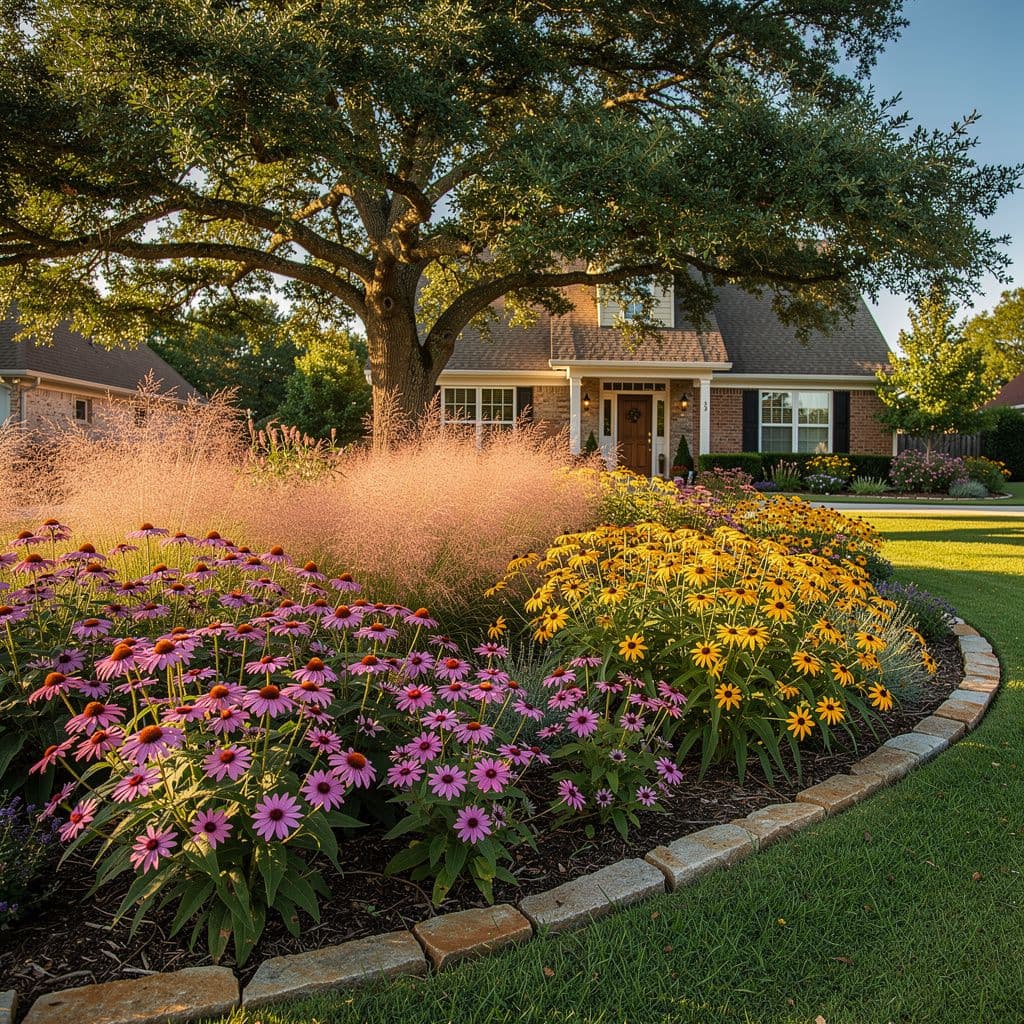
Georgia's state wildflower and one of the most cheerful plants you can grow. Golden-yellow petals surround a dark brown center cone, blooming prolifically from June through October. Black-eyed Susans are drought-tolerant, deer-resistant, and attract butterflies by the dozens. They self-seed freely, so a few plants become a stunning mass planting within a couple of years.
Best for: Full sun beds, wildflower meadows, cut flowers
Height: 1-3 feet
Bloom time: June-October
Plant in: Full sun
Purple Coneflower (Echinacea purpurea)
One of the most popular native perennials in the country, purple coneflower produces large, rosy-purple daisy-like flowers with prominent orange center cones from June through September. Butterflies land on them constantly, and goldfinches eat the seeds in fall. Purple coneflower is incredibly tough — it handles drought, poor soil, and neglect without complaint.
Best for: Sunny borders, pollinator gardens, cut flowers
Height: 2-4 feet
Bloom time: June-September
Plant in: Full sun to light shade
Georgia native bee balm (Monarda didyma)
A member of the mint family that produces showy clusters of tubular red, pink, or purple flowers in mid-summer. Bee balm is a hummingbird magnet — plant it where you can watch the aerial acrobatics from your porch or patio. The foliage has a pleasant minty-spice fragrance. It spreads to form colonies, making it an excellent ground cover for larger areas.
Best for: Pollinator gardens, cottage gardens, hummingbird attractors
Height: 2-4 feet
Bloom time: June-August
Plant in: Full sun to partial shade
Bluestar (Amsonia tabernaemontana)
An underused native that deserves way more attention. Bluestar produces clusters of star-shaped, powder-blue flowers in spring, followed by feathery green foliage that turns a brilliant golden-yellow in fall. It's one of the longest-lasting fall color perennials for Georgia landscapes. Deer and rabbits leave it alone.
Best for: Mixed borders, mass plantings, fall color
Height: 2-3 feet
Bloom time: April-May
Plant in: Full sun to partial shade
Cardinal Flower (Lobelia cardinalis)
If you have a wet spot in your yard — near a downspout, along a creek, or in a low area — cardinal flower will reward you with spikes of the most intense scarlet-red flowers you've ever seen. Hummingbirds can't resist it. It's a short-lived perennial but self-seeds readily in moist conditions.
Best for: Rain gardens, stream edges, moist areas
Height: 2-4 feet
Bloom time: July-September
Plant in: Partial shade, moist soil
Native Grasses for Texture and Movement
Ornamental grasses add texture, movement, and winter interest to your landscape. Georgia's native grasses are tough, drought-tolerant, and beautiful.
Pink Muhly Grass (Muhlenbergia capillaris)
The showstopper of native grasses. In September and October, pink muhly grass erupts into clouds of cotton-candy-pink plumes that catch the light and seem to glow. Mass plantings are absolutely breathtaking. It's drought-tolerant, deer-resistant, and needs almost no maintenance beyond a late-winter cutback.
Best for: Mass plantings, accent plants, borders
Height: 3-4 feet (in bloom)
Plant in: Full sun
Little Bluestem (Schizachyrium scoparium)
A native bunchgrass with blue-green summer foliage that turns copper, orange, and red in fall. The fluffy silver seed heads catch morning dew and frost, creating beautiful winter interest. Little bluestem is incredibly tough — it thrives in poor, dry soil where little else will grow.
Best for: Meadow plantings, erosion control, winter interest
Height: 2-4 feet
Plant in: Full sun
Switchgrass (Panicum virgatum)
A tall, upright native grass that provides excellent vertical structure in the landscape. Switchgrass turns golden-yellow in fall and the dried stalks persist through winter, providing shelter for birds and winter interest for your yard. The deep root system makes it excellent for erosion control on slopes — perfect for properties in Hampton and Morrow with hilly terrain.
Best for: Screens, erosion control, winter structure
Height: 3-6 feet
Plant in: Full sun to partial shade
Planning Your Native Landscape: Practical Tips
Start Small and Expand
You don't have to redo your entire yard at once. Start with a single landscape bed — replace struggling non-native shrubs with native alternatives, or convert a sunny corner into a native wildflower area. Once you see how well native plants perform, you'll want to keep going.
Group Plants by Water Needs
Even among natives, some prefer dry conditions (little bluestem, purple coneflower) while others need moisture (cardinal flower, sweet pepperbush). Group plants with similar water needs together so you can target irrigation efficiently — or better yet, let the natural conditions of your yard guide plant placement. Put moisture-loving plants in low spots and drought-tolerant plants on slopes and sunny ridges.
Plant in Fall for Best Results
In Georgia, fall (October-November) is the ideal planting time for native perennials, shrubs, and trees. The soil is still warm from summer, which encourages root growth, but the air is cooling down, which reduces transplant stress. Plants installed in fall have months to develop strong root systems before facing their first Georgia summer. Spring planting works too — just be prepared to water more diligently during the first summer.
Use Mulch to Help Establishment
Native or not, every new plant benefits from a layer of mulch to retain moisture and suppress weeds while roots establish. We offer mulch delivery and installation throughout Henry County and can help get your new native landscape off to the best possible start.
Work with the Site You Have
Don't fight your yard's natural conditions — work with them. If you have a sunny, dry slope, plant native grasses and sun-loving perennials. If you have a shady, moist area, use native ferns, sweet pepperbush, and oakleaf hydrangea. The beauty of native plants is that there's a species adapted to virtually every condition your Henry County property can throw at them.
How Hedgecoth Property Solutions Can Help
Transitioning to a native landscape doesn't mean you have to do it alone. Our team provides complete landscaping services across Henry County, including:
- Native plant selection and sourcing — we know which Georgia natives thrive in specific locations throughout Locust Grove, McDonough, Stockbridge, Jonesboro, and Hampton
- Landscape bed design and installation — from a single garden bed to a complete property transformation
- Soil preparation — Georgia clay needs amendments before planting; we handle the heavy work
- Ongoing maintenance — native landscapes still need occasional lawn care and property maintenance to look their best
- Mulch and ground cover installation — leaf removal and mulch services to keep native beds looking polished
Whether you want to add a few native pollinator plants to your existing beds or completely redesign your landscape with Georgia-adapted species, we're here to help. We've been maintaining properties throughout Henry County for years and understand exactly what grows best in each neighborhood, soil type, and microclimate.
Frequently Asked Questions About Native Plants in Henry County
Are native plants really lower maintenance than traditional landscaping plants?
Yes, significantly. Native Georgia plants evolved for our specific climate, soil, and rainfall patterns. Once established (typically after the first growing season), they need 50-70% less water than non-native ornamentals, little to no fertilizer, and resist local pests and diseases without chemical treatments. Most native perennials only need annual cleanup and occasional division to thrive.
Can I mix native plants with my existing non-native landscape?
Absolutely. You don't have to go all-native to see benefits. Replacing even a few struggling shrubs or high-maintenance perennials with native alternatives reduces your overall maintenance workload and supports local wildlife. Many Henry County homeowners gradually transition their landscapes over several seasons, replacing plants as they fail or during routine bed renovations.
Where can I buy native plants in Henry County?
Several local nurseries in the McDonough and Stockbridge area carry Georgia native plants, and many can order specific species on request. We also source native plants directly from wholesale growers for our landscaping clients. If you're unsure where to start, our team can recommend the best varieties for your specific property conditions and handle the sourcing and installation for you.
Do native plants attract unwanted pests or animals?
Native plants attract beneficial wildlife — pollinators like bees and butterflies, and songbirds that eat insect pests. They don't typically attract "pests" in the damaging sense. In fact, native plants support predatory insects like ladybugs and lacewings that help control actual garden pests. If deer are a concern, many native plants (like beautyberry, fothergilla, and little bluestem) are naturally deer-resistant.
When is the best time to plant native species in Georgia?
Fall (October through November) is ideal for most native trees, shrubs, and perennials in Henry County. The warm soil encourages rapid root growth while cooler air temperatures reduce stress. Spring (March through April) is the second-best option. Summer planting is possible with dedicated watering but requires more attention during establishment. We can advise on the best timing for your specific project during a free consultation.
How much does a native landscape installation cost compared to traditional landscaping?
Native landscape installation costs are comparable to traditional landscaping initially. However, native landscapes save money long-term through reduced water bills, lower fertilizer and pesticide costs, and fewer replacement plants. Many homeowners see a return on investment within 2-3 years through maintenance savings alone. Call us at 770-490-9519 for a free estimate on your native landscape project.
Ready to Go Native? Let's Talk.
Your Henry County property deserves a landscape that works with Georgia's climate — not against it. Native plants deliver beauty, sustainability, and serious maintenance savings that conventional landscaping simply can't match.
Whether you're in Locust Grove near the train watching platform, McDonough near the square, Stockbridge, Jonesboro, Morrow, Hampton, or anywhere in Henry County, Hedgecoth Property Solutions has the local expertise to design and install a native landscape you'll love.
Call us today at 770-490-9519 or visit our contact page to schedule a free consultation. Let's create a landscape that's built to thrive in Georgia — naturally.