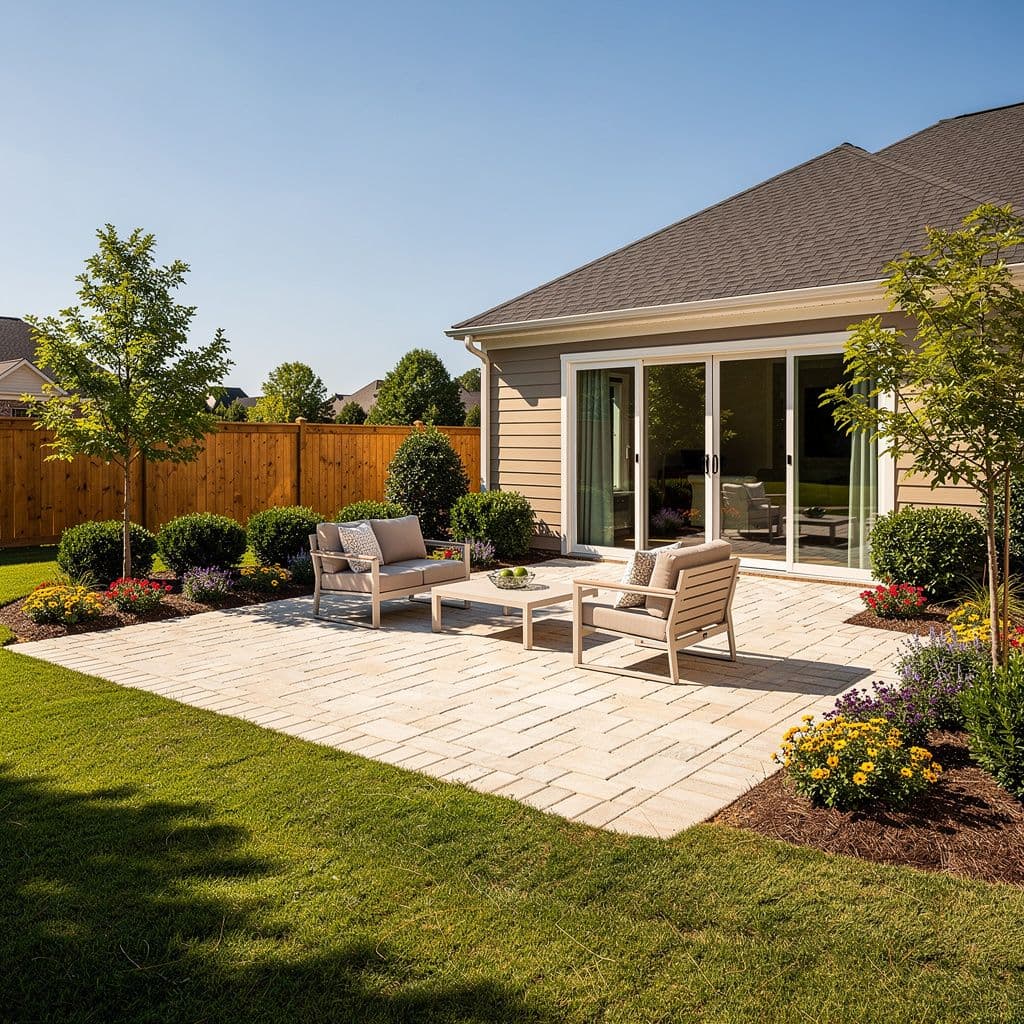
Patio Installation in Locust Grove & Henry County GA: Your Complete Guide to Design, Materials & Costs
Published: May 27, 2026
A patio transforms your backyard from an afterthought into the most-used room on your property. It's where Saturday mornings happen with coffee, where friends gather for cookouts, and where your kids run barefoot without you worrying about stickers or ants. For homeowners in Locust Grove, McDonough, and across Henry County, a professionally installed patio is the single highest-ROI outdoor improvement you can make — and with Georgia's long outdoor season, you'll use it from March through November.
If you've been searching for a "patio company in Locust Grove" or trying to figure out what kind of patio makes sense for your yard and budget, this guide covers everything. Materials, design options, realistic 2026 costs, the installation process, and how to choose a contractor who'll build something that lasts.
Why a Patio Is Henry County's Best Outdoor Investment
According to the National Association of Realtors, a well-designed patio returns 69-102% of its cost in added home value. But the real return isn't measured in resale — it's measured in how often you actually use your yard.
In Henry County, where spring arrives early and fall lingers, a patio gives you 8-9 months of outdoor living space. Compare that to a sunroom addition at $30,000-$80,000, and a patio starts to look like the smartest money you can spend on your home.
Here's what a patio does for Henry County properties:
- Creates an outdoor living room that extends your usable square footage without the cost of construction
- Increases property value by $10,000-$25,000+ depending on size and materials
- Reduces lawn maintenance by replacing grass with a low-maintenance hardscape surface
- Provides a level, clean surface for furniture, grilling, kids' play, and entertaining
- Improves drainage when properly installed with correct grading and base preparation
- Anchors your outdoor design — patios serve as the foundation for fire pits, outdoor kitchens, seating walls, and landscape features
From the newer developments near Tanger Outlets in Locust Grove to established neighborhoods around the McDonough Square, patios are the outdoor feature that ties everything together.
Patio Materials: What Works Best in Georgia
The material you choose affects appearance, durability, maintenance, and cost. Here's how the most popular patio materials perform in Henry County's climate — hot summers, mild winters, and our notorious Georgia red clay.
Concrete Pavers (Most Popular)
Concrete pavers are the top choice for Henry County patios, and for good reason. They're manufactured in hundreds of colors, shapes, and textures, they interlock for stability, and they can be replaced individually if one ever cracks or stains.
Why pavers work in Georgia:
- Flex with ground movement — critical in our clay soil that expands and contracts with moisture
- Don't crack like poured concrete because the joints absorb movement
- Available in styles that mimic natural stone, brick, or contemporary looks
- Permeable paver options allow water to drain through, reducing runoff
- Easy to repair — lift and replace individual units
- Slip-resistant surface even when wet
Popular styles in Henry County:
- Holland Stone — Clean rectangular shape, traditional look, excellent for patterns
- Umbriano — Tumbled texture that mimics natural stone, popular in upscale neighborhoods
- Aqua Bric — Smaller format, intricate patterns, works well for accent borders
- Flagstone texture — Irregular shapes with a natural stone appearance
Maintenance: Sweep and rinse as needed. Polymeric sand in joints prevents weeds and ants. Seal every 3-5 years for color retention. Re-sand joints every 2-3 years.
Cost range: $12-$22 per square foot installed
Natural Stone (Flagstone)
Bluestone, flagstone, and Tennessee fieldstone create patios with authentic character that manufactured products can't fully replicate. Each stone is unique, and the resulting surface has a timeless quality that works beautifully with the traditional and transitional homes common in Locust Grove and Stockbridge.
Pros:
- Genuine, one-of-a-kind appearance
- Excellent durability — natural stone lasts 50-100+ years
- Stays cooler than concrete in direct sun (important in Georgia summers)
- Natural slip resistance
- Develops beautiful patina over time
Considerations:
- Higher cost than manufactured pavers
- Irregular shapes require more skill to install properly
- Limited color selection compared to manufactured options
- Can flake or spall if the wrong stone type is used
Cost range: $18-$35 per square foot installed
Poured Concrete
A solid, flat concrete slab is the most basic patio option. It's cost-effective and provides a clean surface, but it comes with significant drawbacks in Georgia's clay soil.
Pros:
- Lowest material cost
- Smooth, clean surface
- Can be stamped, stained, or scored for decorative effects
Considerations:
- Prone to cracking in Georgia's expansive clay soil
- Repairs are difficult — cracks are hard to hide
- Limited design flexibility
- Can be slippery when wet
- Requires control joints that break up the surface
Our recommendation: If you're considering poured concrete, we strongly suggest upgrading to concrete pavers instead. The cost difference is modest, and pavers solve every problem that plagued concrete in our soil conditions.
Cost range: $8-$15 per square foot installed (basic); $12-$20 (stamped/decorative)
Brick
Clay brick patios have a warm, traditional look that complements the historic homes near downtown McDonough and the established neighborhoods throughout Henry County. Brick is durable, handles heat well, and ages gracefully.
Pros:
- Classic, timeless appearance
- Excellent durability — genuine clay brick lasts decades
- Color doesn't fade (the color goes all the way through)
- Works well in traditional and colonial-style landscapes
Considerations:
- Limited color range (reds, browns, grays)
- Can be slippery when wet if laid with the smooth side up
- Smaller size means more joints to maintain
- Surface can chip with heavy impact
Cost range: $14-$25 per square foot installed
Gravel and Decomposed Granite
For a casual, natural look — think farmhouse or cottage style — gravel and decomposed granite are budget-friendly options. They work well for secondary seating areas, garden paths, and fire pit surrounds.
Cost range: $4-$8 per square foot installed
Patio Design: Planning the Right Size and Layout
Getting the design right is more important than choosing the perfect material. A well-designed small patio beats a poorly planned large one every time.
Sizing Your Patio
The biggest mistake homeowners make is building a patio that's too small. A 10x10 patio sounds adequate until you put a table, four chairs, and a grill on it — suddenly you can't move.
Recommended minimum sizes for Henry County homes:
| Patio Use | Minimum Size | Comfortable Size |
|---|---|---|
| Small dining area (4-person table + grill) | 12x12 ft | 14x16 ft |
| Full dining + lounge area | 16x16 ft | 18x20 ft |
| Entertainment space (dining, lounge, fire pit) | 20x20 ft | 24x28 ft |
| Outdoor kitchen + dining + seating | 20x24 ft | 25x30 ft |
Pro tip: Mark your proposed patio dimensions with spray paint or a garden hose and arrange your furniture inside the outline. Walk around. See if it feels right before you build.
Design Shapes and Layouts
- Rectangular — Clean, formal, maximizes usable space. Works well adjacent to the house.
- Curved/Kidney — Softer, more natural feel. Excellent for freestanding patios away from the house.
- L-shaped — Creates distinct zones (dining area vs. lounge area) within one patio.
- Multi-level — Tiered patios that follow the natural slope of your yard. Popular on Henry County properties with elevation changes.
- Combined with features — Patios that integrate fire pits, seating walls, planters, and water features into the design.
Zoning Your Patio Space
Think of your patio as an outdoor room with zones, just like your indoor living areas:
- Cooking zone — Grill, prep space, possibly an outdoor kitchen
- Dining zone — Table and chairs, close to the kitchen door
- Lounge zone — Comfortable seating, possibly a fire pit or fire feature
- Transition zone — Walkways connecting the patio to the house, yard, and other features
The Installation Process: What Happens When You Hire Hedgecoth Property Solutions
A beautiful patio starts below the surface. The installation process is where professionals earn their money — proper base preparation, grading, and drainage are what separate a patio that lasts 25 years from one that sinks, shifts, and cracks in three.
Step 1: Free Consultation and Design
We visit your property to measure the space, evaluate soil conditions, check drainage patterns, and discuss your vision. We'll bring material samples, show you photos of completed projects in Henry County, and help you choose the right size, shape, and material for your property and budget.
You'll receive a detailed proposal with:
- Accurate measurements and scaled drawings
- Material selections and color options
- A written cost estimate with no hidden fees
- Projected timeline for completion
Step 2: Site Preparation
This is the most critical step — and the one most DIY installations and cut-rate contractors skip.
Our preparation process:
- Utility location — Georgia 811 marks all underground utilities before we dig
- Excavation — We remove existing grass, topsoil, and organic material to the proper depth (typically 7-9 inches for a standard paver patio)
- Subgrade evaluation — We assess the native soil. In Henry County, that usually means Georgia red clay, which has poor drainage and high expansion potential
- Geotextile fabric — Installed between the native soil and base material to prevent mixing and improve stability
- Base installation — We install and compact crushed granite (known locally as "crush and run" or "graded aggregate base") in 2-inch lifts, with each layer mechanically compacted
- Screed layer — A 1-inch layer of bedding sand or granite screenings creates a smooth, level surface for the pavers
Proper base preparation accounts for 40-50% of the total installation labor. It's invisible in the finished product, but it's the difference between a patio that lasts and one that doesn't.
Step 3: Paver Installation
Pavers are laid in your chosen pattern — herringbone, running bond, basket weave, random, or a custom combination. We cut pavers at edges and obstacles using diamond-blade saws for clean, tight fits. The pattern is checked continuously for straight lines and consistent joints.
Step 4: Edging and Restraints
Permanent edge restraints are installed around the perimeter to hold pavers in place and prevent spreading. We use heavy-duty plastic or aluminum edging secured with landscape spikes — not the flimsy plastic edging that fails after a few seasons.
Step 5: Joint Sand and Compaction
Polymeric sand is swept into all joints and activated with water. This specialized sand contains polymers that bind the sand particles together, preventing weeds, ants, and washout while still allowing flexibility. The patio is compacted one final time to set the pavers into the bedding layer and lock everything in place.
Step 6: Cleanup and Walkthrough
We clean the site, remove all debris and excess materials, and walk you through your new patio. We cover care instructions, what to expect during the first few weeks as the patio settles, and when to schedule your first sealing (typically 60-90 days after installation).
Typical timeline: Most patio installations take 3-7 days depending on size and complexity. Larger projects with integrated features may take 1-2 weeks.
Patio Costs in Henry County GA: 2026 Pricing
Here's what Locust Grove and Henry County homeowners can expect to pay for professional patio installation in 2026:
Base Pricing by Material
| Material | Per Sq Ft Installed | 200 Sq Ft Patio | 400 Sq Ft Patio |
|---|---|---|---|
| Concrete pavers (standard) | $12-$16 | $2,400-$3,200 | $4,800-$6,400 |
| Concrete pavers (premium) | $16-$22 | $3,200-$4,400 | $6,400-$8,800 |
| Natural stone (flagstone) | $18-$35 | $3,600-$7,000 | $7,200-$14,000 |
| Stamped concrete | $12-$20 | $2,400-$4,000 | $4,800-$8,000 |
| Brick | $14-$25 | $2,800-$5,000 | $5,600-$10,000 |
Additional Features
| Feature | Typical Cost |
|---|---|
| Seating wall (per linear foot) | $50-$100 |
| Fire pit (wood-burning) | $800-$3,500 |
| Fire pit (gas) | $2,500-$7,500 |
| Steps (per step, per foot width) | $40-$80 |
| Landscape lighting (per fixture) | $75-$200 |
| Retaining wall (per square foot face) | $25-$50 |
| Outdoor kitchen base | $3,000-$10,000+ |
What Affects Your Final Cost
- Site access — Can equipment reach your backyard, or does everything need to be wheelbarrowed through a side gate?
- Soil conditions — Heavy clay or poor drainage may require additional base material or drainage solutions
- Slope and grading — Steep yards may need retaining walls or significant grading work
- Existing hardscape removal — Removing an old concrete slab or deck adds cost
- Complexity of design — Curves, borders, inlays, and multi-level designs require more cutting and labor
- Distance from material suppliers — Delivery costs vary based on location
All quotes from Hedgecoth Property Solutions include materials, labor, base preparation, edge restraints, polymeric sand, and cleanup. No surprise charges.
Choosing a Patio Contractor in Henry County: What to Ask
Not all patio contractors are equal. Here's how to evaluate a contractor before you sign a contract.
Questions That Separate Pros from Amateurs
"How deep do you excavate for the base?"
Correct answer: 7-9 inches for standard patios. This allows for 4-6 inches of compacted base material, 1 inch of bedding sand, and the paver thickness. Contractors who say 3-4 inches are cutting corners.
"What base material do you use?"
Correct answer: Crushed granite, AB-3, or similar graded aggregate base. DG (decompose granite) and crusher run are also acceptable. "Just sand" or "dirt and gravel" are red flags.
"Do you compact the base in lifts?"
Correct answer: Yes, in 2-inch layers. Each layer is compacted before the next is added. A single 6-inch layer of base material cannot be properly compacted from the top.
"Do you install geotextile fabric?"
Correct answer: Yes, between the native soil and base material. This prevents the clay from mixing with the base, which would destroy the base's load-bearing capacity over time.
"What edge restraint do you use?"
Correct answer: Rigid plastic, aluminum, or concrete toe. "None" or "landscape timbers" are insufficient for long-term stability.
"Is your work warrantied?"
Correct answer: Yes, with a written warranty covering materials and workmanship for a specified period. Get it in writing.
Red Flags
- No written contract — If it's not in writing, it doesn't exist
- Large upfront payments — Standard deposits are 25-33%. Requests for 50%+ upfront are a warning sign
- No portfolio — If they can't show you completed projects, they probably haven't done many
- Pressure to decide immediately — Good contractors are busy but don't need to pressure you
- Price seems too good — In landscaping and hardscaping, you absolutely get what you pay for. A patio that's $3,000 cheaper probably has $3,000 less in base preparation, materials, or skilled labor
Maintaining Your Patio: Easy Steps for Long-Lasting Beauty
A properly installed patio is low-maintenance, but not no-maintenance. Here's how to keep it looking great for decades.
Regular Care
- Sweep regularly — Remove leaves, dirt, and debris that can stain surfaces
- Rinse occasionally — A garden hose or pressure washer on low setting keeps the surface clean
- Reseal joints — Polymeric sand may need touch-ups every 2-3 years, especially in high-traffic areas
- Address stains promptly — Oil, grease, and rust stains are much easier to remove when fresh
Seasonal Maintenance
- Spring — Inspect joints for damage, sweep in fresh polymeric sand where needed, clean surface
- Summer — Regular sweeping and rinsing. Move furniture periodically to prevent uneven fading
- Fall — Keep leaves cleared — wet leaves can stain pavers and promote moss growth in joints
- Winter — Avoid using rock salt on pavers — it can damage the surface. Use sand for traction if needed
Sealing
Sealing your patio every 3-5 years protects the surface, enhances color, and makes cleaning easier. We offer sealing as part of our property maintenance services, or you can apply sealant yourself with the right products and equipment.
Patios and Your Overall Landscape
A patio doesn't exist in isolation — it's the centerpiece of your outdoor living space. Here's how to integrate it with the rest of your property maintenance and landscape design.
Planting Around Your Patio
Soft plantings around the patio edges soften the hardscape, provide shade, and create a more inviting space:
- Low hedges — Boxwood or dwarf yaupon holly for clean borders
- Ornamental grasses — Fountain grass and muhly grass add movement and texture
- Perennial beds — Daylilies, coneflowers, and black-eyed Susans for seasonal color
- Shade trees — Red maples, willow oaks, or crape myrtles positioned to provide afternoon shade without dropping debris onto the patio surface
Connecting Your Patio to Your Yard
Walkways, stepping stone paths, and landscape lighting connect your patio to the rest of your property. A well-designed transition from patio to lawn care areas makes the whole yard feel intentional and cohesive.
Adding Features Over Time
One advantage of a well-built patio is that you can add features incrementally. Start with the patio, then add a fire pit next year, a seating wall the year after, and landscape lighting when budget allows. Each addition builds on the last, and the patio serves as the foundation for everything.
Why Henry County Homeowners Choose Hedgecoth Property Solutions
We've been building patios and outdoor living spaces in Henry County long enough to know what works — and what doesn't — in our soil, our climate, and our neighborhoods. Every patio we install is built with:
- Proper base preparation — the non-negotiable foundation for a patio that lasts
- Quality materials — from trusted suppliers, rated for our climate and use conditions
- Skilled installation — our crew has the experience to handle complex designs, challenging sites, and every curve Georgia clay can throw at us
- Honest pricing — detailed written estimates with no hidden costs
- Written warranty — we stand behind our work
We're not the cheapest option, and we don't want to be. We build patios that look great the day they're finished and still look great ten years later. That takes proper materials, proper preparation, and proper labor — and that has a cost.
Frequently Asked Questions About Patio Installation
How long does it take to install a patio in Henry County?
Most residential patios take 3-7 days from start to finish. A standard 300-square-foot paver patio typically takes 3-4 days. Larger projects with features like seating walls, fire pits, or multi-level designs may take 1-2 weeks. Weather can affect timelines — we don't install pavers during heavy rain because moisture compromises the base preparation.
Do I need a permit to build a patio in Henry County?
Most standard at-grade patios (not elevated) do not require a building permit in unincorporated Henry County or the City of Locust Grove. However, if your patio includes a roof structure, outdoor kitchen with plumbing or gas, or a retaining wall over 4 feet, permits may be required. HOA approval may also be needed in some subdivisions. We handle all permitting and HOA coordination as part of our service.
What is the best patio material for Georgia clay soil?
Concrete pavers are the best choice for Georgia's expansive clay soil. Because pavers are individual units separated by joints, they flex with ground movement without cracking. Poured concrete, by contrast, is a rigid slab that often cracks when the clay beneath it expands and contracts with moisture changes. The interlocking joint system in pavers absorbs this movement while maintaining a level, stable surface.
How much does a 20x20 patio cost in Henry County?
A 20x20 (400 square foot) concrete paver patio typically costs $4,800-$8,800 installed, depending on the paver style selected and site conditions. Natural stone would run $7,200-$14,000 for the same size. These prices include excavation, base preparation, materials, installation, edge restraints, polymeric sand, and cleanup. Adding features like seating walls or a fire pit increases the total.
Can a patio be installed on a sloped yard?
Yes — sloped yards are common in Henry County, and a patio can absolutely be installed on a slope. The solution usually involves one or more of these approaches: cutting into the slope to create a level area, building a retaining wall to hold back the grade, or designing a multi-level patio that follows the natural contour. Sloped sites may add 20-40% to the project cost depending on the severity, but the result is a flat, usable space that would otherwise go unused.
When is the best time to install a patio in Georgia?
Patios can be installed year-round in Georgia's mild climate, but spring and fall are ideal. Spring installations are ready for summer use, and fall installations benefit from cooler working conditions. Summer installations are common and work well — we just schedule around rain. Winter installations are possible during dry spells. The most important factor is booking your contractor early, as the best landscaping companies in Henry County schedule weeks or months in advance during peak season.
Ready to Build Your Dream Patio in Henry County?
A professionally installed patio is an investment in your home and your lifestyle. It's the improvement you'll use every single day from spring through fall — morning coffee, weekend cookouts, evening conversations, and everything in between.
At Hedgecoth Property Solutions, we design and build custom patios and complete outdoor living spaces for homeowners throughout Locust Grove, McDonough, Stockbridge, Jonesboro, Morrow, Hampton, and all of Henry County, Georgia. From material selection to final walkthrough, we handle every detail.
Call us today at 770-490-9519 or contact us online to schedule your free on-site consultation. We'll bring samples, measure your space, and give you a detailed estimate — no pressure, no obligation.
Your backyard has potential. Let's build something that brings it to life.
Hedgecoth Property Solutions provides professional landscaping, lawn care, property maintenance, hardscaping, and leaf removal services throughout Henry County, Georgia — including Locust Grove, McDonough, Stockbridge, Jonesboro, Morrow, and Hampton. Licensed, insured, and locally owned.