Erosion Control Solutions for Henry County Yards: Stop Soil Runoff Before It Destroys Your Property
Published: July 3, 2026
If you've noticed deepening gullies in your backyard after every thunderstorm, bald patches where grass used to grow on a slope, or mud washing onto your driveway and into the street, you're watching erosion happen in real time. And in Henry County, you're far from alone.
Georgia's heavy clay soil, rolling terrain, and intense summer downpours create the perfect recipe for erosion. Add in the construction-grade fill dirt that many newer subdivisions in Locust Grove, McDonough, and Stockbridge are built on, and you have properties that can lose significant topsoil in a single storm season.
Erosion isn't just a cosmetic issue. Left unchecked, it destroys landscaping, exposes tree roots, creates dangerous runoff, damages foundations, and can reduce your property value by thousands of dollars. The good news? Erosion is predictable, preventable, and — when addressed by professionals who understand Henry County's soil and terrain — entirely fixable.
This guide covers everything you need to know about erosion control for your Henry County property: what causes it, how to spot the warning signs, and the most effective solutions for Georgia yards.
Why Erosion Is Worse in Henry County Than Most Places
Understanding why erosion happens here requires understanding what makes Henry County's geography unique. This isn't just bad luck — it's geology.
Georgia Red Clay: Beautiful but Problematic
Henry County sits on a foundation of ultisols — the red clay soil that Georgia is famous for. While clay soil is nutrient-rich, its physical structure creates serious erosion challenges:
- Low permeability: Clay particles are microscopic and pack tightly together, meaning water runs off the surface rather than soaking in. During heavy rain, clay soil acts almost like pavement.
- Shrink-swell behavior: Clay expands when wet and contracts when dry. This constant movement cracks the soil, creates channels for water to exploit, and destabilizes anything planted in it.
- Surface sealing: During intense rainfall, clay particles on the surface rearrange and form a hard crust that's nearly impermeable, increasing runoff volume dramatically.
When a summer thunderstorm drops two inches of rain in 30 minutes on Henry County clay, that water has nowhere to go but downhill — and it takes your topsoil with it.
Henry County's Terrain
Drive through any neighborhood in Locust Grove, McDonough, or Hampton and you'll notice the rolling hills and sloped lots that characterize the area. Many subdivisions were developed with minimal grading, leaving homeowners with:
- Sloped backyards where water accelerates as it flows downhill
- Side yards that become natural drainage channels during storms
- Building pads cut into hillsides, creating artificial slopes that are prone to failure
- Fill dirt zones around foundations where the soil is loose, uncompacted, and easily washed away
The Thunderstorm Factor
Georgia averages 45-55 thunderstorm days per year, with the heaviest concentration from May through September. A single intense storm can cause more erosion damage than months of gentle rainfall. Climate data shows that extreme precipitation events are becoming more frequent in the southeastern United States, meaning erosion problems will only intensify in coming years.
Warning Signs: How to Spot Erosion Damage Early
Catching erosion early saves thousands of dollars in repairs. Walk your property after the next heavy rain and look for these signs.
Visible Signs of Active Erosion
- Gullies and channels forming in your yard, especially on slopes or in natural drainage paths
- Exposed tree roots that were previously covered with soil — a clear sign that topsoil is washing away
- Soil deposits at the bottom of slopes, on driveways, sidewalks, or in the street after rain
- Undercut sections of lawn where soil has washed out beneath the grass, creating overhangs that eventually collapse
- Thinning grass on slopes while grass at the bottom of the slope grows thick from deposited sediment
- Cracks in your home's foundation, driveway, or walkway — erosion beneath concrete can cause settling and cracking
- Muddy water running off your property during storms
Signs of Long-Term Erosion Damage
- Landscaping that won't stay put — mulch, pine straw, and gravel constantly washing downhill
- Fence posts and mailbox posts that have become loose or tilted as surrounding soil erodes
- Uneven lawn surfaces where sections have subsided or settled
- Bare patches where grass, shrubs, or flowers used to grow but the soil has become too compacted or depleted
- Spongy or sinking areas in your yard where underground erosion has created voids beneath the surface
If you notice three or more of these signs, it's time to call a professional. Erosion accelerates over time — what's a manageable problem this year can become a landscape-destroying crisis next year.
Effective Erosion Control Solutions for Georgia Yards
Erosion control isn't one-size-fits-all. The right solution depends on your property's slope, soil composition, drainage patterns, and the severity of the problem. Here are the most effective approaches for Henry County properties.
1. Proper Grading and Regrading
The foundation of all erosion control is proper grading — shaping the ground so water flows where you want it to go rather than where gravity takes it.
How it works: Professional grading reshapes the soil surface to create gentle, controlled slopes (typically 2-5% grade away from structures) that direct water toward designated drainage areas. For existing lawns with erosion damage, regrading may involve adding topsoil, recompacting fill areas, and re-establishing grass.
Best for: Properties with improper initial grading, areas where water flows toward the foundation, and yards with uneven surfaces from previous erosion.
Why professionals matter: Grading requires precision. A slope that's too steep accelerates erosion; too flat and water pools. Heavy equipment is needed to move and compact soil properly. And in Henry County's clay soil, proper compaction techniques are essential to prevent future settling.
Learn more about our property maintenance services.
2. Retaining Walls
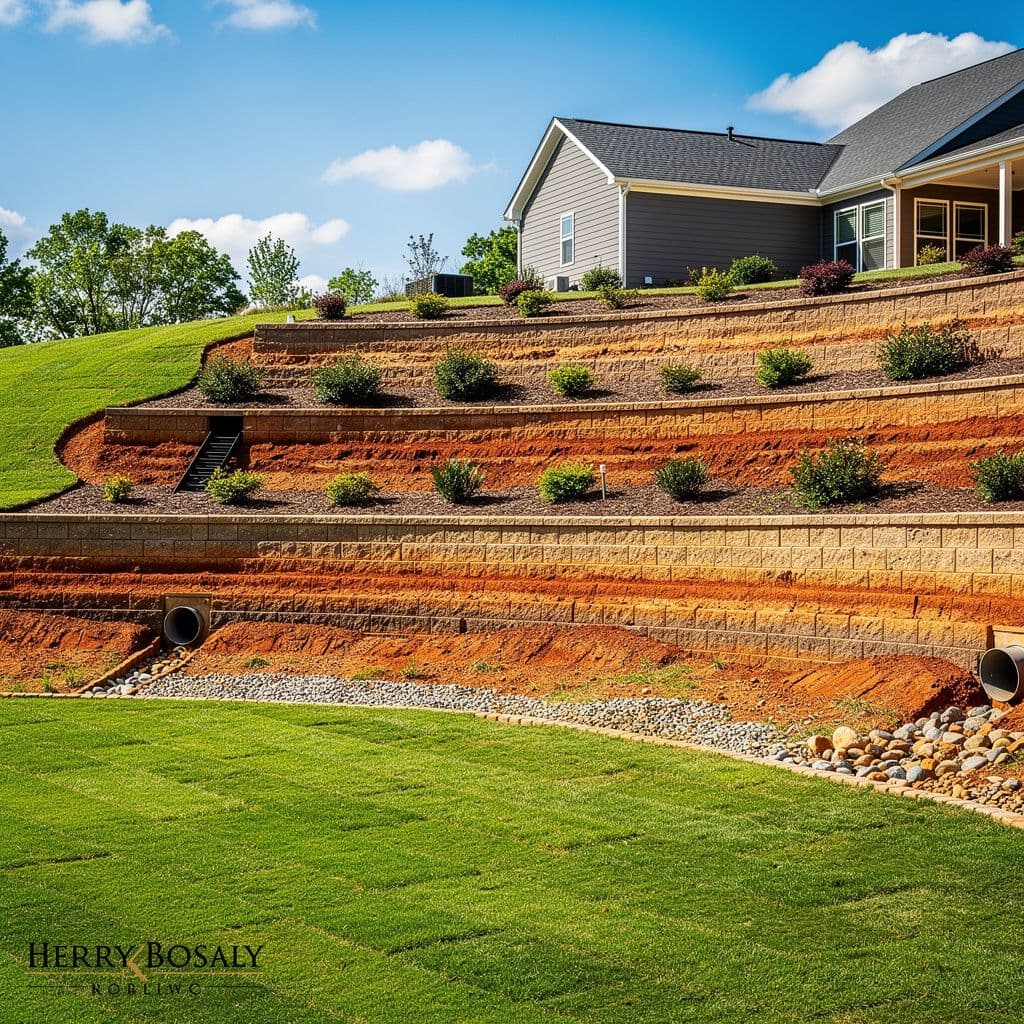
Retaining walls are one of the most effective — and visually appealing — erosion control solutions for sloped properties common throughout Henry County.
How they work: Retaining walls hold back soil on a slope, creating level terraces that slow water flow and prevent soil from washing downhill. They transform unusable sloped areas into functional lawn or garden space.
Types of retaining walls for Henry County:
- Segmental concrete block walls — the most popular choice, durable and available in colors that complement Georgia homes
- Natural stone walls — premium appearance, excellent drainage characteristics, and incredibly long-lasting
- Timber walls — cost-effective for shorter walls (under 3 feet), though they have a shorter lifespan in Georgia's humid climate
- Boulder walls — large natural boulders create a rugged, natural look while providing massive structural support
Best for: Sloped yards, properties with significant elevation changes, and homes where erosion is threatening landscaped areas or structures.
Explore our hardscaping and retaining wall services.
3. French Drains and Drainage Systems
Where erosion is caused by concentrated water flow — a natural drainage path through your property, runoff from a neighbor's yard, or water from your roof — drainage systems redirect that water before it can cause damage.
French drains are the workhorse of Henry County erosion control. A trench filled with gravel and a perforated pipe collects water and channels it to a safe discharge point. In clay soil, French drains are particularly effective because they bypass the impermeable clay layer entirely.
Other drainage solutions:
- Dry creek beds — decorative surface channels that direct water flow while looking like a natural landscape feature
- Downspout extensions and underground drainage — move roof runoff away from your foundation and erosion-prone areas
- Catch basins and channel drains — collect surface water in hardscape areas and route it underground
Best for: Properties where water flows through from higher ground, erosion caused by roof runoff, and yards with natural drainage paths.
Our yard drainage solutions provide detailed information on drainage options for Henry County properties.
4. Ground Cover and Deep-Rooted Plantings
Vegetation is nature's erosion control. Plant roots act like a living net, holding soil in place while plant foliage absorbs raindrop impact and slows surface water flow.
Best erosion-control plants for Henry County:
- Creeping juniper — low-growing evergreen that spreads quickly on sunny slopes
- Liriope (monkey grass) — tough, shade-tolerant, and excellent for stabilizing soil on banks
- Vinca minor (periwinkle) — fast-spreading ground cover for shaded areas
- Ornamental grasses — deep roots and year-round coverage
- Native Georgia plants — see our native plants guide for species adapted to our climate
For steeper slopes: Professional hydroseeding or sod installation provides immediate erosion protection while permanent vegetation establishes. Our sod installation services can transform a bare, eroding slope into a stable, attractive landscape.
Best for: Mild to moderate erosion, slopes that aren't steep enough for retaining walls, and areas where you want a natural, planted look.
5. Mulch, Pine Straw, and Surface Protection
For existing landscape beds and mild erosion areas, proper surface covering provides simple but effective protection.
- Pine straw — interlocks naturally to form a mat that resists washing, ideal for Georgia landscapes
- Hardwood mulch — heavier than pine straw, stays in place better on gentle slopes
- Erosion control blankets — biodegradable mats that hold soil and seed in place on slopes during grass establishment
Not sure whether pine straw or mulch is right for your property? Our pine straw vs mulch comparison breaks down the pros and cons for Henry County yards.
6. Rip Rap and Stone Stabilization
For high-flow areas where water concentrates — the outlet of a drain pipe, the bottom of a downspout, or a natural drainage channel — large stones (rip rap) dissipate water energy and prevent the soil from being washed away.
Rip rap is particularly effective at the discharge points of French drains and dry creek beds, where water exits with enough velocity to erode bare soil.
The Cost of Ignoring Erosion
Many homeowners put off erosion control because it seems like a "later" problem. Here's why that's a mistake.
Erosion Accelerates Over Time
Erosion creates a feedback loop. As soil washes away, the remaining surface becomes steeper and more compacted, which increases water velocity and erosion rate. What starts as a minor drainage issue can become a major landscape failure within one or two storm seasons.
The Real Costs of Erosion Damage
- Foundation damage: $5,000-$25,000+ for underpinning and repair when erosion undermines your home's foundation
- Driveway and walkway replacement: $3,000-$10,000 when erosion causes settling and cracking
- Landscape replacement: $1,000-$5,000+ to replace washed-out mulch, plants, and sod after a bad storm season
- Tree loss: $500-$3,000 per tree when erosion exposes and damages root systems
- Property value impact: Properties with visible erosion damage consistently appraise for less than comparable properties with stable terrain
Professional erosion control is an investment that pays for itself by preventing these costs — often within the first major storm event after installation.
Professional Erosion Control Assessment: What to Expect
When you contact Hedgecoth Property Solutions for erosion control, here's what happens.
Step 1: Property Evaluation
We walk your entire property to identify erosion patterns, water flow routes, and problem areas. This includes assessing your soil type, slope angles, existing vegetation, drainage infrastructure, and any contributing factors from neighboring properties.
Step 2: Custom Solution Design
Based on the assessment, we design a comprehensive erosion control plan. This may include grading, retaining walls, drainage systems, vegetation establishment, or a combination of solutions. We explain each recommendation, why it's needed, and what it will accomplish.
Step 3: Professional Installation
Our experienced crew installs your erosion control solutions using commercial-grade equipment and materials rated for Georgia clay soil conditions. We work efficiently and clean up thoroughly — your property looks better when we leave than when we arrived.
Step 4: Long-Term Stability
We provide guidance on maintaining your erosion control features and can schedule periodic inspections to ensure everything continues performing as designed. Our goal is a permanent solution, not a temporary fix.
Frequently Asked Questions About Erosion Control in Henry County
How do I know if my property needs erosion control?
If you notice any of these signs — soil washing out after storms, exposed tree roots, gullies forming on slopes, mud on driveways or sidewalks, or areas where grass won't grow due to soil loss — you need erosion control. Even mild erosion worsens over time, so addressing it early is always less expensive than waiting. Properties on slopes, near the bottom of hills, or in newer subdivisions with fill dirt are especially vulnerable in Henry County.
How much does erosion control cost in Henry County, GA?
Erosion control costs vary widely based on the solution needed. Surface solutions like ground cover planting and mulch range from $500-$2,500. French drains cost $1,000-$4,000 depending on length. Retaining walls range from $2,500-$15,000+ depending on height, length, and materials. Comprehensive property-wide erosion management typically runs $3,000-$12,000. While that may seem significant, foundation repairs from unchecked erosion cost $5,000-$25,000+, making proactive erosion control the smarter financial decision.
Will a retaining wall fix my erosion problem?
Retaining walls are excellent for stabilizing slopes and preventing soil movement, but they're not always the complete solution. Many erosion problems require a combined approach — a retaining wall to hold back soil, plus drainage to redirect water, plus ground cover to protect the surface. A professional assessment determines whether a retaining wall alone will solve your specific problem or if additional measures are needed. In Henry County's clay soil, drainage is almost always part of the equation.
Can I fix erosion myself?
Minor erosion on flat ground — small bare patches or slight surface washing — can sometimes be addressed with DIY solutions like adding topsoil, planting grass, or installing downspout extensions. However, any erosion involving slopes, persistent water flow, retaining walls, or drainage installation should be handled by professionals. Improper grading or drain installation can worsen erosion, and poorly constructed retaining walls can fail catastrophically. In Henry County, where clay soil and heavy rainfall amplify erosion risks, professional installation ensures solutions that actually last.
How long do erosion control solutions last?
Properly installed erosion control solutions are designed to be permanent. Segmental concrete retaining walls last 50+ years. Natural stone walls can last centuries. French drains typically last 20-30 years in clay soil when installed with appropriate materials. Ground cover plantings become more effective over time as root systems establish. The key is professional design and installation — DIY or cut-corner solutions often fail within the first few storm seasons.
When is the best time to address erosion control?
Late summer through fall (August-November) is ideal for erosion control installation in Henry County. The ground is typically drier and easier to work with, you'll avoid the spring rainy season that makes grading and excavation difficult, and your erosion control systems will be in place before winter and next spring's heavy rains. However, if you're experiencing active erosion that threatens your foundation or landscape, don't wait — call immediately. Erosion damage compounds quickly, and every storm that passes causes more damage.
Protect Your Property with Professional Erosion Control
Every thunderstorm that rolls through Henry County is moving your soil downhill. The question isn't whether erosion is happening on your property — it's whether you're going to stop it before it causes serious damage.
Hedgecoth Property Solutions provides comprehensive erosion control services across Henry County. We understand Georgia clay soil, we know how water moves through Henry County terrain, and we have the equipment and expertise to solve erosion problems permanently.
Our erosion control services include:
- Free on-site assessment — we'll evaluate your property and identify all erosion issues
- Custom solution design — grading, retaining walls, drainage, vegetation, or combined approaches
- Professional installation — experienced crews using commercial-grade equipment and clay-rated materials
- Complete landscape restoration — your yard looks finished and polished, not like a construction site
- Ongoing support — we stand behind our work and ensure long-term stability
Why Henry County homeowners trust us:
- Local experience in Locust Grove, McDonough, Stockbridge, Jonesboro, Hampton, and Morrow
- Deep understanding of Georgia clay soil and regional erosion patterns
- Full-service landscaping, lawn care, and property maintenance — one call for everything
- Transparent pricing and honest recommendations
- We live and work in Henry County — we're your neighbors
Don't wait for the next storm to cause more damage.
📞 Call 770-490-9519 for a free erosion control assessment
📍 Serving: Locust Grove, McDonough, Jonesboro, Stockbridge, Hampton, Morrow, and all of Henry County
🌐 Request a quote online: hedgecoth.pro/contact
Your property is one of your biggest investments. Protect it with professional erosion control that lasts.
Hedgecoth Property Solutions has been solving erosion, drainage, and landscape problems across Henry County, GA since 2018. From retaining walls and French drains to complete property maintenance, we help homeowners protect and improve their outdoor spaces. Call 770-490-9519 to schedule your free assessment.