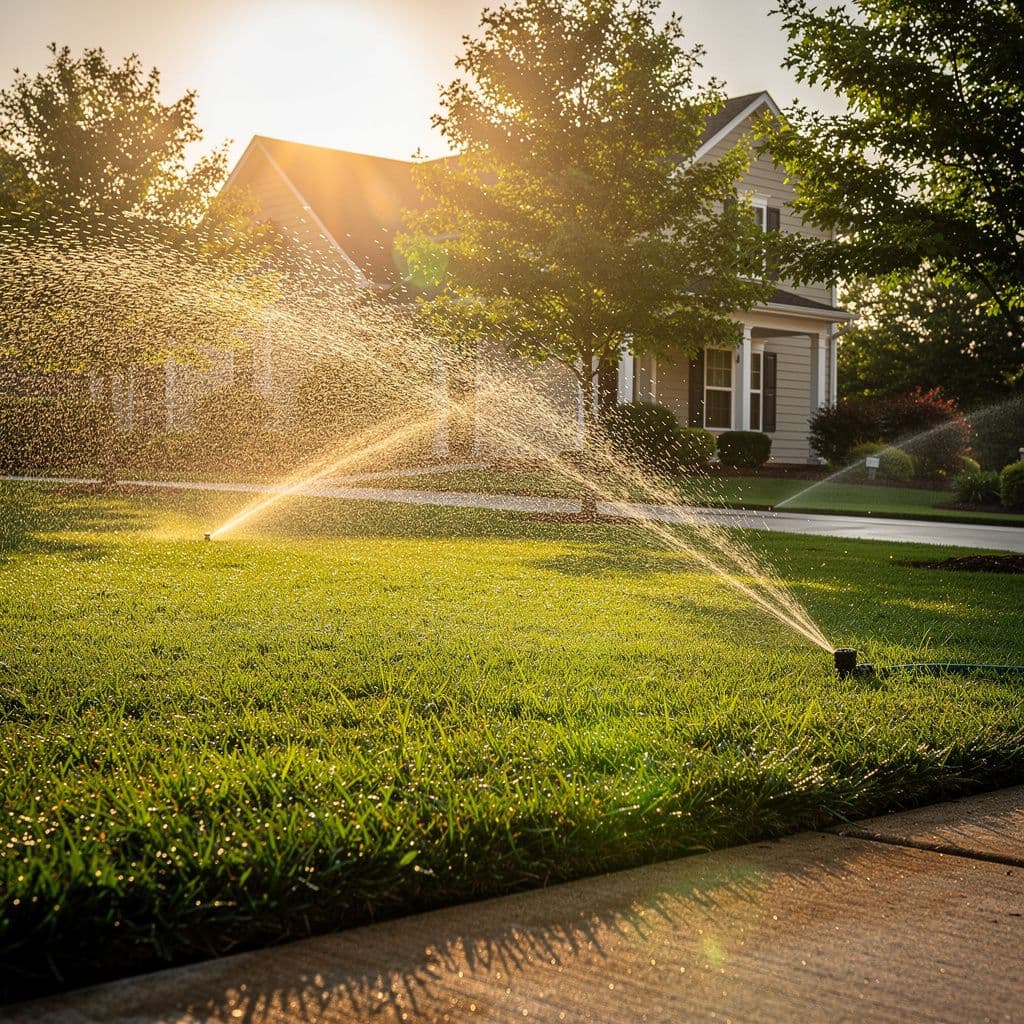
How Often Should You Water Your Lawn in Georgia? A Henry County Guide
Published: June 15, 2026
If you're standing in your yard holding a garden hose wondering, "How often am I supposed to be doing this?" — you're not alone. It's one of the most common questions homeowners in Locust Grove, McDonough, Stockbridge, and across Henry County ask about their lawns.
And it makes sense. Georgia weather doesn't follow neat patterns. One week it pours. The next week the ground cracks. June temperatures push into the mid-90s. Your grass looks great on Monday and fried by Thursday. Without a clear watering plan, most homeowners end up either drowning their lawn or letting it slowly dehydrate — and both mistakes lead to the same result: brown patches, weeds, and fungal problems.
This guide cuts through the confusion. Whether you have a sprinkler system, a hose-end sprinkler, or you're just figuring things out, you'll learn exactly how often to water your lawn in Georgia, how much water to apply, the best times to do it, and how to adjust for each season.
The Short Answer: How Often to Water a Georgia Lawn
Here's the quick version for homeowners who just need a straight answer:
During the growing season (April–October), water your lawn 2–3 times per week, applying about 1 to 1.5 inches of water per week total. In peak summer (June–August), you may need 3–4 times per week.
That's the baseline. But your specific lawn's needs depend on several factors:
- Grass type (Bermuda, Zoysia, Centipede, or Fescue)
- Soil type (Henry County is mostly heavy clay)
- Sun exposure (full sun vs. partial shade)
- Recent rainfall (always check before watering)
- Slope and drainage (water runs off slopes quickly)
We'll break down each of these factors below. But first, let's understand why watering frequency matters so much in Georgia.
Why Georgia Lawns Are Different
If you've lived in Henry County for more than one summer, you already know: Georgia heat is no joke. But the combination of heat, humidity, and clay soil creates unique watering challenges that generic lawn care advice from national websites doesn't address.
The Clay Soil Factor
Henry County's soil is predominantly heavy clay. Clay soil has some advantages — it holds onto nutrients and moisture better than sandy soil — but it also has a major drawback: it absorbs water very slowly.
When you water clay soil too quickly (or for too long in a single session), the water doesn't soak in. Instead, it runs off across the surface, pooling in low spots and washing away topsoil while leaving the root zone dry. This is why many homeowners are confused when their sprinklers run for 30 minutes but their grass still looks thirsty — the water never actually reached the roots.
The solution is cycle-and-soak watering: instead of one long watering session, break it into shorter cycles with breaks in between. For example, instead of running sprinklers for 30 minutes straight, run them for 10 minutes, wait 30 minutes, then run another 10 minutes. This gives the clay soil time to absorb each round of water before adding more.
Georgia's Humid Heat
Temperatures in Henry County regularly hit 90°F or higher from June through September, with humidity levels that make it feel even hotter. This combination causes rapid moisture loss from grass blades (through transpiration) and from the soil surface (through evaporation).
Warm-season grasses like Bermuda and Zoysia are adapted to this heat — they actually thrive at temperatures between 80°F and 95°F. But even heat-tolerant grasses need consistent soil moisture to maintain active growth. When soil moisture drops too low, these grasses go into survival mode, slowing growth and turning brown to conserve energy.
Unpredictable Rainfall
Georgia's summer rainfall is famously inconsistent. Afternoon thunderstorms can dump 2 inches of rain on one neighborhood while leaving the next town over completely dry. A common mistake is assuming that because it rained somewhere nearby, your lawn got enough water. Unless you have a rain gauge, you don't actually know how much water your lawn received.
The fix is simple: install a cheap rain gauge (they cost $5–$10 at any hardware store) and check it after each rain event. If you got an inch or more of rain in a week, skip a supplemental watering. If you got less, water as planned.
How Much Water Does Your Lawn Actually Need?
Most homeowners drastically overestimate or underestimate how much water their lawn needs. The target is straightforward:
Your lawn needs 1 to 1.5 inches of water per week during the growing season, delivered either by rainfall, irrigation, or a combination of both.
How to Measure Your Watering
You can't manage what you don't measure. Here's how to figure out how much water your sprinklers actually deliver:
The Tuna Can Method:
- Place 4–6 empty, shallow containers (tuna cans work great) randomly around your lawn
- Turn on your sprinkler(s) and let them run for 15 minutes
- Measure the water depth in each can with a ruler
- Average the measurements
- Multiply by 4 to get your hourly output
If your sprinklers deliver 0.5 inches per hour, you'd need to run them for 2–3 hours per week to hit the 1–1.5 inch target. Split across 3 watering days, that's about 40–60 minutes per session.
Why This Matters:
Every sprinkler system delivers water at a different rate. Spray heads might deliver 1.5–2 inches per hour, while rotor heads deliver only 0.4–0.6 inches per hour. Without measuring, you're guessing — and guessing usually means you're either wasting water or starving your lawn.
Signs You're Watering Too Much
Overwatering is actually more common than underwatering in Henry County, thanks to our clay soil that holds moisture longer than people expect. Watch for:
- Standing water or puddles that don't drain within an hour
- Spongy feeling when you walk on the lawn
- Mushrooms or fungal growth appearing in the grass
- Weeds like nutsedge and crabgrass thriving (they love wet soil)
- Brown patch disease — circular patches of brown, dying grass (fueled by constant moisture)
- Excessive thatch buildup — a spongy layer of dead grass between the soil and green growth
Signs You're Watering Too Little
Underwatering symptoms are easier to spot but often mistaken for other problems:
- Grass blades folding or rolling — grass conserves moisture by folding its leaves
- Footprints that stay visible — healthy grass springs back; dry grass stays compressed
- Blue-gray tint instead of vibrant green
- Soil that's hard and cracked near the surface
- Weeds like clover and dandelions moving in (they outcompete weak, drought-stressed grass)
Month-by-Month Watering Schedule for Henry County
Different months require different watering strategies. Here's a seasonal breakdown tailored to Henry County's climate and the warm-season grasses common in our area.
March–May: Spring Green-Up
As temperatures warm and grass breaks dormancy, gradually increase watering. Your lawn doesn't need full summer watering yet, but it does need consistent moisture to support new growth.
- Frequency: 1–2 times per week (only if rainfall is insufficient)
- Amount per session: 0.5–0.75 inches
- Weekly total: 1 inch
- Best time of day: 5:00–8:00 AM
- Notes: Don't water if soil is still cool and wet from winter. Check soil moisture before watering — if a screwdriver goes 4–6 inches into the soil easily, you don't need to water yet.
June–August: Peak Summer
This is when watering matters most. Temperatures peak, rainfall becomes sporadic, and your lawn is under maximum stress. This is also when most watering mistakes happen.
- Frequency: 3–4 times per week
- Amount per session: 0.4–0.5 inches (use cycle-and-soak for clay soil)
- Weekly total: 1.5 inches (adjust for rainfall)
- Best time of day: 4:00–7:00 AM
- Notes: Water early in the morning — before sunrise is ideal. This gives grass time to absorb water before the heat kicks in, and allows blades to dry before nightfall, which prevents fungal diseases. Never water in the evening during summer.
September–October: Fall Transition
As temperatures gradually cool and rainfall typically increases, reduce watering frequency. Your lawn is preparing for dormancy and needs less water.
- Frequency: 1–2 times per week
- Amount per session: 0.5 inches
- Weekly total: 1 inch
- Best time of day: 5:00–8:00 AM
- Notes: Fall is a critical time for lawn care. Even though grass is slowing down, it still needs moisture to store energy for winter. Don't stop watering abruptly — gradually reduce frequency.
November–February: Dormant Season
Warm-season grasses are dormant and need almost no supplemental irrigation. Most winters in Henry County provide enough rainfall to sustain dormant grass.
- Frequency: As needed only (typically 0–1 times per month)
- Amount per session: 0.5 inches
- Best time of day: Mid-morning (if watering is needed)
- Notes: Only water during winter if we're experiencing an extended dry period with no rainfall for 3+ weeks. Newly planted shrubs, trees, or sod may need occasional winter watering to establish roots.
Best Time of Day to Water Your Lawn in Georgia
Timing matters almost as much as frequency. Watering at the wrong time can waste water, promote disease, and even damage your grass.
Early Morning: The Gold Standard (4:00–8:00 AM)
Watering in the early morning is hands-down the best choice for Georgia lawns. Here's why:
- Lowest evaporation rates — cooler temperatures and calm winds mean more water reaches the roots
- Grass has time to dry — blades dry quickly as the sun comes up, preventing fungal diseases
- Better water pressure — municipal water systems have less demand early in the morning
- Matches grass's natural cycle — grass absorbs water most efficiently in the early morning hours
If you have an irrigation system, set it to start around 4:00 AM. If you water manually, set your sprinkler up the night before and turn it on as soon as you wake up.
Midday: The Worst Option (10:00 AM–4:00 PM)
Watering during the hottest part of the day is wasteful and potentially harmful:
- Up to 50% of water is lost to evaporation before it reaches the roots
- Wind is typically stronger, blowing water off-target
- Water droplets on grass blades can act like tiny magnifying glasses in intense sunlight (though this effect is debated by scientists, why risk it?)
- Peak water demand means lower pressure and higher costs
Evening: Better Than Midday, But Risky (6:00–10:00 PM)
Evening watering is less wasteful than midday (lower evaporation), but it creates a different problem: grass stays wet all night.
In Henry County's warm, humid climate, overnight moisture on grass blades creates the perfect environment for fungal diseases like brown patch, dollar spot, and Pythium blight. These diseases can destroy large sections of lawn within days, and they're much easier to prevent than to cure.
If you have no choice but to water in the evening, do it as early as possible — ideally before 6:00 PM — so grass has some time to dry before nightfall.
Late Night: Avoid (10:00 PM–4:00 AM)
Watering late at night is essentially the same as evening watering but worse. Grass will stay wet for 8+ hours, virtually guaranteeing fungal problems during summer.
Watering by Grass Type: What Henry County Homeowners Need to Know
Different grass types have different watering needs. Most Henry County lawns are warm-season grasses, but some homeowners — especially in shadier areas — have tall fescue.
Bermuda Grass
Bermuda is the most drought-tolerant warm-season grass grown in Henry County. It has deep roots (up to 6 feet in ideal soil) and can survive extended dry periods by going dormant.
- Ideal watering schedule: 2–3 times per week, 0.5 inches per session
- Drought tolerance: Excellent — can survive 3–4 weeks without water by going dormant
- Recovery from drought: Fast — greens up quickly once watering resumes
- Best for: Full sun areas with at least 6–8 hours of direct sunlight
- Common in: Newer subdivisions in Locust Grove and McDonough where lots are cleared and open
Zoysia Grass
Zoysia is gaining popularity in Henry County for its dense, lush appearance and good shade tolerance. It needs slightly less water than Bermuda but more careful management.
- Ideal watering schedule: 2–3 times per week, 0.5 inches per session
- Drought tolerance: Very good — goes dormant under extended drought
- Recovery from drought: Moderate — slower to recover than Bermuda
- Best for: Full sun to partial shade (4–6 hours of sunlight)
- Common in: Established neighborhoods with mature trees in Stockbridge and Jonesboro
Centipede Grass
Centipede is sometimes called the "lazy person's grass" because it requires less fertilizer and mowing. But it's actually quite sensitive to overwatering.
- Ideal watering schedule: 1–2 times per week, 0.5 inches per session
- Drought tolerance: Moderate — less tolerant than Bermuda or Zoysia
- Recovery from drought: Slow — can take weeks to fully recover
- Best for: Acidic, infertile soils (common in some areas of Henry County)
- Key warning: Centipede is easily killed by overwatering. Less is more with this grass.
Tall Fescue
Tall fescue is a cool-season grass, which means it struggles during Henry County summers. It needs more water than warm-season grasses and is highly susceptible to heat stress.
- Ideal watering schedule: 3–4 times per week during summer, 0.4 inches per session
- Drought tolerance: Poor — cannot survive extended drought without going dormant or dying
- Recovery from drought: Moderate — may require overseeding in fall if severely damaged
- Best for: Shady areas where warm-season grasses won't grow
- Summer strategy: Tall fescue needs consistent moisture during summer to survive. Consider professional lawn care if you have fescue — it requires precise management in Georgia's climate.
The Cycle-and-Soak Method: Essential for Henry County Clay Soil
If you take one technique from this guide, make it this one. The cycle-and-soak method is the single most effective way to water a lawn on clay soil — and almost no one does it.
What Is Cycle-and-Soak?
Instead of running your sprinklers for one long session (say, 30 minutes), you break the watering into shorter cycles with rest periods in between:
Cycle 1: Run sprinklers for 10 minutes
Wait: 30–60 minutes
Cycle 2: Run sprinklers for 10 minutes
Wait: 30–60 minutes
Cycle 3: Run sprinklers for 10 minutes
Total water applied: same as one 30-minute session. But the results are dramatically different.
Why It Works
Clay soil absorbs water slowly — roughly 0.1 to 0.2 inches per hour. When you apply water faster than the soil can absorb it, the excess runs off. With a 30-minute continuous session on clay soil:
- The first 5–7 minutes of water soak in
- The remaining 23–25 minutes run off across the surface
- You lose up to 80% of the water you're paying for
With cycle-and-soak:
- Cycle 1: Water soaks into the top 1–2 inches of soil
- Wait period: Water continues to percolate downward, opening up pore space in the clay
- Cycle 2: Water soaks deeper into the now-receptive soil (reaching 3–4 inches)
- Wait period: More percolation
- Cycle 3: Water reaches the full root zone (5–6 inches deep)
How to Set Up Cycle-and-Soak
If you have an irrigation system with a smart controller, programming cycle-and-soak is straightforward:
- Set each zone for multiple start times (e.g., 4:00 AM, 5:00 AM, 6:00 AM)
- Set shorter run times per cycle (e.g., 8–10 minutes instead of 30)
- The controller automatically cycles through each zone at each start time
If you water manually with hose-end sprinklers, it's harder but doable:
- Set up your sprinkler and run it for 10 minutes
- Move to another area of the lawn and water that for 10 minutes
- Come back to the first area and run another 10-minute cycle
How to Tell If It's Working
After a properly cycle-and-soaked watering session:
- No runoff — water should stay on your property, not stream down the driveway
- Soil is moist 4–6 inches deep — push a screwdriver or soil probe into the ground; it should go in easily
- No standing water — puddles that remain after an hour mean you're still watering too fast
- Grass looks hydrated for 2–3 days — if it's wilting the next day, water isn't reaching the roots
How Rainfall Affects Your Watering Schedule
One of the biggest mistakes homeowners make is watering on a fixed schedule regardless of rainfall. Your lawn doesn't need supplemental irrigation if nature is providing enough.
How to Account for Rain
Install a Rain Gauge
A simple rain gauge is the most useful tool a homeowner can have. Check it after every rain event and subtract that amount from your weekly watering target.
Example: Your target is 1.5 inches per week. You get 0.75 inches of rain on Tuesday. You now need to apply 0.75 inches of supplemental irrigation — not 1.5 inches.
Use a Rain Sensor
If you have an irrigation system, a rain sensor is essential. It automatically prevents your system from running during or after rainfall. Basic rain sensors cost $20–$50 and connect directly to your irrigation controller.
Smart Controllers with Weather Data
Modern smart controllers connect to Wi-Fi and pull local weather data. They automatically skip watering when rain is detected or forecast, and adjust run times based on temperature and humidity. If you're still using a basic timer controller, upgrading to a smart controller is one of the best investments you can make for your lawn care routine.
Georgia's Summer Thunderstorm Problem
Afternoon thunderstorms are a staple of Georgia summers, and they create a false sense of security. A thunderstorm might look impressive, but it often produces less water than you think:
- Heavy rain falls faster than clay soil can absorb it — most runs off
- A 30-minute thunderstorm might only deliver 0.25 inches of effective water
- Rain from thunderstorms is extremely localized — your neighbor might get 2 inches while you get nothing
Always verify rainfall amounts with your own rain gauge rather than assuming.
Common Watering Mistakes Henry County Homeowners Make
After years of helping homeowners across Locust Grove, McDonough, Stockbridge, and the rest of Henry County, we've seen every watering mistake in the book. Here are the most common ones — and how to fix them.
Mistake 1: Watering Every Day
Daily watering is the single most damaging habit for Georgia lawns. It creates shallow root systems (roots stay near the surface where the daily water is), which makes grass MORE vulnerable to drought, not less. Daily watering also promotes fungal diseases and weed growth.
The Fix: Water deeply and infrequently — 2–3 times per week is ideal. This forces roots to grow deeper in search of moisture, creating a stronger, more drought-resistant lawn.
Mistake 2: Watering in the Evening
After a long day at work, it's tempting to turn on the sprinklers after dinner. But evening watering leaves grass wet for 10+ hours overnight, which is an open invitation for brown patch and other fungal diseases.
The Fix: Set your alarm and water in the early morning. If you have an irrigation system, program it for 4:00–6:00 AM. If you water manually, set up the sprinkler the night before and turn it on first thing when you wake up.
Mistake 3: Ignoring the Forecast
We've seen homeowners run their sprinklers on a timer right through a 2-inch rainstorm. Not only is this wasteful, it can actually drown your lawn.
The Fix: Check the weather forecast before watering. If rain is expected in the next 24–48 hours, wait. Install a rain sensor on your irrigation system so it skips automatically.
Mistake 4: Watering the Driveway
Misaligned sprinklers that spray onto sidewalks, driveways, and streets waste enormous amounts of water. In Henry County, where water rates have been steadily increasing, this can add $20–$50 per month to your water bill.
The Fix: Check your sprinkler coverage at least once per season. Adjust heads so they water only the lawn. If you use hose-end sprinklers, position them carefully and check for overspray.
Mistake 5: Using the Same Setting Year-Round
Your lawn's water needs change dramatically from April to October. Running the same sprinkler schedule all season guarantees you'll overwater in spring and underwater in peak summer.
The Fix: Adjust your watering schedule at least three times per year — once in spring (light schedule), once in early summer (increase frequency), and once in fall (decrease frequency). Smart controllers handle this automatically.
When to Call a Professional
Some watering problems go beyond DIY fixes. Consider calling Hedgecoth Property Solutions at 770-490-9519 if you're experiencing any of these issues:
- Persistent brown spots despite regular watering — could indicate soil compaction, irrigation coverage problems, or disease
- Standing water that doesn't drain within 24 hours after watering or rain — indicates drainage issues that may need yard drainage solutions
- Fungal disease recurring despite changing your watering habits — may need professional treatment
- High water bills with mediocre lawn results — your irrigation system may be inefficient or leaking
- Newly installed sod or seed — requires precise watering schedules that are hard to manage manually
Professional property maintenance ensures your lawn gets exactly the right amount of water at the right time, all season long. Our team understands Henry County's clay soil, Georgia's climate patterns, and the specific needs of warm-season grasses common in our area.
FAQ: Lawn Watering in Georgia
How many minutes should I water my lawn?
There's no universal answer because every sprinkler delivers water at a different rate. The best approach is to measure your sprinkler's output using the tuna can method described above. As a general rule: spray heads typically need 15–20 minutes per zone, while rotor heads need 30–45 minutes per zone. Always measure to confirm.
Should I water my lawn every day in summer?
No. Daily watering promotes shallow root growth and fungal diseases, even during peak summer. Water deeply 3–4 times per week instead. This encourages roots to grow deeper, making your lawn more drought-resistant. The only exception is newly laid sod, which needs daily light watering for the first 2–3 weeks to establish roots.
Is it better to water in the morning or at night?
Morning is always better — specifically, between 4:00 and 8:00 AM. Early morning watering minimizes evaporation, gives grass time to dry before nightfall (preventing fungal diseases), and aligns with your lawn's natural water absorption cycle. Nighttime watering leaves grass wet for hours, which invites brown patch and other diseases.
How do I know if my lawn needs water?
Look for these signs: grass blades folding or rolling lengthwise, a blue-gray tint to the lawn, footprints that remain visible after walking across the grass, and soil that feels hard when you try to push a screwdriver in. If you see any of these signs, water deeply as soon as possible.
Can I water my lawn too much?
Absolutely — and overwatering is more common than underwatering in Henry County. Too much water saturates the soil, starving grass roots of oxygen. This leads to shallow root systems, fungal diseases, weed infestations (especially nutsedge), and ultimately a weaker lawn. If your lawn feels spongy or you see standing water, reduce watering immediately.
How much water does new sod need?
Newly installed sod needs frequent, light watering to establish roots. For the first 2 weeks, water 2–3 times daily for 10–15 minutes per zone. In weeks 3–4, reduce to once daily. After week 4, transition to a normal deep-and-infrequent schedule. For professional sod installation and watering guidance, call us at 770-490-9519.
Does cycle-and-soak really make a difference?
Yes — dramatically, especially on Henry County's clay soil. Studies show cycle-and-soak watering can improve water absorption by 40–60% compared to continuous watering. It reduces runoff, delivers water deeper into the root zone, and can lower your water bill significantly while improving lawn health.
Stop Guessing — Start Watering Right
Proper watering is the foundation of a healthy lawn. You can fertilize, mow, and treat for weeds perfectly, but if your watering habits are wrong, your lawn will never reach its full potential.
The good news? Once you dial in the right schedule for your lawn — accounting for grass type, soil, sun exposure, and seasonal changes — watering becomes simple and almost automatic. And if you'd rather let someone else handle it, that's exactly what we do.
Hedgecoth Property Solutions provides complete lawn care and property maintenance services throughout Henry County. From irrigation system programming to weekly lawn maintenance, we make sure your lawn gets exactly what it needs — no more, no less.
📞 Call: 770-490-9519
🌐 Web: https://hedgecoth.pro
📍 Serving: Locust Grove, McDonough, Stockbridge, Jonesboro, Morrow & Henry County
Because a green lawn shouldn't be a guessing game.
Related Resources
- Complete Guide to Lawn Irrigation & Sprinkler Systems — Everything about irrigation systems for Henry County
- How to Keep Your Lawn Green in Summer — Heat stress solutions for Georgia lawns
- Lawn Care Calendar 2026 — Month-by-month maintenance schedule
- Best Grass Types for Henry County — Choosing the right grass for your property
Service Areas
We provide lawn care and irrigation services throughout Henry County:
- Locust Grove — Our home base, full watering and irrigation services
- McDonough — Sprinkler programming and lawn maintenance
- Stockbridge — Irrigation repair and lawn care
Hedgecoth Property Solutions — Smart Watering for Healthier Henry County Lawns