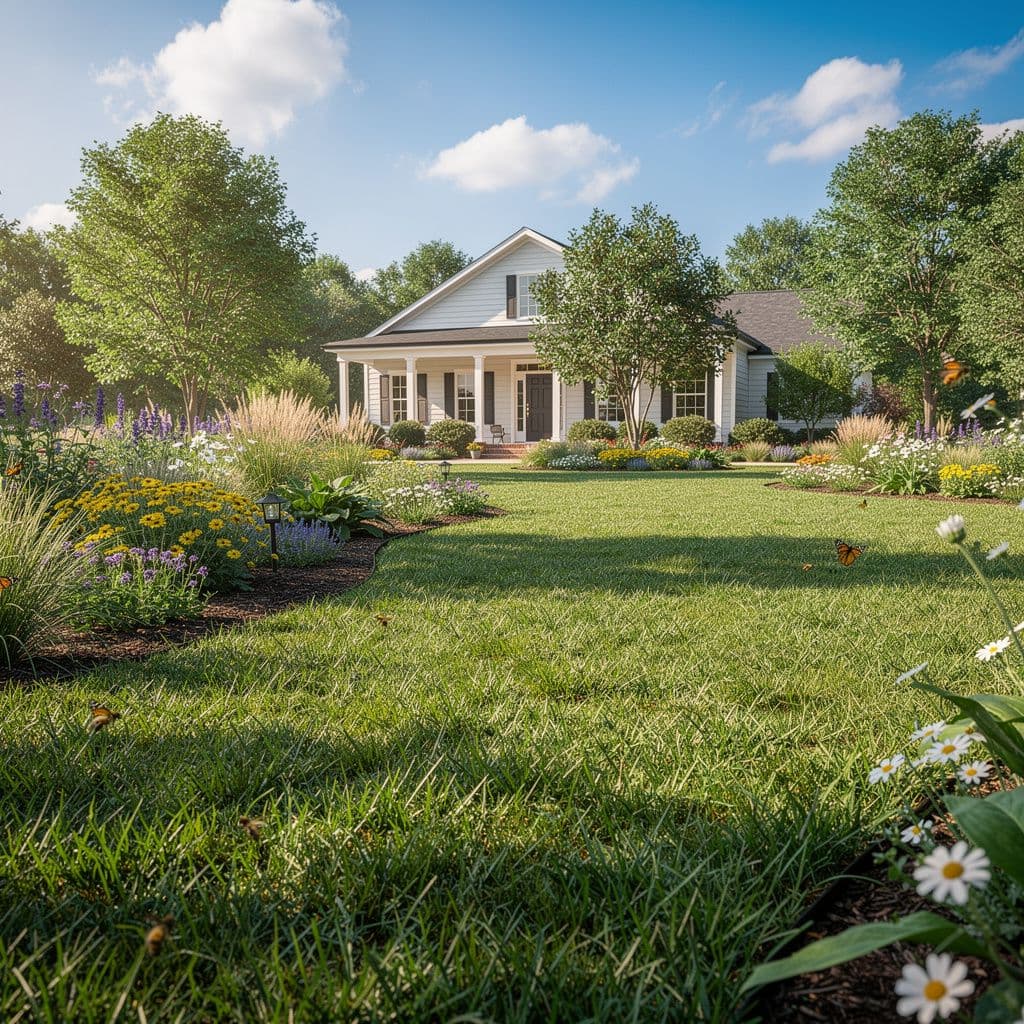
Organic Lawn Care in Henry County: A Complete Guide to Natural Weed Control, Fertilization & Chemical-Free Lawns
Published: July 29, 2026
Maybe you've got kids who play barefoot in the backyard. Maybe your dog rolls in the grass every afternoon. Maybe you're tired of the yellow warning flags that lawn chemical companies stick in your yard after every treatment. Or maybe you just want to do right by the soil, the pollinators, and the groundwater that feeds the streams winding through Henry County.
Whatever your reason, you're interested in organic lawn care — and you're not alone. Across Locust Grove, McDonough, Stockbridge, Hampton, and the surrounding areas, more homeowners are asking the same question: Can I get a great-looking lawn without synthetic fertilizers and chemical herbicides?
The short answer is yes. The longer answer is that organic lawn care works differently than conventional lawn care. It's not just swapping one product for another — it's a fundamentally different philosophy that builds soil health, supports natural ecosystems, and creates lawns that are genuinely self-sustaining over time.
This guide breaks down everything Henry County homeowners need to know about organic lawn care: how it works, what to use, when to apply it, and what results you can realistically expect from a natural approach in Georgia's challenging climate.
What Is Organic Lawn Care (And What It Isn't)
Organic lawn care means maintaining your turf using natural inputs and biological processes instead of synthetic chemicals. But there's a lot of confusion about what that actually means, so let's clear it up.
Organic Lawn Care IS:
- Soil-first approach — Instead of feeding the grass directly with synthetic nitrogen, you feed the soil microbiology so it can feed the grass naturally
- Biological pest and weed management — Using beneficial organisms, competitive planting, and cultural practices to keep weeds and pests in check
- Natural-input fertilization — Compost, compost tea, fish emulsion, kelp extracts, bone meal, and other naturally derived amendments
- Prevention over intervention — Creating conditions where problems don't start rather than reacting with chemicals after they do
- Long-term ecosystem building — Improving your soil's biology, structure, and nutrient cycling so your lawn becomes more self-maintaining each year
Organic Lawn Care ISN'T:
- Just "not spraying chemicals" — Skipping treatments without replacing them with organic alternatives leads to a neglected, declining lawn
- Instant results — Organic programs take 1-3 growing seasons to fully establish. Synthetic chemicals show results in days; organic methods build results over months and years
- More expensive forever — The first year or two of organic lawn care can cost more as you rebuild soil health. But by year three, a healthy organic lawn often costs LESS than a conventional one because it needs fewer inputs
- All or nothing — Many Henry County homeowners use a "mostly organic" approach, reserving synthetic products for spot treatments only when necessary
Why Organic Lawn Care Makes Sense in Henry County
Georgia's climate is tough on lawns — but it's also tough on the soil microbiology that organic lawn care depends on. Understanding how our local conditions affect organic approaches is key to making them work.
Our Red Clay Soil Actually Helps
Henry County's heavy clay soil is often seen as a lawn care obstacle, but for organic approaches, it's actually an advantage. Clay soil holds nutrients well — sometimes too well — meaning that once you build up a healthy biological ecosystem, your soil retains organic matter and microbial life better than sandy soil. The key is breaking up compaction so air, water, and organisms can move through it.
If you live near the rolling terrain around Heritage Park in McDonough or the established neighborhoods around the Locust Grove Train Viewing Platform, your clay soil likely has decent mineral content but needs biological help to unlock those minerals for your grass.
Our Long Growing Season Gives Organic Methods Time to Work
Organic lawn care relies on biological processes — and those processes need active, warm soil to function. Georgia's long growing season (April through October for warm-season grasses) means your soil biology is active for 7+ months per year. That's more time for compost to break down, for microbes to establish, and for organic fertilizers to release nutrients.
Homeowners in cooler climates get maybe 4-5 months of active soil biology. We get 7. That's a significant advantage for building an organic program.
Our Pollinator Population Needs Protection
Henry County has a surprisingly robust pollinator population. The agricultural areas around Hampton, the wildflower meadows near Noah's Ark Animal Sanctuary, and the gardens throughout Stockbridge and Jonesboro all depend on bees, butterflies, and other beneficial insects. Chemical lawn treatments — particularly broadleaf herbicides and insecticides — directly impact these populations.
Organic lawn care protects pollinators while still maintaining an attractive, functional yard. That matters not just for your landscape but for the entire local ecosystem that depends on these insects.
Building Healthy Soil: The Foundation of Organic Lawn Care
If conventional lawn care is about treating the grass, organic lawn care is about treating the soil. Everything starts underground.
Start with a Soil Test
Before applying any organic amendment, get a professional soil test. You can't build a healthy organic lawn if you don't know what your soil is missing. A soil test from the University of Georgia Extension (available through the Henry County office) will tell you:
- pH level — Georgia clay tends to be acidic (pH 5.0-6.0). Most lawn grasses prefer 6.0-6.5
- Nutrient levels — Phosphorus, potassium, calcium, magnesium, and micronutrients
- Organic matter percentage — Most Henry County lawns have less than 1% organic matter. Healthy lawns need 3-5%
- Cation exchange capacity (CEC) — A measure of how well your soil holds nutrients
Once you know your soil's baseline, you can choose the right organic amendments instead of guessing.
Add Compost — Lots of It
Compost is the single most important input in organic lawn care. It adds organic matter, introduces beneficial microorganisms, improves soil structure, increases water retention, and slowly releases nutrients. For Henry County's clay soil, compost is transformative — it separates compacted clay particles, improves drainage, and creates the environment where soil biology thrives.
How to apply compost to an existing lawn:
- Use finished, screened compost (no recognizable food scraps or manure chunks)
- Apply as a topdressing: spread ¼ to ½ inch evenly across the lawn
- Rake it in so it falls between the grass blades and contacts the soil
- Water thoroughly after application
- Best timing for Henry County: late spring (May) or early fall (September)
A single cubic yard of compost covers about 1,000 square feet at a ¼-inch depth. Most Henry County residential lots (¼ to ½ acre of turf) need 5-10 cubic yards per application.
Use Compost Tea for Quick Biological Boosts
Compost tea is made by steeping compost in aerated water, creating a liquid concentrate of beneficial bacteria, fungi, protozoa, and nematodes. It's like a probiotic smoothie for your soil.
For lawns in Locust Grove and throughout Henry County, compost tea applications every 4-6 weeks during the growing season can dramatically increase soil microbial activity. You can apply it with a standard hose-end sprayer, making it one of the easiest organic treatments to apply yourself.
Organic Fertilization: Natural Alternatives That Work in Georgia
Replacing synthetic fertilizer is usually the first concern homeowners have about going organic. Here are the natural alternatives that actually perform well in Henry County's climate.
Corn Gluten Meal for Natural Weed Prevention and Nitrogen
Corn gluten meal (CGM) is a byproduct of corn processing that does double duty in organic lawn care: it provides a slow-release source of nitrogen (about 10% by weight), and it inhibits seed germination, making it a natural pre-emergent weed control.
Application timing for Henry County:
- Spring application: Mid-February to early March (before soil temperatures reach 55°F and weed seeds germinate)
- Fall application: Late August to early September (before winter weed seeds germinate)
Apply 20 pounds per 1,000 square feet using a standard broadcast spreader. Water it in lightly, then let the surface dry for 2-3 days to activate the weed-suppressing compounds.
Important: CGM prevents ALL seeds from germinating, including grass seed. Don't apply it within 6 weeks of any seeding or aeration and overseeding projects.
Fish Emulsion and Hydrolysate for Quick Green-Up
When your lawn needs a fast nitrogen boost — say, after winter dormancy or during a summer stress period — fish-based fertilizers provide readily available nitrogen along with trace minerals.
Fish hydrolysate (made from whole fish enzymatically digested) is superior to fish emulsion (made from fish processing waste) because it retains more of the natural oils and proteins that feed soil microbiology. Either way, your lawn gets a quick green-up without the flush of growth (and subsequent crash) that synthetic nitrogen causes.
Dilute fish fertilizer at 2-3 ounces per gallon of water and apply with a hose-end sprayer every 4-6 weeks during the growing season. Yes, it smells fishy for about 24 hours. No, the smell doesn't last.
Kelp and Seaweed Extracts for Stress Tolerance
Liquid kelp extract is one of the most valuable tools in organic lawn care, especially in Henry County's brutal summer heat. Kelp contains natural plant growth hormones (auxins, cytokinins, and gibberellins) along with trace minerals that help grass:
- Tolerate heat and drought stress
- Develop deeper root systems
- Resist fungal diseases
- Recover from insect damage
Apply liquid kelp every 3-4 weeks from June through August. It's inexpensive, easy to apply, and makes a visible difference in how your lawn handles Georgia summer heat. For homeowners near the exposed, sunny lots in new Stockbridge and Hampton subdivisions, kelp can be the difference between a lawn that survives August and one that thrives.
Bone Meal and Rock Phosphate for Root Development
If your soil test shows low phosphorus (common in new construction areas throughout Henry County), bone meal and rock phosphate are excellent organic phosphorus sources. Phosphorus supports root development, which is especially important for establishing new lawns or helping stressed turf recover.
Natural Weed Control That Actually Works in Georgia
Weed control is where most organic lawn care programs fail — not because organic methods don't work, but because people expect them to work like chemical herbicides. Organic weed control requires a different mindset.
The Density Strategy: Grow a Lawn So Thick Weeds Can't Compete
The most effective organic weed control is a dense, healthy lawn. Weeds are opportunists — they fill gaps, exploit thin turf, and colonize stressed areas. When your grass is thick, vigorous, and deeply rooted, weeds simply can't compete for space, light, and nutrients.
Achieving density requires:
- Proper mowing height (Bermuda at 1-2 inches, tall fescue at 3-4 inches)
- Consistent nitrogen feeding through organic sources
- Annual core aeration to relieve compaction
- Regular overseeding of thin areas
- Addressing shade issues that weaken turf
This is the core principle behind professional lawn treatment services that use organic methods. Instead of killing weeds, you create conditions where weeds can't establish.
Corn Gluten Meal as Pre-Emergent
As mentioned above, CGM prevents seed germination. Applied correctly in late winter and early fall, it significantly reduces annual weeds like crabgrass, chickweed, and henbit — the three most common weeds in Henry County lawns.
Spot Treatment with Horticultural Vinegar
For weeds that do appear, horticultural vinegar (20% acetic acid, not the 5% stuff in your kitchen) provides a natural burn-down. It works best on young weeds in full sun and requires direct application to the weed's foliage.
Caution: Horticultural vinegar is non-selective — it will damage any plant it contacts. Use a targeted sprayer, not a broadcast application. Wear gloves and eye protection; 20% acetic acid can cause skin and eye irritation.
Manual Removal for Deep-Rooted Perennials
For persistent weeds like dandelions and nutsedge (the two most frustrating lawn weeds in Henry County), manual removal is the most reliable organic method. A weed puller tool with a long handle makes this manageable even for large lawns.
The key is removing the entire root. Dandelion taproots can extend 6-10 inches deep in Georgia clay, and any piece left behind will regrow. Water the area thoroughly the night before to soften the soil, then pull straight up with a twisting motion.
Organic Pest Management for Henry County Lawns
Chemical insecticides kill everything — pests and beneficial insects alike. Organic pest management targets specific problems while preserving the beneficial organisms that keep pest populations in check naturally.
Beneficial Nematodes for Grubs and Soil Pests
Beneficial nematodes are microscopic roundworms that prey on soil-dwelling pests like white grubs, billbugs, and mole crickets. They're completely safe for humans, pets, and plants — they only target insects in the soil.
Apply nematodes in early evening (UV light kills them) when soil temperatures are above 60°F. Water them in immediately and keep the soil moist for 48 hours. In Henry County's warm climate, a single application in late spring can provide season-long grub control.
Bt (Bacillus thuringiensis) for Caterpillar Pests
Bt is a naturally occurring soil bacterium that specifically targets caterpillars, including the fall armyworms that devastate Henry County lawns every August and September. It's harmless to bees, birds, pets, and people.
Apply Bt as a liquid spray when you first notice armyworm damage (brown patches that expand rapidly, often with visible caterpillars). Early detection is critical — Bt works best on young caterpillars.
Neem Oil for Surface Pests and Fungal Issues
Neem oil, extracted from the neem tree, works as both a mild insecticide and fungicide. It disrupts insect feeding and reproduction while also suppressing common lawn fungi like brown patch and dollar spot — two diseases that plague Henry County lawns during humid summer months.
Transitioning to Organic: A Realistic Timeline for Henry County Homeowners
If you're currently using a conventional lawn care program and want to switch to organic, here's what to expect.
Year 1: The Transition Year
Your lawn may look slightly worse before it looks better. Synthetic chemicals have suppressed soil biology; as you transition, your soil needs time to rebuild microbial populations. Expect:
- Some weed pressure as your lawn adjusts
- Slower green-up in spring
- Need for more frequent compost tea and organic fertilizer applications
Focus on: Soil testing, compost topdressing, stopping synthetic herbicides, starting organic fertilization
Year 2: Building Momentum
Soil biology is establishing. Your lawn should look noticeably healthier with improved color, density, and drought tolerance. Weed pressure decreases as turf density increases.
Focus on: CGM applications for weed prevention, beneficial nematode applications, continued compost topdressing, kelp applications for stress tolerance
Year 3 and Beyond: Self-Sustaining
Your soil ecosystem is functioning. Your lawn needs fewer inputs — less fertilizer, less water, less intervention. It handles heat stress, resists pests and diseases, and outcompetes weeds naturally.
Focus on: Maintenance-level compost tea applications, annual aeration, monitoring and spot-treating any issues
Professional Organic Lawn Care Services in Henry County
Going organic doesn't mean you have to do everything yourself. Many homeowners in Locust Grove, McDonough, and throughout Henry County prefer to have a professional service handle the applications, timing, and monitoring that a proper organic program requires.
Hedgecoth Property Solutions offers lawn care and property maintenance services that can incorporate organic and natural approaches based on your preferences. Whether you want a fully organic program or a hybrid approach that minimizes chemical use while maximizing results, we can customize a plan for your property.
Our team understands Henry County's soil, climate, and grass types. We know the right timing for organic applications, the best products for Georgia conditions, and how to build a program that works with nature rather than against it.
Frequently Asked Questions About Organic Lawn Care in Henry County
Does organic lawn care cost more than conventional lawn care in Henry County?
In the first 1-2 years, organic lawn care can cost 20-30% more than conventional programs because you're investing in soil-building inputs like compost and compost tea. However, by year 3, a healthy organic lawn typically costs the same or less than a conventional lawn because it needs fewer fertilizer applications, no herbicide treatments, and less watering. The long-term savings on water and chemical inputs often make organic more cost-effective over time.
Can organic lawn care control crabgrass and other weeds in Georgia?
Yes, but the approach is different. Instead of applying chemical pre-emergents, organic weed control uses corn gluten meal to prevent seed germination, proper mowing and fertilization to create dense turf that crowds out weeds, and targeted spot treatments for any weeds that do appear. It takes longer to achieve full weed suppression (1-2 growing seasons) but provides lasting results without chemical residues.
Is organic lawn care safe for pets and children in Henry County?
Absolutely. Organic lawn care products — compost, fish emulsion, kelp, corn gluten meal, beneficial nematodes — are non-toxic to humans and pets. There are no re-entry restrictions after application, no warning flags needed, and no risk of chemical exposure from playing on treated grass. This makes organic lawn care especially popular with families in the pet-friendly neighborhoods around Heritage Park in McDonough and the family subdivisions throughout Stockbridge and Hampton.
How long does it take to transition my Henry County lawn to organic care?
A full transition typically takes 2-3 growing seasons. The first year is the hardest because synthetic chemicals have suppressed your soil's natural biology. During this transition, expect some weed pressure and slower results. By year two, you'll see significant improvement in soil health, drought tolerance, and turf density. By year three, your lawn should be largely self-sustaining with minimal inputs needed.
What grass type works best for organic lawn care in Henry County?
Bermuda grass and Zoysia grass are the best candidates for organic lawn care in Henry County. Both are warm-season grasses that naturally thrive in Georgia's climate, meaning they need fewer interventions to stay healthy. They also spread aggressively, which helps them fill in bare spots and compete with weeds naturally. Tall fescue can work with organic methods but requires more attention to soil health and watering. Centipede grass is the most challenging for organic care due to its sensitivity to nitrogen and slow recovery from damage.
Does Hedgecoth Property Solutions offer organic lawn care in Henry County?
Yes! We provide professional lawn care and property maintenance services throughout Henry County, including Locust Grove, McDonough, Stockbridge, Hampton, Morrow, and Jonesboro. We can design a fully organic or hybrid program based on your preferences, your lawn's needs, and your budget. Call us at 770-490-9519 to discuss organic options for your property.
Start Your Organic Lawn Care Journey in Henry County
Organic lawn care isn't about being perfect — it's about making better choices for your soil, your family, and the environment we all share in Henry County. Whether you want to go fully chemical-free or just reduce your reliance on synthetic products, every step toward organic methods makes your lawn healthier and more sustainable.
At Hedgecoth Property Solutions, we help homeowners across Locust Grove, McDonough, Stockbridge, Hampton, and throughout Henry County create beautiful, healthy lawns using proven organic and natural methods. From soil testing to compost topdressing to organic weed and pest control, we have the knowledge, products, and experience to make your organic lawn care transition successful.
Call 770-490-9519 or contact us online today to learn about organic lawn care options for your Henry County property.
Serving homeowners throughout Henry County, including Locust Grove, McDonough, Stockbridge, Hampton, Morrow, and Jonesboro.
Hedgecoth Property Solutions — Professional Lawn Care & Property Maintenance in Henry County, Georgia.