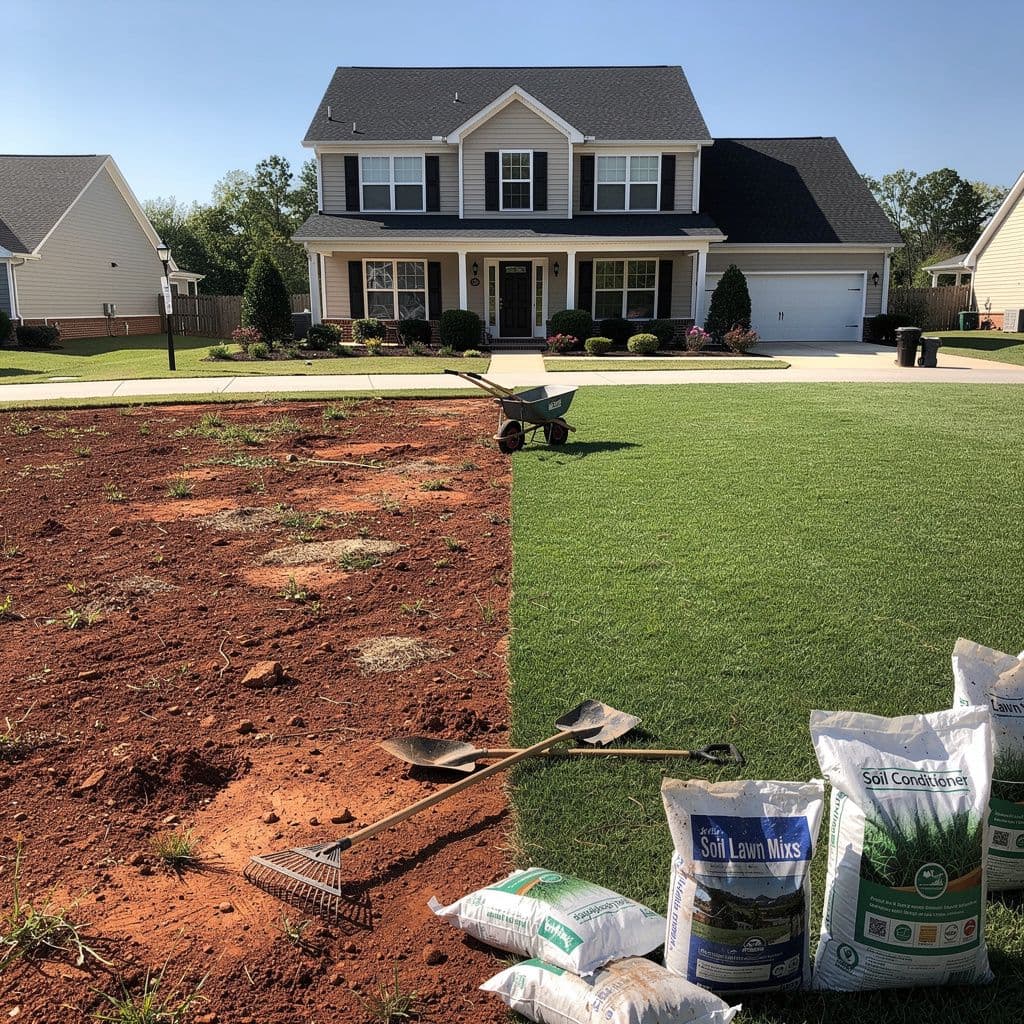
Why Your Lawn Won't Grow in Georgia: Common Causes and Proven Fixes for Henry County Lawns
Published: June 5, 2026
You planted the seed. You watered it. You waited. And waited. Weeks later, you're staring at the same bare patches and thin spots you started with — or maybe the grass came up patchy and then just stopped growing. If this sounds like your yard in Locust Grove, McDonough, or Stockbridge, you're dealing with one of the most frustrating problems a Henry County homeowner can face.
Here's the reality: grass that won't grow isn't a single problem. It's a symptom with at least eight different possible causes, and until you identify which one (or which combination) is at work in your yard, nothing you do will make a lasting difference. You'll keep throwing seed, fertilizer, and water at ground that simply cannot support healthy grass.
This guide breaks down every common reason lawns fail to grow in Georgia — from our notorious red clay soil to tree root competition, grading problems, and wrong grass selection — and gives you specific, actionable fixes for each one. Whether you're starting a new lawn from scratch or trying to revive dead spots that keep returning season after season, this is your roadmap.
Why Georgia Lawns Are Uniquely Difficult to Establish
Before diagnosing specific problems, it helps to understand why growing a lawn in Henry County is fundamentally harder than in most of the country.
Georgia's red clay soil — the same soil that stretches from Locust Grove through Hampton and across all of Henry County — is dense, nutrient-poor, and drains poorly. It compacts easily under foot traffic and lawnmowers, creating a hard crust that grass roots struggle to penetrate. When it dries out, clay becomes nearly impenetrable; when it's wet, it turns into a soggy mess that suffocates roots.
Our climate adds another layer of difficulty. Henry County summers bring sustained temperatures above 90°F with 60-80% humidity. Spring and fall are short transition windows. And rainfall is unpredictable — drought conditions can persist for weeks, followed by torrential downpours that wash away seed and erode bare soil before new grass can establish.
New construction makes it worse. If your home in McDonough, Stockbridge, or Jonesboro was built in the last ten years, your yard likely has compacted fill dirt instead of real topsoil. Builders grade the lot for drainage, strip the organic matter, and leave behind a surface that barely qualifies as growing medium.
Understanding these baseline challenges is the first step. Now let's identify which specific problem is killing your lawn.
Cause 1: Compacted Clay Soil
How to identify it: The surface feels hard and crusty, especially when dry. Water runs off instead of soaking in. You can barely push a screwdriver into the ground more than an inch or two. Grass grows in patches — usually near edges, fences, or areas that get less foot traffic.
Why it stops growth: Grass roots need loose, aerated soil to expand and absorb water and nutrients. Compacted clay has almost no pore space. Roots hit a wall and stop growing downward, leaving you with shallow-rooted grass that dries out quickly and can't access nutrients below the surface.
The fix:
Professional aeration is the single most effective solution. Core aeration pulls small plugs of soil from the ground, creating channels for air, water, and roots to move through. For severely compacted clay:
- Aerate in late spring (May-June) when warm-season grasses are actively growing
- Apply a thin layer of compost after aeration — this introduces organic matter into the holes and begins improving soil structure
- Repeat annually — clay compaction returns, especially in high-traffic areas
- Avoid mowing when wet — this is one of the fastest ways to re-compact soil
For new lawns or severely compacted areas, you may need deep-tine aeration or even soil amendment with tilled-in compost before grass will thrive.
Cause 2: Too Much Shade
How to identify it: Grass grows fine in the sunny parts of your yard but thins out or dies completely under trees, along the north side of your home, or near fences and outbuildings. The shady areas may have moss growing instead of grass.
Why it stops growth: Most warm-season grasses grown in Henry County — Bermuda, Zoysia, and Centipede — need at least 6-8 hours of direct sunlight. Even "shade-tolerant" varieties like certain Zoysia cultivars need 4 hours of direct sun or 6 hours of dappled light. Trees in mature Locust Grove and McDonough neighborhoods create dense canopies that block essential light.
The fix:
This is one of the hardest problems to solve because you can't manufacture sunlight. Options include:
- Trim and thin tree canopies to let more light through — professional tree trimming can open up the canopy without harming the tree
- Switch to shade-tolerant ground cover in the darkest areas — creeping red fescue, mondo grass, or ajuga can thrive where turf grass cannot
- Prune lower tree branches to raise the canopy and allow morning and afternoon light underneath
- Remove trees that are causing widespread lawn failure — a difficult but sometimes necessary decision
- Accept mulch or gravel beds under the densest shade areas instead of fighting a losing battle with grass
Cause 3: Wrong Grass Type for Your Conditions
How to identify it: You planted grass (or the builder laid sod) and it never really thrived. It looks okay in spring, struggles by mid-summer, and comes back thin every year. You might notice neighbors with lush lawns growing a different type of grass.
Why it stops growth: Not all grass is created equal for Henry County conditions. Bermuda grass loves full sun but dies in shade. Centipede needs acidic soil and minimal fertilizer — too much nitrogen actually kills it. St. Augustine handles shade better but doesn't tolerate cold snaps well. Zoysia is versatile but slow to establish from seed.
If you planted the wrong grass for your specific yard conditions — sun exposure, soil pH, moisture levels — it will never grow well no matter how much you water and fertilize.
The fix:
- Identify what grass you currently have — a professional lawn care service can identify your grass type and assess whether it matches your conditions
- Consider gradual replacement — overseed or plug a more suitable grass type into failing areas rather than tearing out the entire lawn
- Match grass to zones in your yard — use Bermuda in full-sun areas and Zoysia or St. Augustine in partially shaded sections
For Henry County, the general recommendations are:
- Full sun (8+ hours): Bermuda or Zoysia
- Partial shade (4-6 hours): Zoysia (specifically Zeon or Zorro cultivars)
- Heavy shade (less than 4 hours): Consider ground cover alternatives
Cause 4: Poor Soil pH and Nutrient Imbalance
How to identify it: Grass looks pale yellow-green instead of dark green. Growth is slow even during peak growing season. Fertilizer doesn't seem to help. Weeds like dandelions, clover, and plantain thrive while grass struggles.
Why it stops growth: Soil pH determines whether grass can absorb nutrients at all. In Henry County, soil pH often runs too acidic (below 6.0) or, in some newer developments with concrete and mortar residue in the soil, too alkaline (above 7.0). When pH is out of range, fertilizer sits in the soil unused — the grass literally can't eat even when food is available.
The fix:
- Get a soil test — this is step one for any lawn that won't grow. The University of Georgia Cooperative Extension offers affordable soil testing, or a professional lawn care provider can test and interpret results
- Apply lime to raise pH if soil is too acidic (common in Henry County)
- Apply sulfur to lower pH if soil is too alkaline
- Fertilize based on test results — not on a generic schedule. Over-fertilizing is as harmful as under-fertilizing
A soil test costs under $15 and can save you hundreds in wasted fertilizer and seed. It's the single most underutilized tool in lawn care.
Cause 5: Tree Root Competition
How to identify it: The area under and near large trees has thin, weak grass or bare soil. Surface roots are visible. The soil dries out extremely fast after rain. This is especially common under mature oaks, maples, and pines common in established Locust Grove and Jonesboro neighborhoods.
Why it stops growth: Large trees compete aggressively with grass for water, nutrients, and oxygen. A mature oak can consume 100+ gallons of water per day during summer, leaving nothing for the grass underneath. Tree roots also create a physical barrier that prevents grass roots from establishing.
The fix:
Tree root competition is nearly impossible to solve while keeping both the tree and the grass healthy. Realistic options include:
- Create mulch rings around tree trunks extending to the drip line — this is better for the tree and eliminates the struggle
- Plant shade-tolerant perennials instead of grass under trees
- Increase watering and fertilization specifically in tree-root zones (expensive and ongoing)
- Install landscape beds with shade-loving plants under the canopy
Trying to grow grass under mature trees is a battle you'll fight every single year. Working with the conditions — not against them — saves money and frustration.
Cause 6: Improper Watering
How to identify it: Grass germinates and then dies. New seed sprouts but doesn't mature. Established grass wilts between waterings. Soil surface cracks when dry.
Why it stops growth: New grass seed needs consistently moist (not soaked) soil for 2-3 weeks to germinate and establish roots. Most homeowners either water too shallowly, water at the wrong time of day, or water inconsistently. In Henry County's summer heat, the soil surface can dry out completely in a matter of hours — killing newly sprouted seeds before they develop root systems.
Established lawns have the opposite problem: many homeowners water every day for 15 minutes, which trains roots to stay shallow and makes the lawn dependent on daily watering instead of developing deep, drought-resistant roots.
The fix:
For new seed and bare spots:
- Water lightly 2-3 times per day for the first 2 weeks to keep the surface moist
- Reduce to once daily for weeks 3-4
- Transition to deep watering (1 inch) 2-3 times per week after establishment
For established lawns:
- Water deeply (1 inch per session) 2-3 times per week
- Water between 4-8 AM — evening watering promotes fungal disease
- Use a rain gauge or tuna can to measure how much water you're actually applying
- Consider a professional irrigation system for consistent, efficient coverage
Cause 7: Erosion and Grading Problems
How to identify it: Bare spots appear on slopes or along the edges of your property. Soil washes away during heavy rain. Seed and mulch disappear after storms. Water flows across the surface instead of soaking in, leaving channels and ruts.
Why it stops growth: Grass can't establish if the soil beneath it is washing away. Even mild slopes in Henry County can lose topsoil during summer thunderstorms. If the grade directs water across your lawn instead of away from it, grass seed and young plants get flushed out before they can root.
The fix:
- Re-grade problem areas to slow water flow and direct it away from bare spots
- Install erosion control measures — straw matting, erosion blanket, or retaining walls on steeper slopes
- Aerate and top-dress with compost to improve water absorption
- Use sod instead of seed on slopes — sod establishes faster and resists washout better
- Address drainage with French drains, swales, or dry creek beds to manage water flow
For serious erosion or grading issues, professional property maintenance and landscaping services can regrade and install permanent drainage solutions.
Cause 8: Pest and Disease Damage
How to identify it: Grass develops irregular brown or yellow patches that spread over days or weeks. You may see insects in the soil or on grass blades. Grass pulls up easily with no root resistance. White, web-like growth may be visible on grass blades in early morning.
Why it stops growth: Henry County's warm, humid climate creates ideal conditions for lawn pests and fungal diseases. Common culprits include:
- Grubs — beetle larvae that eat grass roots from below, killing large patches
- Armyworms — caterpillars that devour grass blades overnight
- Brown patch — a fungal disease that thrives in hot, humid conditions
- Take-all root rot — a soil-borne fungus that destroys root systems
- Dollar spot — small, circular patches of dead grass
These problems can destroy new growth before it establishes and weaken existing grass until it dies.
The fix:
- Identify the specific pest or disease — treatment varies dramatically depending on the culprit
- Apply targeted treatments — grub control, fungicide, or insecticide specific to the problem
- Improve air circulation by trimming nearby shrubs and trees
- Avoid overwatering and evening watering that promotes fungal growth
- Schedule professional lawn treatment for accurate diagnosis and treatment
How to Diagnose Your Specific Problem
If you're not sure which of these eight causes applies to your yard, start here:
- Do a screwdriver test — push a screwdriver into the soil. If it won't go in easily, you have compaction (Cause 1)
- Check sun exposure — spend a day noting which areas get less than 6 hours of direct sun (Cause 2)
- Get a soil test — this eliminates or confirms pH and nutrient issues (Cause 4)
- Inspect for pests — pull back a section of dead grass and look for grubs, insects, or fungal growth (Cause 8)
- Check drainage — after the next rain, note where water collects or flows across the surface (Cause 7)
Most failing Henry County lawns have two or three of these problems happening simultaneously. Compacted clay soil plus too much shade is the most common combination. Addressing only one while ignoring the others is why so many homeowners see temporary improvement followed by the same bare spots returning.
Starting Over: When to Replace vs. Repair
Sometimes the most efficient path is to stop patching and start fresh. Here's when each approach makes sense:
Repair existing lawn if:
- Grass covers 60% or more of the area
- Problems are isolated to specific spots
- Soil conditions are fundamentally sound
- You're dealing with a single cause (compaction, shade, etc.)
Replace the lawn if:
- More than 50% of the area is bare or thin
- You have the wrong grass type for your conditions
- Soil is severely compacted fill dirt from construction
- Multiple causes are working together and the lawn has been failing for years
Sod installation provides instant results and is the fastest way to establish a lawn that will actually grow. Professional grading, soil amendment, and sod installation costs more upfront but eliminates years of frustration and wasted money on seed that won't take.
Professional Help for Lawns That Won't Grow
If you've tried seeding, watering, and fertilizing and your lawn still won't grow, you're not alone. Bare spots, thin patches, and failed lawns are among the most common calls we get from homeowners across Henry County.
At Hedgecoth Property Solutions, we start with a proper diagnosis — testing soil, assessing sun exposure, checking compaction, and identifying the specific cause (or causes) preventing growth. Then we build a treatment plan that addresses the root problem, not just the symptoms.
We serve homeowners in Locust Grove, McDonough, Stockbridge, Jonesboro, Morrow, Hampton, and throughout Henry County with comprehensive lawn care, landscaping, and property maintenance services.
Ready to stop guessing and start growing? Call us at 770-490-9519 or visit our contact page to schedule a lawn assessment. We'll tell you exactly what's going on and what it will take to fix it — no guesswork, no wasted money.
Frequently Asked Questions
Why won't grass grow in bare spots in my Henry County yard?
Bare spots usually have one or more underlying problems: compacted soil that roots can't penetrate, insufficient sunlight, poor soil nutrients or wrong pH, tree root competition, or erosion that washes away seed before it establishes. A soil test and sun exposure assessment can identify the specific cause.
Can I just keep putting down seed until it grows?
Throwing seed at a problem without fixing the underlying cause wastes money. Grass seed needs loose soil, proper pH, adequate sunlight, consistent moisture, and temperatures above 65°F to germinate and establish. If any of these conditions are missing, seed will fail repeatedly. Fix the cause first, then seed.
How long does it take for new grass to fully establish in Georgia?
Warm-season grasses like Bermuda and Zoysia typically need 60-90 days to establish from seed and 2-4 weeks from sod. Full root development takes a full growing season. During establishment, consistent moisture and staying off the lawn are critical.
Does red clay soil really prevent grass from growing?
Clay soil doesn't prevent grass from growing — but compacted, unamended clay makes it much harder. Clay holds nutrients well but drains poorly and compacts easily. Core aeration, compost topdressing, and proper soil amendment can turn clay into acceptable growing medium over time.
Should I use sod instead of seed for bare spots in my lawn?
Sod is the better choice for bare spots larger than a few square feet, areas on slopes where seed washes away, shady areas where seed establishment is slow, and any situation where you need fast results. Seed works well for small bare spots and overseeding thin areas with good soil conditions.
How much does it cost to fix a lawn that won't grow in Henry County?
Costs vary widely depending on the cause. Soil testing runs $10-20. Aeration costs $75-200 for an average yard. Sod installation runs $0.50-1.50 per square foot installed. Full lawn renovation with grading and soil amendment can range from $1,500-5,000+ depending on yard size. A professional assessment at 770-490-9519 can give you an accurate quote.