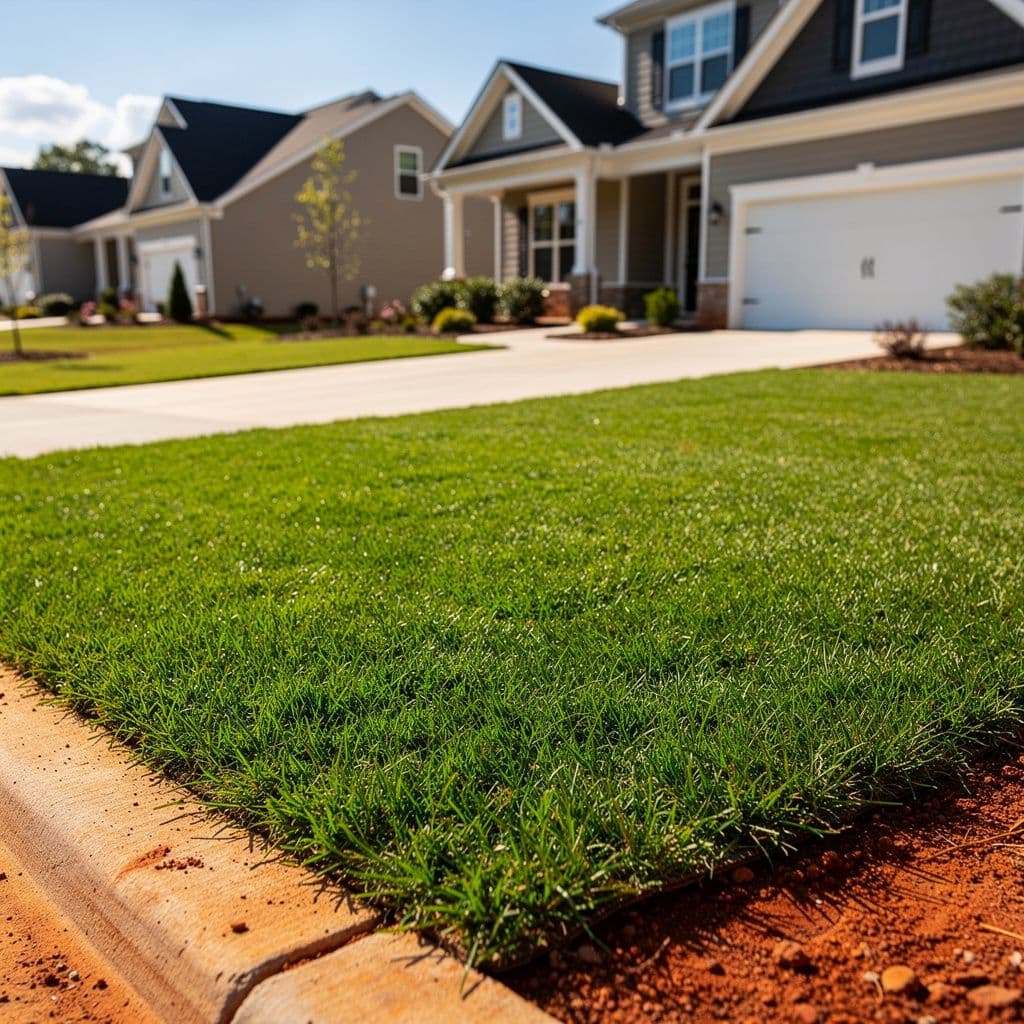
New Construction Lawn Care in Henry County, GA: How to Build a Healthy Lawn From Scratch
Published: July 20, 2026
You just closed on your new construction home in Locust Grove — maybe in one of the growing subdivisions near Tanger Outlets or off GA-42. The house is beautiful. The kitchen is perfect. The yard... is a disaster. Maybe the builder laid down some thin sod that's already struggling. Maybe you're staring at a sea of red clay and construction debris. Either way, you're not alone.
Henry County is one of the fastest-growing areas in metro Atlanta. New subdivisions are popping up everywhere — from the rolling hills near Hampton to the wide-open tracts between McDonough and Locust Grove. Builders are great at constructing houses. They're not great at building lawns. Most new construction yards in our area face the same set of problems: compacted clay soil, buried construction debris, zero topsoil, and sod laid directly over subsoil that struggles to root.
Whether your new yard is bare dirt, freshly sodded, or somewhere in between, this guide walks you through exactly what it takes to build a healthy, lasting lawn in Henry County's challenging clay soil. We'll cover the timeline, the common mistakes, and when to call in professional help.
Why New Construction Lawns Struggle in Henry County
Understanding why your new yard looks bad is the first step toward fixing it.
The Clay Soil Problem
Henry County sits on a foundation of heavy red clay — technically classified as Ultisols. This soil type is nutrient-poor, highly compacted, and drains poorly. When builders grade your lot, they typically strip away any existing topsoil and push around the clay subsoil to create a level building pad. What's left is a dense, rock-hard surface that grass struggles to penetrate.
What this means for your new lawn:
- Roots can't breathe. Compacted clay has almost no air space. Grass roots need oxygen just as much as water, and in dense clay, they suffocate.
- Water pools instead of soaking in. Clay drains slowly. After rain or irrigation, water tends to sit on the surface or in low spots, which can drown grass and promote fungal disease.
- Nutrients wash away. Clay holds some nutrients well, but fertilizer applied to compacted clay often runs off before it can be absorbed.
- pH is usually wrong. Henry County clay tends to run acidic, with pH levels between 5.0 and 6.0. Most warm-season grasses prefer a pH between 6.0 and 7.0.
The Construction Debris Problem
Here's something builders rarely tell you: before your house existed, heavy equipment drove over your lot hundreds of times. Trucks, excavators, forklifts, and delivery vehicles compacted the soil to near-concrete density. Workers dropped nails, screws, concrete chunks, brick fragments, wood scraps, and plastic wrap — then buried it all during final grading.
If your grass has dead patches that never fill in, or if certain areas refuse to grow no matter how much you water and fertilize, there's a decent chance you have buried debris or severely compacted soil just below the surface. This is especially common in the areas directly adjacent to the foundation, where workers walked and staged materials.
The Thin Sod Problem
Many Henry County builders include "landscaping" in the purchase price, which usually means laying down the cheapest sod available — often unsodded fescue or thin Bermuda — directly over compacted clay with no soil preparation. This sod looks decent for the first few weeks because it's living off its own stored nutrients. By month two or three, it starts declining as the roots fail to penetrate the clay beneath it.
If your builder's sod is thinning out, turning brown in patches, or pulling up easily when you tug on it, the roots haven't established. This is a soil problem, not a water problem, and no amount of irrigation will fix it permanently without addressing the underlying compaction and nutrient issues.
Step-by-Step: Building a New Lawn From Scratch in Henry County
Whether you're starting with bare dirt or struggling builder's sod, here's the proven process for establishing a healthy lawn in our area.
Step 1: Soil Testing (Before You Do Anything Else)
Don't guess. Test. A professional soil test through the University of Georgia Cooperative Extension (available through the Henry County Extension office) costs about $10 and tells you:
- Current pH level — and exactly how much lime you need to correct it
- Nutrient deficiencies — phosphorus, potassium, calcium, magnesium
- Organic matter content — typically less than 1% in new construction yards
- Cation exchange capacity (CEC) — a measure of how well your soil holds nutrients
You can't build a healthy lawn without knowing what your soil is missing. Applying fertilizer without a soil test is like taking medicine without a diagnosis — you might get lucky, but you're more likely to waste money or make things worse.
Step 2: Soil Preparation and Amendment
This is where most homeowners — and many contractors — cut corners. If you're starting from scratch or removing failed builder's sod, proper soil prep is the single most important investment you'll make in your lawn.
The proper amendment process:
- Clear debris. Remove rocks, construction waste, and any remaining builder's materials. If you find large buried debris, dig it out and fill the hole with clean topsoil.
- Break up compaction. Use a core aerator or tiller to break up the top 4-6 inches of clay. This is physically demanding work and often best left to professionals with heavy-duty equipment.
- Add organic matter. Mix in 2-3 cubic yards of compost per 1,000 square feet. Compost improves drainage, adds nutrients, and creates the air pockets that roots need. This is the single most effective amendment for Henry County clay.
- Add topsoil. Spread 2-4 inches of quality loamy topsoil over the amended clay. This gives grass roots a friendly medium to establish in before tackling the denser clay below.
- Apply lime and fertilizer per soil test. Work these into the top few inches of soil.
- Grade and level. Create a gentle slope (1-2%) away from the foundation. Fill in low spots where water would pool.
Step 3: Choose the Right Grass for Your Yard
Not all grasses perform well in Henry County. Your choice depends on sun exposure, soil conditions, and how you use your yard.
Best options for new construction in our area:
- Bermuda grass — The top choice for full-sun yards. Tolerant of heat, drought, and heavy foot traffic. Spreads aggressively via rhizomes and stolons, which helps it fill in bare spots. Best mowed at 1-2 inches. Downside: goes dormant (brown) from November through April.
- Zoysia grass — Excellent for yards with mixed sun and shade. Dense, lush, and more cold-tolerant than Bermuda. Slower to establish but worth the wait. Best mowed at 1.5-2.5 inches.
- Tall Fescue — The only viable cool-season option for Henry County. Stays green year-round (mostly) but struggles in our summer heat. Best for heavily shaded yards. Requires more water and reseeding each fall.
- Centipede grass — Low-maintenance and drought-tolerant. Good for large yards and acreage where you want a "natural" look. Not suited for high-traffic areas.
For most new construction yards in Locust Grove, McDonough, and Stockbridge, Bermuda or Zoysia sod is the fastest path to an established lawn. Seeding is cheaper but takes an entire growing season to achieve what sod provides on day one.
Step 4: Installation — Sod vs. Seed vs. Hydroseed
Sod provides instant results and is the most reliable option for new construction. Installed properly over prepared soil, sod establishes roots within 2-3 weeks during the growing season. It costs more upfront ($0.40-$0.80 per square foot installed), but the success rate is dramatically higher than seeding.
Seeding is budget-friendly ($0.05-$0.15 per square foot) but requires perfect timing, consistent moisture, and patience. In Henry County, the window for seeding warm-season grasses is narrow — late spring to early summer (May-June). Seed planted outside this window will likely fail.
Hydroseeding sits between sod and seed in cost ($0.10-$0.25 per square foot). A slurry of seed, fertilizer, mulch, and water is sprayed over prepared soil. It germinates faster than dry seed and provides some erosion control on sloped yards. However, results are uneven and it still requires weeks of careful watering.
Step 5: Establishment Care (The Critical First 90 Days)
The first three months after installation make or break a new lawn. Here's what matters most:
Watering: New sod needs daily watering for the first 2 weeks — enough to keep the soil consistently moist but not saturated. Gradually reduce to every other day in weeks 3-4, then transition to a normal schedule (1-1.5 inches per week) after establishment. New seed needs light, frequent watering (2-3 times daily) until germination, then gradually deeper, less frequent watering.
Mowing: Wait until the grass is at least 3 inches tall and the roots have anchored (test by gently tugging — if it resists, it's ready). Never remove more than one-third of the blade height in a single cut. For Bermuda, set your mower at 1.5 inches for the first cut, then lower gradually. For Zoysia, start at 2.5 inches.
Fertilization: Apply a starter fertilizer high in phosphorus at installation to promote root development. After 4-6 weeks, switch to a balanced fertilizer with slow-release nitrogen. Avoid weed-and-feed products during establishment — the herbicide can damage young grass.
Traffic control: Keep foot traffic, pets, and children off the new lawn for at least 3 weeks. New roots are fragile and compacted soil is the enemy of establishment.
Common New Construction Lawn Mistakes in Henry County
After helping homeowners across McDonough, Stockbridge, Hampton, and Locust Grove establish new lawns, we've seen the same mistakes repeatedly:
1. Skipping Soil Prep Entirely
The most expensive mistake is also the most common. Homeowners lay sod directly over compacted clay — sometimes on top of the failed builder's sod — and hope for the best. Within a season, the lawn is thinning, patchy, and declining. Proper soil prep costs more upfront but saves the cost of redoing the entire lawn in two years.
2. Overwatering
More new lawns die from overwatering than underwatering. Saturated clay soil suffocates roots and promotes fungal disease. If water is running off your lawn or pooling in low spots, you're watering too much or too fast.
3. Mowing Too Soon
Mowing before roots have anchored tears the sod out of the ground and disrupts establishment. Be patient. Test root development before the first mow.
4. Ignoring Drainage Issues
If your yard has standing water after rain, fix the drainage before investing in grass. Consider professional yard drainage solutions like French drains, grading corrections, or dry creek beds. Grass won't solve a drainage problem — it'll just die in it.
5. Planting the Wrong Grass for Your Conditions
Planting fescue in a full-sun south-facing yard in McDonough means watching it cook every summer. Planting Bermuda under heavy tree canopy in an older Locust Grove neighborhood means watching it thin out and never fill in. Match the grass to the conditions.
When to Call Professionals
Some aspects of new lawn establishment are perfect DIY projects. Others require equipment, expertise, and labor that most homeowners don't have. Consider professional help for:
- Soil testing and analysis — Understanding exactly what your soil needs
- Heavy tilling and amendment — Breaking up compacted clay requires industrial equipment
- Grading and drainage work — Fixing slope and water flow issues before they destroy your lawn
- Sod or seed installation — Proper installation ensures roots establish quickly
- Ongoing maintenance — A professional lawn care program that includes fertilization, weed control, and proper mowing gives your new lawn the best chance to thrive
At Hedgecoth Property Solutions, we've helped dozens of Henry County homeowners transform bare dirt and failed builder's yards into lush, healthy lawns. We understand the local soil conditions, the best grass varieties for our climate, and the exact timeline for establishment in Georgia's challenging growing conditions.
FAQ
How long does it take to establish a new lawn in Henry County, GA?
With proper soil preparation and sod installation during the growing season (May-September), Bermuda and Zoysia sod typically establish roots within 2-3 weeks. Full establishment — where the lawn can handle normal traffic and stress — takes 60-90 days. Seeded lawns take an entire growing season (3-4 months) to fully establish.
Can I lay new sod over my builder's existing sod?
No. If your builder's sod is failing, it's almost always because of poor soil prep beneath it. Laying new sod on top just adds another layer of grass that will eventually fail for the same reason. Remove the old sod, amend the soil, and start fresh for long-term success.
What's the best grass type for new construction in Henry County?
For full-sun yards, Bermuda grass is the top performer in our climate. For yards with partial shade, Zoysia is the best choice. Tall fescue works for heavily shaded yards but requires more maintenance and water. Avoid St. Augustine — it's not cold-hardy enough for Henry County winters.
How much does it cost to establish a new lawn in Henry County?
Professional soil prep and sod installation typically runs $0.75-$1.50 per square foot, depending on the amount of amendment needed and the grass variety chosen. For a typical 5,000-square-foot yard, expect $3,750-$7,500. Seeding costs significantly less ($0.15-$0.30 per square foot) but takes much longer and has a lower success rate.
When is the best time to install a new lawn in Georgia?
For warm-season grasses (Bermuda, Zoysia, Centipede), the best installation window is late spring through mid-summer (May-July). This gives the grass a full growing season to establish before winter dormancy. Fall installation (September-October) is possible but risky — the grass may not have enough time to root before cold weather arrives. For tall fescue, early fall (September-October) is the optimal planting time.
Should I test my soil before planting new grass?
Absolutely. A $10 soil test through the UGA Extension saves hundreds or thousands of dollars in wasted fertilizer, wrong amendments, and failed grass. The test tells you your soil's pH, nutrient levels, and exactly what amendments you need. Skipping this step is the most common — and most expensive — mistake in new lawn establishment.
Ready to Transform Your New Construction Yard?
Building a healthy lawn from scratch in Henry County's clay soil isn't easy — but you don't have to do it alone. Whether you're staring at bare red clay after closing on your new build, or your builder's sod is already failing, Hedgecoth Property Solutions can help.
We offer complete landscaping and lawn care services specifically tailored for new construction yards in Locust Grove, McDonough, Stockbridge, Jonesboro, Hampton, and throughout Henry County. From soil testing and amendment to professional sod installation and ongoing maintenance, we handle every step of the process.
Call us today for a free estimate: 770-490-9519
Or visit our contact page to request a consultation.
Your new home deserves a lawn that matches it. Let's build it right the first time.
Hedgecoth Property Solutions — Professional Lawn Care, Landscaping & Property Maintenance
Locust Grove • McDonough • Stockbridge • Jonesboro • Morrow • Hampton • Henry County
Phone: 770-490-9519