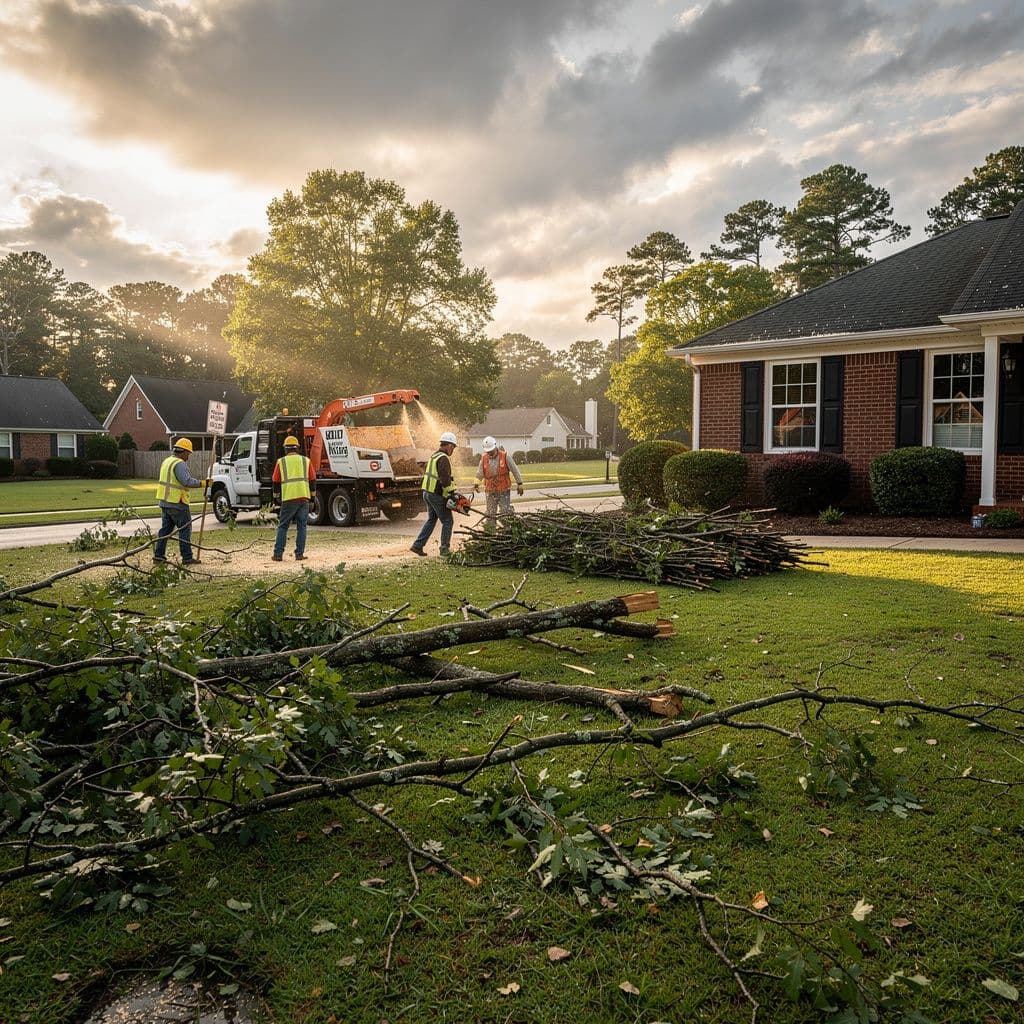
Storm Damage Tree Cleanup in Henry County, GA: Emergency Property Protection Guide
Published: June 3, 2026
If you've lived in Henry County for more than a year, you already know the drill. The sky turns green, the wind picks up, and the next thing you know there are tree limbs in your yard, debris across your driveway, and a sinking feeling that your property just took a hit you didn't budget for.
Georgia's storm season runs from March through September, with the heaviest activity hitting right about now — June and July. Thunderstorms with 60+ mph wind gusts, isolated tornadoes, and the remnants of Gulf Coast hurricanes all sweep through Locust Grove, McDonough, Stockbridge, and the surrounding areas with alarming regularity. And when they do, trees are usually the first casualties.
At Hedgecoth Property Solutions, we've spent years helping Henry County homeowners deal with the aftermath of severe weather. This guide covers what to do before, during, and after a storm damages your trees and property — from immediate safety steps to working with insurance to getting your yard back to normal.
Why Henry County Properties Are Vulnerable to Storm Damage
Henry County's landscape is one of its biggest selling points — mature oaks, tall pines, and established shade trees line neighborhoods from the historic district of Locust Grove to the newer developments around McDonough. But that same tree canopy becomes a liability during severe weather.
Georgia's Red Clay and Shallow Root Systems
The heavy red clay soil common across Henry County doesn't drain well and tends to compaction. When soil is compacted and saturated from heavy rain — exactly what happens during a thunderstorm — tree roots lose their grip. Shallow-rooted trees like loblolly pines, which are everywhere in our area, become top-heavy and unstable when the ground softens.
This is why you see so many trees uprooted rather than snapped after a storm in Locust Grove and McDonough. The roots literally pull out of the saturated clay like a fork out of wet dough.
Mature Tree Population
Many of the trees in Henry County's older neighborhoods are 40 to 60+ years old. While mature trees are beautiful and valuable, they're also more likely to have hidden decay, dead limbs, and structural weaknesses that aren't visible from the ground. A storm that a healthy 20-year-old oak would shrug off can cause catastrophic failure in an older tree with internal rot.
Dense Development Near Trees
As Henry County has grown, new homes and subdivisions have been built around existing tree stands. Properties in areas like Flippen Road, Highway 42, and near Noah's Ark Animal Sanctuary often have large trees within 20 feet of the house. That proximity means any tree failure has a high chance of causing property damage.
Before the Storm: Proactive Tree and Property Maintenance
The best storm damage cleanup is the one that never has to happen. Proactive property maintenance and tree care significantly reduce your risk of storm damage. Here's what to focus on before severe weather arrives.
Schedule a Professional Tree Inspection
If you have large trees within falling distance of your home, vehicles, or power lines, have them inspected by a professional tree service at least once a year — ideally in late winter or early spring before storm season ramps up.
A professional inspection checks for:
- Dead or weakened branches that could break in moderate winds
- Cracks or splits in the trunk or major unions where branches meet
- Root zone issues like soil heaving, fungal growth, or construction damage
- Leaning that has developed or worsened over time
- Dense canopy that catches wind like a sail instead of letting it pass through
At Hedgecoth Property Solutions, our professional tree service includes comprehensive tree health assessments for homeowners throughout Henry County. Catching problems early is dramatically cheaper than emergency removal after a tree falls on your roof.
Trim and Prune Strategically
Proper tree trimming isn't just about appearance — it's a critical storm preparation step. Strategic pruning reduces wind resistance by thinning the canopy, removes weak or dead branches before storms can break them, and maintains proper branch structure to prevent splitting.
Key trimming priorities before storm season:
- Remove dead, diseased, or crossing branches from all large trees
- Thin dense canopies on trees near structures to allow wind to pass through
- Raise the crown (remove lower branches) on trees overhanging roofs or driveways
- Clear branches within 10 feet of your roof, siding, and power lines
This is exactly the kind of work our tree trimming services handle for homeowners in McDonough, Stockbridge, and Locust Grove every spring.
Maintain Your Entire Property
Storm resilience isn't just about trees. Your overall property condition plays a role in how well your yard weathers severe weather and how quickly you recover afterward.
Pre-storm property maintenance checklist:
- Clean gutters and downspouts so heavy rain can drain properly
- Secure loose items in your yard — patio furniture, trash cans, toys, decorations
- Check drainage patterns around your foundation and redirect if water pools near the house
- Maintain lawn care to prevent erosion during heavy rainfall
- Inspect fences, sheds, and outbuildings for loose panels or structural weakness
- Trim hedges and shrubs away from structures and walkways
Our landscaping services include comprehensive property assessments that identify these vulnerabilities before they become storm-related problems.
After the Storm: Immediate Safety Steps
When the storm passes and you step outside to assess the damage, safety has to be your first priority. Storm-damaged trees and property present hazards that aren't always obvious.
Step 1: Stay Away from Downed Power Lines
This is the most critical safety rule. If a tree has taken down power lines on or near your property, treat every wire as if it's live. Stay at least 30 feet away and call 911 or your utility company immediately. The ground around a downed line can be energized and deadly — you don't need to touch the wire to be electrocuted.
Step 2: Assess From a Safe Distance
Before walking through your yard, look at the damage from your driveway or a safe vantage point. Check for:
- Hanging branches caught in other trees ("widow makers") that could fall at any moment
- Trees leaning against structures or other trees that could shift and fall
- Split trunks that are barely holding together
- Exposed root plates on uprooted trees that could settle or roll
- Flooded areas hiding debris or unstable ground
Step 3: Document Everything
Before any cleanup begins, photograph and video all damage thoroughly. This documentation is essential for insurance claims. Capture:
- Wide shots showing the full extent of damage
- Close-ups of specific damage to structures, vehicles, and landscape
- The position of fallen trees and limbs relative to structures
- Any visible pre-existing tree defects (rot, cracks, etc.) that may have contributed
Step 4: Call a Professional for Large Tree Damage
If a tree has fallen on your house, vehicle, fence, or other structures — or if large limbs are hanging and dangerous — do not attempt to remove them yourself. Storm-damaged trees are under tension and can shift unpredictably when cut. Professional tree crews have the training, equipment, and insurance to handle these situations safely.
Hedgecoth Property Solutions provides emergency storm response for homeowners throughout Locust Grove, McDonough, Jonesboro, Stockbridge, and all of Henry County. We can be on-site quickly to assess the situation and begin safe removal.
Professional Storm Damage Tree Cleanup: What to Expect
When you call a professional tree service for storm damage cleanup, here's what the process typically looks like.
Emergency Hazard Reduction
The first priority is making the property safe. This may involve:
- Removing hanging branches that could fall on people or structures
- Cutting and removing trees that have fallen on homes, vehicles, or fences
- Stabilizing partially fallen trees to prevent further damage
- Clearing access routes so other contractors (roofers, electricians) can reach damaged areas
Complete Tree Removal
Trees that have uprooted or suffered catastrophic trunk failure need to be completely removed. This involves cutting the tree into manageable sections, lowering them carefully (especially when near structures), and hauling away the debris. The root ball of an uprooted tree can weigh thousands of pounds and requires equipment to move safely.
Stump and Root Cleanup
After the tree is removed, you're left with a stump and possibly a large hole where the root plate was pulled from the ground. Professional cleanup includes grinding the stump below grade and filling and grading the root zone to restore your yard's surface.
Debris Hauling and Site Cleanup
Storm cleanup generates an enormous amount of debris — branches, leaves, wood chips, and damaged landscaping. A thorough cleanup includes hauling all debris off-site and restoring your yard to a clean, usable condition. This is where having a full-service property maintenance company makes a real difference — we handle the entire process from tree removal to final yard cleanup.
Working with Insurance After Storm Damage
Most homeowner's insurance policies cover storm damage to trees and property, but navigating the claims process can be confusing. Here's what Henry County homeowners should know.
What's Typically Covered
- Tree removal when it damages a covered structure — If a tree falls on your house, garage, fence, or other insured structure, removal is usually covered
- Structural damage repair — Roof damage, broken windows, siding damage, etc. caused by falling trees or limbs
- Debris removal — Most policies include some coverage for removing storm debris from your property
- Damage from neighbor's tree — If your neighbor's tree falls on your property, your insurance typically handles it (then may subrogate against their policy)
What May Not Be Covered
- Trees that fall without hitting a structure — If a tree falls in your yard and doesn't hit anything insured, removal may not be covered
- Pre-existing tree problems — If an adjuster determines the tree was already dead or diseased before the storm, coverage may be denied
- Gradual damage — Damage that develops over time (like roots growing into a foundation) is generally excluded
Tips for a Smooth Claims Process
- File promptly — Most policies require notification within a reasonable timeframe
- Document thoroughly — Photos and video before any cleanup begins
- Get professional estimates — Have a licensed tree service provide a written estimate for the work
- Keep receipts — For any emergency expenses (temporary repairs, tarps, hotel if displaced)
- Don't sign over insurance benefits — Some storm-chasing companies ask you to sign over your insurance check directly. Work with established local companies instead.
As a locally owned and operated company serving Henry County, we work with homeowners and their insurance companies regularly. We provide detailed estimates and documentation that insurance adjusters need to process claims efficiently.
Preventing Future Storm Damage
Once your property is cleaned up and repaired, it's time to think about preventing the next incident. If you've had storm damage once, you're at elevated risk for repeat damage without corrective action.
Replace Vulnerable Trees with Storm-Resistant Species
Not all trees are equally vulnerable to storm damage. If you need to remove damaged trees, consider replacing them with species that hold up better in Georgia's climate:
- Live Oak — Dense wood, deep roots, exceptional wind resistance
- Southern Magnolia — Strong branching structure, handles wind well
- Red Maple — Fast-growing but with better wind resistance than pines
- Bald Cypress — Excellent root system, tolerant of wet conditions
- Dogwood — Small but sturdy native tree with great ornamental value
Avoid planting loblolly pines, silver maples, and Bradford pears near structures — all are notorious for storm damage in Georgia.
Install Proper Drainage
Many tree failures during storms are caused by saturated soil. Improving drainage around large trees reduces the risk of uprooting during heavy rain. This might include French drains, grading improvements, or redirecting downspouts away from the root zone.
Our team handles drainage solutions as part of comprehensive property maintenance for homeowners throughout the area.
Establish a Regular Tree Care Program
The single most effective way to prevent storm damage is consistent, professional tree care. Annual inspections, regular pruning, and prompt removal of dead or diseased trees keep your property safe year after year.
Hedgecoth Property Solutions offers year-round property maintenance plans that include tree care, lawn maintenance, and landscape management for homeowners in Locust Grove, McDonough, Stockbridge, Jonesboro, and across Henry County.
Why Henry County Trusts Hedgecoth Property Solutions for Storm Cleanup
When a storm hits your property, you need a team that responds quickly, works safely, and delivers results. Here's why homeowners across Henry County call us first.
Local Knowledge and Fast Response
We're based right here in Locust Grove. We know the neighborhoods, the tree species, the soil conditions, and the common storm patterns. When you call, we can often be on-site the same day to assess damage and begin the cleanup process.
Full-Service Capability
Storm cleanup isn't just about cutting up fallen trees. It's about restoring your entire property. Because we offer complete property maintenance, landscaping, and lawn care services, we handle the entire recovery — from emergency tree removal to yard restoration to replanting.
Licensed and Insured
Storm cleanup is dangerous work. Our crews are trained in safe tree removal techniques, carry full liability insurance, and follow OSHA safety standards. If something goes wrong during the job — which is always a risk with storm-damaged trees — our insurance covers it, not yours.
Established Reputation
We've been serving Henry County homeowners for years. We're not a storm-chasing outfit that shows up after severe weather and disappears when the work dries up. We're your neighbors, and we're here for the long term.
Frequently Asked Questions
How quickly can you respond to storm damage in Henry County?
We prioritize emergency calls and can typically be on-site within 24 hours for storm damage in Locust Grove, McDonough, Stockbridge, Jonesboro, and surrounding areas. For situations where trees have fallen on homes or created immediate safety hazards, we make every effort to respond the same day. Call us at 770-490-9519 for emergency storm response.
Does homeowner's insurance cover storm damage tree removal?
In most cases, yes — if the tree damaged a covered structure like your home, garage, or fence. If a tree falls in your yard without hitting anything, coverage varies by policy. We recommend checking with your insurance provider and documenting all damage with photos before cleanup begins. We provide detailed estimates that work with insurance claims.
How much does storm damage tree cleanup cost in Henry County?
Costs vary significantly depending on the size and number of trees, proximity to structures, accessibility, and the extent of damage. Small limb removal might cost a few hundred dollars, while a large tree removal from a house can run several thousand. We provide free on-site estimates for all storm damage work in the Henry County area.
Can I remove a fallen tree myself?
We strongly advise against DIY removal of any tree larger than small branches. Storm-damaged trees are under unpredictable tension, and chainsaw injuries are among the most common emergency room visits after storms. Professional tree crews have the training, equipment, and insurance to handle the job safely. It's simply not worth the risk.
What should I do if a tree is leaning against my house after a storm?
Evacuate the area immediately and call a professional tree service. Do not attempt to cut or push the tree — it can shift suddenly and cause further structural damage or injury. Keep everyone away from the area until a professional has assessed the situation and determined it's safe.
How can I tell if a tree on my property is at risk of falling in the next storm?
Look for dead branches in the canopy, cracks or splits in the trunk, mushrooms or fungal growth at the base (indicating root decay), soil heaving around the root zone, and recent leaning. If you notice any of these signs, schedule a professional tree inspection. Our team serves all of Henry County and can assess tree health and stability on your property.
Get Help With Storm Damage Cleanup in Henry County
If your property has been damaged by a storm — or if you want to take proactive steps to protect your trees and landscape before the next one hits — Hedgecoth Property Solutions is here to help.
We provide emergency storm response, tree removal, debris cleanup, and full property restoration for homeowners throughout Locust Grove, McDonough, Stockbridge, Jonesboro, Morrow, Hampton, and all of Henry County, Georgia.
Call us today at 770-490-9519 or visit our contact page to schedule a free estimate. Don't wait until the next storm — protect your property now.