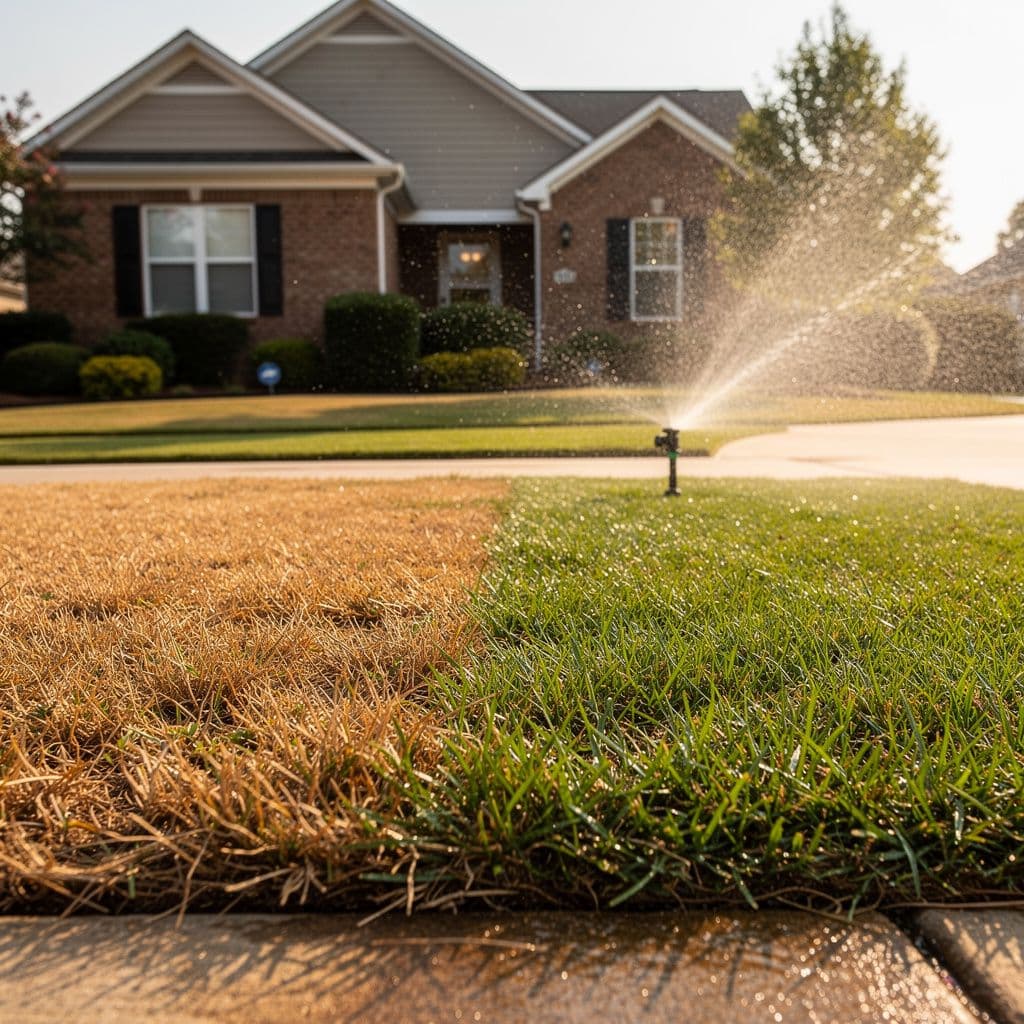
Late Summer Lawn Recovery: How to Revive Heat-Stressed Grass in Henry County, GA
Published: July 23, 2026
By late July, your lawn has been through the wringer. Weeks of 90°+ temperatures, stretches of no rain followed by torrential downpours, fungus pressure, insect attacks, and the constant stress of Georgia's brutal summer sun have taken their toll. If your yard looks thin, patchy, brown, or just plain tired — you're not alone.
For homeowners in Locust Grove, McDonough, Stockbridge, Hampton, and throughout Henry County, late July through August is the critical window for lawn recovery. What you do right now determines whether your grass limps into fall weak and vulnerable — or heads into the cooler months strong, thick, and ready to thrive.
This guide covers everything you need to know about reviving heat-stressed grass in Henry County. Whether your lawn needs minor repair or a full recovery program, these are the steps that actually work for Georgia's clay soil, warm-season grasses, and unpredictable summer weather.
Why Late Summer Is the Best Time for Lawn Recovery
Most homeowners think spring is the time to fix lawn problems. That's half right — spring is good for prevention. But late summer is when recovery happens for warm-season grasses like Bermuda, Zoysia, and Centipede that dominate Henry County lawns.
Here's why:
Warm-season grasses are still actively growing. Bermuda, Zoysia, and Centipede thrive in heat. As long as soil temperatures stay above 70°F — which they do through September in central Georgia — these grasses can spread, fill in bare spots, and rebuild root systems. Once the grass goes dormant in late October or November, recovery stops until spring.
There's still time before dormancy. You have roughly 8-10 weeks of active growing season left. That's enough time for fertilizer to work, for grass to spread into thin areas, and for root systems to strengthen before winter.
Weed pressure shifts. Summer annual weeds are beginning their slow decline. If you act now, your grass can claim territory that weeds have been holding before winter weeds germinate.
Soil conditions improve. Late summer often brings more consistent rainfall to Henry County than the dry stretches of June. Soil that was bone-dry in early summer starts absorbing moisture again, making it easier for grass roots to access water and nutrients.
If you wait until spring to address summer damage, you've lost six months of recovery time. Acting now means your lawn enters winter strong — and emerges in spring already ahead.
Diagnosing Your Lawn's Summer Damage
Before you can fix the damage, you need to know what caused it. Heat stress looks different from insect damage, which looks different from fungal disease. Treating the wrong problem wastes money and can make things worse.
Heat and Drought Stress
The most common summer damage in Henry County. Look for:
- Uniform browning or yellowing across sunny areas of the yard
- Grass blades that feel crisp or brittle
- Footprints that remain visible in the grass (blades don't spring back)
- Soil that's hard and cracked, especially in areas with heavy clay
Heat-stressed grass isn't dead — it's dormant. With the right recovery steps, it will green up and resume growth within 2-3 weeks.
Insect Damage
Fall armyworms, white grubs, and chinch bugs are active through September in Henry County. Signs include:
- Irregular brown patches that expand quickly (sometimes overnight)
- Grass that pulls up easily from the soil (grub damage — roots are eaten)
- Visible caterpillars on the grass surface in early morning
- Birds feeding heavily on your lawn
- Spongy or loose areas when you walk across the yard
Insect damage requires immediate treatment. The longer you wait, the more grass you lose. If you suspect insects, a professional lawn treatment service can identify the specific pest and apply the correct insecticide.
Fungal Disease
Henry County's summer humidity creates ideal conditions for fungal diseases like brown patch, dollar spot, and Pythium blight. Look for:
- Circular patches of brown or tan grass (brown patch)
- Small, silver-dollar-sized spots (dollar spot)
- Dark, water-soaked patches that appear overnight after heavy rain
- Grass blades with lesions or dark borders
Fungal damage requires fungicide treatment and cultural changes (improved drainage, better air circulation, adjusted watering schedule). Left untreated, it can spread rapidly through a lawn.
Weed Competition
By late summer, weeds like crabgrass, dallisgrass, and nutsedge have been competing with your grass for months. Even after you kill the weeds, the areas they occupied are often bare or thin. These gaps need to be addressed before winter weeds fill them instead.
The 6-Step Late Summer Lawn Recovery Plan
Step 1: Water Correctly
Recovery starts with water — but not just any water. Deep, infrequent watering is the key to rebuilding root systems.
The right approach:
- Apply 1 to 1.5 inches of water per week, divided into 2-3 sessions
- Water between 4:00 AM and 8:00 AM to minimize evaporation and fungal risk
- Use tuna cans or rain gauges to measure actual output — sprinkler coverage is never as even as you think
- Water deeply enough to moisten soil to a depth of 6 inches (check by pushing a screwdriver into the ground — it should slide in easily)
The wrong approach:
- Watering every day for 15 minutes (encourages shallow roots)
- Watering in the evening (promotes fungal disease)
- Watering at midday (most water evaporates before reaching roots)
If you have an irrigation system, late summer is the time to audit and adjust it. Brown patches often correspond to broken or misaligned sprinkler heads that you haven't noticed because you're not outside at 6 AM watching them run.
Step 2: Mow at the Right Height
Your mowing height directly affects recovery. Mowing too short stresses already-damaged grass and slows recovery dramatically. Mowing too tall can create a canopy that traps moisture and promotes disease.
Recommended mowing heights for late summer recovery in Henry County:
- Bermuda grass: 1.5 to 2 inches (raise from early summer height)
- Zoysia grass: 2 to 2.5 inches
- Centipede grass: 1.5 to 2 inches (never scalp centipede — it recovers slowly)
- Tall Fescue: 3.5 to 4 inches (fescue struggles in summer; height provides shade for soil)
Keep your mower blade sharp. Dull blades tear grass, creating ragged edges that lose moisture and become infection points for disease. A sharp blade makes a clean cut that heals quickly — critical for stressed grass trying to recover.
If your lawn is severely stressed, skip a mowing or two. Let the grass grow slightly taller than normal to shade the soil and encourage root growth. When you resume mowing, never remove more than one-third of the grass blade in a single cut.
Professional lawn mowing services adjust height and frequency based on conditions — one of the advantages of having a trained crew monitoring your lawn weekly.
Step 3: Apply Recovery Fertilizer
Heat-stressed grass needs nutrients to rebuild, but the wrong fertilizer can cause more damage. Quick-release nitrogen pushes excessive top growth at the expense of roots — the last thing a stressed lawn needs.
What to apply in late July through August:
- Slow-release nitrogen fertilizer — Provides steady nutrition without the growth surge. Look for products with at least 50% slow-release nitrogen.
- Potassium (K) — Strengthens cell walls, improves stress tolerance, and enhances disease resistance. A fertilizer with a 1:1 or 1:2 nitrogen-to-potassium ratio is ideal for summer recovery.
- Iron (Fe) — Greens up the grass without pushing growth. Iron sulfate or chelated iron can restore color to yellow, stressed turf.
What to avoid:
- Quick-release or high-nitrogen fertilizers (can burn stressed grass)
- Weed-and-feed products (the herbicide can damage already-stressed turf)
- Fertilizing during a heat wave (wait for a break in temperatures)
For Bermuda and Zoysia lawns, a late July or early August application of slow-release fertilizer with potassium gives the grass 6-8 weeks of nutrition to fill in thin spots before fall. For Centipede lawns, a very light application of low-nitrogen fertilizer is sufficient — Centipede naturally needs less food than other warm-season grasses.
Professional lawn fertilization services use commercial-grade products calibrated for Henry County's clay soil and Georgia's climate. Store-bought products often release nutrients too quickly, leading to rapid growth followed by crashes.
Step 4: Aerate Compacted Soil
If your lawn has hard, compacted soil — common in newer subdivisions around McDonough and Locust Grove where construction equipment compressed the soil — core aeration is one of the most effective recovery steps you can take.
What aeration does:
- Relieves soil compaction, allowing roots to expand
- Improves water infiltration (especially important for clay soil)
- Increases oxygen flow to the root zone
- Reduces thatch buildup
- Creates channels for fertilizer and seed to reach the soil
Core aeration removes small plugs of soil from the ground, leaving holes that allow air, water, and nutrients to penetrate. The plugs decompose on the surface over 1-2 weeks, returning nutrients to the soil.
Timing matters: Late August to early September is ideal for aeration in Henry County. The grass is still actively growing and can quickly fill in the holes, but temperatures are beginning to moderate, reducing stress.
If your lawn has heavy clay soil — and most Henry County lawns do — consider annual aeration. It's one of the highest-ROI lawn care investments you can make for long-term lawn health.
Step 5: Treat Remaining Weeds
Summer weeds compete with your recovering grass for water, nutrients, and sunlight. By late July, summer weeds like crabgrass and dallisgrass are mature and harder to control — but controlling them now opens space for your grass to fill in.
Post-emergent weed control in late summer:
- Spot-treat individual weeds rather than blanket-applying herbicide
- Use selective herbicides that target the specific weed type without harming your grass
- Avoid herbicide application during heat waves (temperatures above 90°F can cause herbicide damage to stressed turf)
- Wait at least 3-4 weeks between herbicide treatment and any seeding or aeration
Nutsedge (nut grass) is particularly common in Henry County's moist clay soil. It grows faster than turf grass and stands out like a sore thumb. Selective herbicides like halosulfuron or sulfentrazone effectively control nutsedge without harming Bermuda, Zoysia, or Centipede.
For lawns with heavy weed pressure, a professional weed control service can identify weed species and apply the correct products safely — an important consideration, since the wrong herbicide can kill the grass you're trying to save.
Step 6: Plan Your Fall Pre-Emergent
The final recovery step is defensive: applying fall pre-emergent herbicide to prevent winter weeds from germinating. This is perhaps the single most important application of the year for Henry County lawns.
Why it matters: Winter annual weeds — annual bluegrass (Poa annua), chickweed, henbit, rescuegrass, and annual rye — germinate when soil temperatures drop below 70°F, typically in late September to mid-October in Henry County. Once they germinate, they're much harder to control.
A fall pre-emergent creates a chemical barrier in the soil that prevents weed seeds from sprouting. Applied correctly, it eliminates 90-95% of winter weeds before they ever emerge.
Critical timing: Apply in late August to early September — before soil temperatures drop to the germination threshold. Apply too early and the barrier degrades before weed season. Apply too late and weeds have already germinated.
Important note: Pre-emergent prevents ALL seeds from germinating, including grass seed. If you're planning to overseed your lawn (common for Fescue), do not apply pre-emergent to those areas. For warm-season lawns that don't need overseeding, pre-emergent is essential.
Lawn Recovery for Different Grass Types
Bermuda Grass Recovery
Bermuda is the most resilient warm-season grass grown in Henry County. It spreads aggressively through both above-ground stolons and below-ground rhizomes, which means it can recover from significant damage if given the right conditions.
Bermuda recovery plan:
- Lower mowing height gradually to 1.5 inches to encourage dense lateral growth
- Apply slow-release nitrogen fertilizer (0.5-1 lb N per 1,000 sq ft)
- Core aerate in late August
- Water deeply twice per week
- Bermuda will fill in bare spots within 3-4 weeks during peak growing season
Zoysia Grass Recovery
Zoysia is slower-growing than Bermuda but creates an incredibly dense, luxurious lawn once established. Recovery takes patience — Zoysia fills in at about half the speed of Bermuda.
Zoysia recovery plan:
- Maintain mowing height at 2-2.5 inches
- Apply slow-release fertilizer with potassium for stress recovery
- Core aerate to relieve compaction
- Water deeply 2-3 times per week
- Expect 4-6 weeks for visible filling of thin areas
Centipede Grass Recovery
Centipede is the most low-maintenance warm-season grass, but it's also the slowest to recover from damage. It doesn't tolerate heavy fertilization or aggressive maintenance.
Centipede recovery plan:
- Maintain mowing height at 1.5-2 inches (never scalp)
- Apply ONLY a light dose of low-nitrogen fertilizer (0.25 lb N per 1,000 sq ft maximum)
- Core aerate lightly
- Water deeply once or twice per week
- Be patient — Centipede recovers slowly but steadily
Tall Fescue Recovery
Fescue is a cool-season grass that struggles through Henry County summers. By late July, Fescue lawns often look rough. The recovery strategy is different — you're not trying to push summer growth but rather keep the grass alive until fall.
Fescue recovery plan:
- Raise mowing height to 3.5-4 inches
- Do NOT fertilize in August — wait until September
- Water consistently to prevent dormancy
- Plan for overseeding in late September to fill in thinned areas
- Core aerate in September before overseeding
When to Call a Professional
Some lawn problems are DIY-friendly. Others require professional expertise, specialized equipment, and commercial-grade products. Here's when to call for help:
Call immediately if:
- You see signs of insect damage (rapid browning, loose turf, visible caterpillars)
- Circular patches are spreading across your lawn (fungal disease)
- Large areas of grass are completely dead (not just dormant)
- You've tried recovery steps for 3-4 weeks with no improvement
Consider professional service for:
- Ongoing fertilization and weed control (calibrated applications yield better results than store-bought products)
- Core aeration (requires specialized equipment)
- Soil testing and pH adjustment
- Comprehensive lawn care service plans that handle every aspect of recovery
A professional lawn care service brings three things that DIY can't match: expertise (knowing exactly what your lawn needs and when), equipment (commercial-grade aerators, sprayers, and spreaders), and consistency (showing up on schedule, every time, regardless of weather or scheduling conflicts).
For homeowners in Locust Grove, McDonough, Stockbridge, Hampton, and Jonesboro, Hedgecoth Property Solutions provides comprehensive lawn recovery services tailored to Henry County's unique soil, climate, and grass types. Our team knows the difference between heat stress and fungus damage, knows when to fertilize and when to wait, and knows exactly what your grass needs in late July to be ready for fall.
Common Late Summer Lawn Recovery Mistakes
Mistake 1: Overseeding Warm-Season Grass in Summer
Many homeowners see thin, damaged Bermuda or Zoysia lawns and immediately buy seed. But warm-season grass seed (Bermuda, Zoysia, Centipede) has low germination rates and seedlings can't survive summer heat. The right approach is to help your existing grass spread and fill in naturally. Save seeding for Fescue lawns in September.
Mistake 2: Watering on a Daily Schedule
Daily shallow watering keeps grass alive but creates weak, shallow roots. This makes the lawn MORE vulnerable to heat stress, not less. Switch to deep, infrequent watering to build drought resistance.
Mistake 3: Applying Weed-and-Feed to Stressed Lawns
Weed-and-feed products combine fertilizer and herbicide. The herbicide component can damage grass that's already stressed from heat, drought, or disease. Always separate fertilization and weed control applications on stressed turf.
Mistake 4: Mowing the Same Height Year-Round
Grass needs different mowing heights in different seasons. Late summer requires slightly taller grass to shade the soil and protect roots. Many homeowners never adjust their mower — a mistake that prolongs recovery.
Mistake 5: Ignoring Soil Health
You can fertilize, water, and mow perfectly, but if your soil is compacted, has poor pH, or lacks organic matter, your lawn will struggle. A soil test ($15-25 through the county extension office) reveals exactly what your soil needs. Most Henry County lawns need lime (to raise pH in acidic clay soil) and core aeration (to relieve compaction).
FAQ: Late Summer Lawn Recovery in Henry County
Can brown grass recover in late summer, or is it dead?
Most brown grass in late summer is dormant, not dead. Warm-season grasses (Bermuda, Zoysia, Centipede) go dormant as a survival mechanism during extreme stress. With proper watering, fertilization, and care, dormant grass typically greens up within 2-3 weeks. To test if grass is alive, pull a grass blade gently — if it resists and stays anchored, the roots are still active. If it pulls out easily with no resistance, that section may be dead and need repair.
How long does lawn recovery take in Henry County?
With proper care, most warm-season lawns show visible improvement within 2-3 weeks and significant recovery within 4-6 weeks. Bermuda recovers fastest due to aggressive growth. Zoysia takes 4-6 weeks. Centipede is slowest, sometimes taking 6-8 weeks for visible improvement. The key is starting early enough — late July to mid-August gives your grass enough growing season to recover before dormancy.
Should I fertilize my lawn during a heat wave?
Avoid fertilizing during extended heat waves (multiple days above 95°F). Wait for a break in temperatures, then apply slow-release fertilizer with potassium. Fertilizing during extreme heat can burn stressed grass and trigger excessive growth that the root system can't support. Water immediately after applying fertilizer to help it reach the root zone.
Is it too late to save my lawn this summer?
In most cases, no. As long as your grass has some green growth and we're still 8+ weeks from first frost (typically late October in Henry County), there's time for recovery. The warm-season grasses common in Locust Grove, McDonough, and Stockbridge are remarkably resilient. Even lawns with significant damage can make substantial recovery with the right treatment plan.
How much does professional lawn recovery service cost?
Professional lawn recovery typically ranges from $75-150 per treatment for an average-sized Henry County yard, depending on lawn size, condition, and services needed. A full recovery program might include fertilization, weed control, aeration, and ongoing monitoring. Many homeowners find that professional service costs less than repeatedly buying products that don't work. See our monthly plans for ongoing care options, or check our lawn care pricing guide for detailed cost information.
What's the difference between lawn recovery and lawn renovation?
Lawn recovery focuses on nursing your existing grass back to health through fertilization, watering, weed control, and aeration. It works when your grass is stressed but still alive. Lawn renovation is more intensive — it may involve killing the existing lawn, grading the soil, and installing new sod or seed. Recovery is always the first choice when possible because it's faster, cheaper, and less disruptive.
Start Your Lawn Recovery Today
Every day you wait in late July and August is a day your lawn isn't recovering. The window for warm-season grass recovery closes when soil temperatures drop in October — and that window gets smaller every week.
Whether your lawn needs a simple fertilizer and watering adjustment or a comprehensive recovery program, the team at Hedgecoth Property Solutions can help. We've been reviving heat-stressed lawns in Henry County for years, and we know exactly what Georgia clay soil, Bermuda grass, and 95-degree summers do to a yard.
Call 770-490-9519 or contact us online to schedule a lawn evaluation. We'll assess your grass type, soil condition, and damage level, then build a recovery plan that gets your lawn back on track before fall.
Your neighbors will wonder what you did differently. You'll know it was just the right care at the right time.