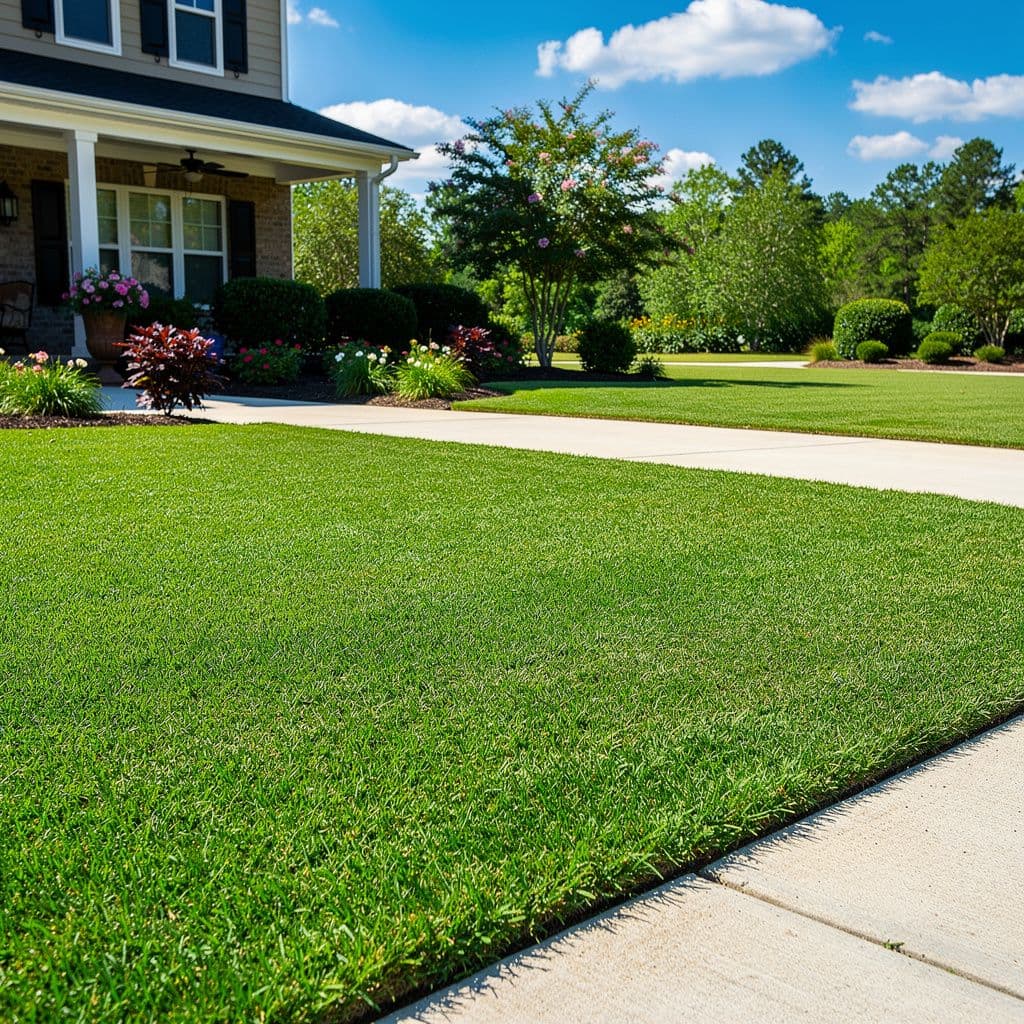
Lawn Soil Testing & pH Treatment in Henry County, GA: Why Your Fertilizer Isn't Working
Published: July 22, 2026
You're doing everything right — or at least it feels that way. You fertilize on schedule. You water consistently. You mow at the right height. You even applied pre-emergent herbicide at the right time this spring. But your lawn still looks thin, patchy, and pale. The grass in the front yard is barely growing, weeds keep coming back despite treatments, and your neighbor's lawn two doors down looks like a golf course.
Here's what most homeowners in Henry County don't realize: the problem isn't your fertilizer, your watering schedule, or your mowing habits. The problem is almost certainly your soil. More specifically, your soil pH.
Georgia's red clay is notorious for nutrient lockout — a condition where fertilizer nutrients are physically present in the soil but chemically unavailable to grass roots because the pH is too far out of balance. You can dump bags of premium fertilizer on your lawn every month, and if your pH is off, your grass can't absorb any of it. You're literally throwing money into the dirt.
Professional lawn treatment services start with one critical step that most DIY homeowners skip entirely: a soil test. This $15-20 lab analysis tells you exactly what your soil needs — and just as importantly, what it doesn't need. Without it, you're guessing. And in Henry County's heavy clay soil, guessing almost always means wasting money.
Whether you live near the Locust Grove Train Viewing Platform, in a subdivision off Highway 155 in McDonough, or in a Stockbridge neighborhood near Panola Mountain State Park, this guide explains everything you need to know about lawn soil testing, pH treatment, and why this single test could transform your entire lawn care strategy.
What Is Soil pH (And Why It Controls Your Lawn's Health)
Understanding the pH Scale
Soil pH is a measure of how acidic or alkaline your soil is, measured on a scale from 0 to 14:
- Below 7.0 = acidic
- Exactly 7.0 = neutral
- Above 7.0 = alkaline
Most turf grasses grown in Georgia — including Bermuda, Zoysia, Tall Fescue, and Centipede — thrive in a slightly acidic range between 5.5 and 6.5. When your soil pH falls outside this window, a chemical chain reaction occurs that makes essential nutrients unavailable to your grass.
Here's why that matters: nitrogen, phosphorus, potassium, iron, and other critical nutrients exist in your soil right now. But pH controls whether those nutrients are in a form that grass roots can actually absorb. When pH is too low (too acidic), aluminum and manganese become toxic to roots while phosphorus gets locked away. When pH is too high (too alkaline), iron and manganese become unavailable, leading to chlorosis — that yellow, sickly look even in well-fertilized lawns.
Henry County's Default Soil Conditions
If you live in Locust Grove, McDonough, Stockbridge, Hampton, or Jonesboro, your soil is almost certainly acidic. Here's why:
Red Clay Dominance:
- Henry County sits on a foundation of ultisols — highly weathered red clay soils
- These soils naturally acidify over time as rainfall leaches away basic nutrients like calcium and magnesium
- Most untreated clay soils in our area test between pH 4.5 and 5.5 — too acidic for optimal grass growth
- Rainfall in Georgia averages 48-52 inches per year, accelerating the acidification process
New Construction Impact:
- Many neighborhoods in Henry County were developed in the last 10-20 years
- Construction strips topsoil and exposes subsoil, which tends to be more acidic
- Developers often lay sod directly over compacted, acidic subsoil with no amendment
- These lawns may look good for the first year or two (living off the sod farm's fertilizer) and then steadily decline
Pine Tree Legacy:
- Much of Henry County was pine forest before development
- Pine needles are naturally acidic, and years of decomposition lower soil pH further
- Properties near wooded areas or former timberland tend to be especially acidic
Fertilizer Acidification:
- Nitrogen-based fertilizers (ammonium sulfate, ammonium nitrate) lower soil pH over time
- If you've been fertilizing for years without testing your soil, you may be making the problem worse
- This is one of the most common issues we see in established neighborhoods throughout Stockbridge and McDonough
The Nutrient Lockout Problem: Why Your Fertilizer Is Being Wasted
To understand why soil testing matters so much, you need to understand nutrient availability. It's not enough for nutrients to be present in your soil — they need to be in a chemical form that grass roots can actually take up.
How pH Controls Nutrient Availability
At pH 5.5-6.5 (the sweet spot for Georgia turf grasses):
- Nitrogen is readily available for uptake and conversion to lush green growth
- Phosphorus dissolves into forms roots can absorb, supporting root development
- Potassium remains accessible, helping your lawn resist drought and disease
- Iron, manganese, and zinc are available in balanced amounts
At pH below 5.0 (common in untreated Henry County clay):
- Aluminum becomes soluble and toxic to grass roots, causing stunting and thinning
- Phosphorus binds with aluminum and iron, becoming completely unavailable
- Magnesium and calcium are leached away by rainfall, weakening cell walls
- Nitrogen is converted too quickly, leading to rapid growth followed by crash
- Weeds like dandelions, sorrel, and moss thrive in these acidic conditions — outcompeting your grass
At pH above 7.0 (less common but happens with over-liming):
- Iron becomes locked out, causing iron chlorosis — yellowing between leaf veins
- Manganese and zinc become unavailable, weakening disease resistance
- Phosphorus binds with calcium, creating insoluble compounds
- Thatch buildup accelerates because microbial activity drops off
The Cost of Guessing
Let's put real numbers on this. If you're spending $40-60 per month on premium fertilizer from a big-box store and applying it to soil with a pH of 4.8, studies show your grass is only absorbing 20-30% of those nutrients. The remaining 70-80% either leaches away with rainfall or becomes chemically locked in the soil.
Over a single growing season (March-October in Henry County), that's:
- $320-480 spent on fertilizer
- $224-384 effectively wasted
- Zero improvement in lawn appearance
A professional lawn fertilization program starts with a soil test for $15-20. That test tells your technician exactly what your soil needs — and often, the answer is less fertilizer and more lime. It's the single highest-ROI step in lawn care, and most homeowners never do it.
How to Test Your Soil: DIY vs Professional Testing
DIY Soil Testing (UVA Extension)
The University of Georgia Cooperative Extension offers soil testing through its Agricultural and Environmental Services Laboratories. This is the gold standard for Georgia homeowners because the results include nutrient recommendations calibrated specifically for Georgia's climate and grass types.
How to Collect a Sample:
-
Gather tools: You'll need a clean trowel or soil probe, a plastic bucket (not metal — it can contaminate samples), and a sample bag (available from the Henry County Extension office)
-
Sample multiple areas: Walk your lawn in a zigzag pattern. Collect 10-15 small subsamples from different spots, each about 4 inches deep (where most grass roots live)
-
Mix thoroughly: Combine all subsamples in your plastic bucket. Remove rocks, roots, and debris. Mix well.
-
Submit: Take about 2 cups of the mixed soil to the Henry County UGA Extension office. Results typically come back in 7-10 business days with pH, nutrient levels, and specific recommendations for lime and fertilizer application.
Cost: $10-15 per sample. This is the best $15 you'll ever spend on your lawn.
Professional Soil Testing Through a Lawn Care Company
A professional lawn treatment service like Hedgecoth Property Solutions includes soil testing as part of our initial lawn assessment. Here's what makes professional testing different:
-
Interpretation: We translate lab numbers into a concrete treatment plan. Raw pH and nutrient data are meaningless if you don't know how to act on them.
-
Customized Treatment: We don't just tell you to "add lime." We calculate exactly how much agricultural lime your specific soil needs based on its buffer pH, current pH, soil type, and target grass species. Over-liming is just as damaging as under-liming.
-
Ongoing Monitoring: Soil pH changes over time. We re-test annually to track changes and adjust treatment programs accordingly. A lawn that needed 50 pounds of lime per 1,000 square feet this year might need zero next year — or vice versa.
-
Integrated Approach: Soil test results inform every other aspect of your lawn program — fertilizer type and rate, weed control strategy, aeration timing, and overseeding decisions. It's the foundation of a data-driven lawn care program.
Understanding Your Soil Test Results
When your soil test comes back, you'll see several key measurements. Here's what each one means for your Henry County lawn:
pH (Current and Buffer)
Current pH is the actual acidity level of your soil. Buffer pH measures your soil's resistance to pH change — this is what determines how much lime you need to apply.
For Georgia turf grasses:
- Bermuda grass: Ideal pH 6.0-7.0
- Zoysia grass: Ideal pH 6.0-7.0
- Tall Fescue: Ideal pH 5.8-6.5
- Centipede grass: Ideal pH 5.0-6.0 (the exception — centipede prefers more acidic soil)
Nutrient Levels (N-P-K)
Your test will report levels of nitrogen (N), phosphorus (P), and potassium (K) as parts per million (ppm) or pounds per acre:
- Low: Nutrient is deficient and limiting growth. Supplementation needed.
- Medium: Adequate for maintenance but may need boosting for optimal growth.
- High: Sufficient or excessive. Additional application is wasteful or harmful.
Many Henry County lawns show high phosphorus because it binds tightly to clay particles and doesn't leach. If your phosphorus is already high, applying a "weed and feed" product with phosphorus is wasting money and contributing to water pollution.
Cation Exchange Capacity (CEC)
CEC measures your soil's ability to hold and exchange nutrients. Henry County clay soils typically have CEC values of 5-15, which is moderate. Sandy soils have lower CEC (3-8) and lose nutrients quickly. Higher CEC means your soil can hold more nutrients but also means pH changes happen slowly — requiring more lime to shift pH but also maintaining the new pH longer.
Organic Matter
Most Henry County lawns have less than 1% organic matter in their soil. Ideal levels are 3-5%. Low organic matter means poor water retention, reduced microbial activity, and faster nutrient loss. Core aeration followed by compost top-dressing can raise organic matter over time.
Lime Treatment: The #1 Soil Amendment for Henry County Lawns
If your soil test shows a pH below 5.5 (and in Henry County, it usually will), lime is the most important treatment you can apply. Here's what you need to know:
What Lime Does
Agricultural lime (calcium carbonate) neutralizes soil acidity through a chemical reaction that releases calcium and raises pH. This process:
- Unlocks bound nutrients, making fertilizer effective again
- Reduces aluminum toxicity, which stunts root growth in acidic clay
- Improves microbial activity, which breaks down thatch and cycles nutrients
- Enhances herbicide effectiveness — many weed killers work poorly in acidic soil
- Strengthens cell walls through added calcium, improving disease resistance
Types of Lime
Agricultural Limestone (Calcitic Lime):
- Most common and affordable
- Contains calcium carbonate (30-40% calcium)
- Takes 3-6 months to fully react with soil
- Best for lawns with adequate magnesium levels
Dolomitic Lime:
- Contains both calcium carbonate and magnesium carbonate
- Best choice if your soil test shows low magnesium (common in Henry County)
- Slightly slower-acting but provides dual nutrient benefit
- Our preferred amendment for most local lawns
Pelletized Lime:
- Finely ground lime compressed into pellets
- Easier to spread and less dusty than powdered lime
- Reacts faster (2-4 months) due to smaller particle size
- Ideal for residential applications
Quick Lime / Hydrated Lime:
- Not recommended for lawns — too caustic and can burn grass
- Reacts too quickly, causing rapid pH swings
- Should only be used by professionals in specific situations
How Much Lime Do You Need?
This is where buffer pH comes in. The lab uses your buffer pH to calculate a precise lime requirement. General ranges for Henry County clay:
- pH 4.5-5.0: 50-80 lbs of lime per 1,000 sq ft
- pH 5.0-5.5: 30-50 lbs per 1,000 sq ft
- pH 5.5-6.0: 15-30 lbs per 1,000 sq ft
- pH 6.0-6.5: 0-10 lbs per 1,000 sq ft (maintenance only)
When to Apply Lime
Best Time: Late fall through early spring (November-March in Henry County). Lime takes months to fully react, so applying in winter means your soil pH is corrected by the time the growing season starts.
Second Best: Anytime during the growing season. If your pH is severely low, don't wait — apply as soon as possible and plan to re-test in 6 months.
Avoid: Applying lime during extreme drought or when soil is frozen. Water lightly after application to help lime begin reacting with soil.
Beyond Lime: Other Soil Amendments for Georgia Lawns
Sulfur (For Lowering pH)
Rarely needed in Henry County since our soils are naturally acidic. But if you've over-applied lime or have a Centipede grass lawn that prefers pH 5.0-6.0, elemental sulfur can lower pH. Apply carefully — too much sulfur can damage your lawn.
Gypsum (Calcium Sulfate)
Gypsum provides calcium without changing pH. It's useful for:
- Improving clay soil structure and drainage
- Treating salt damage from winter de-icing products
- Addressing calcium deficiency without raising pH
Many properties near main roads in Locust Grove or along Interstate 75 benefit from gypsum applications due to road salt exposure.
Compost and Organic Matter
Adding finished compost through top-dressing after core aeration is the single best long-term strategy for improving Henry County clay soil. Compost:
- Increases CEC, helping soil hold nutrients
- Improves drainage and reduces compaction
- Feeds beneficial soil microbes
- Buffers pH naturally
- Reduces fertilizer requirements over time
Building a Soil-Test-Driven Lawn Care Program
Once you have your soil test results, every aspect of your lawn care program should be informed by that data. Here's how a professional approach works:
Step 1: Correct pH First
Before spending a dollar on fertilizer, fix your pH. Applying fertilizer to acidic soil is like pouring water into a bucket with a hole in it. Lime is inexpensive ($3-5 per bag at local suppliers) and has the highest impact of any single treatment.
Step 2: Customize Fertilizer Blend
Based on your test results, choose a fertilizer with the right N-P-K ratio. If phosphorus is already high (common in clay), use a phosphorus-free formula like 32-0-10. If potassium is low, choose a higher-K blend. A soil test eliminates guesswork and saves money.
Step 3: Time Applications Correctly
Georgia's warm-season grasses (Bermuda, Zoysia) need fertilizer when they're actively growing — late spring through late summer. Cool-season fescue needs fertilization in fall and early spring. Your soil test tells you what to apply; your grass type tells you when.
Step 4: Address Micronutrients
If your test reveals iron, manganese, or zinc deficiencies, targeted micronutrient supplements can green up your lawn without excessive nitrogen. Iron sulfate applications, for example, can produce dramatic greening in pH-corrected Bermuda lawns within 48 hours.
Step 5: Re-Test Annually
Soil chemistry changes over time. Fertilization, rainfall, lime decomposition, and organic matter breakdown all shift your soil's chemistry. Annual soil testing ensures your program stays dialed in — and prevents the pH creep that quietly undermines lawn health.
Why Professional Lawn Treatment Services Start with Soil Testing
At Hedgecoth Property Solutions, every new lawn care client starts with a comprehensive soil test. Here's why that matters:
We Don't Guess:
We've seen lawns in Hampton that needed 1,500 pounds of lime per acre. We've seen lawns in McDonough where the pH was already perfect and the homeowner had been wasting money on lime for years because their previous company never tested. Without a soil test, you're gambling.
We Customize Everything:
Your fertilizer blend, application timing, lime rate, and amendment schedule are all based on your actual soil data — not a generic calendar. Every property in Henry County is different, even within the same neighborhood.
We Save You Money:
A soil test often reveals that you need fewer inputs than you think. Many of our new clients were over-applying nitrogen, under-applying lime, or using the wrong fertilizer blend entirely. Correcting these mistakes typically saves $200-400 per year on fertilizer costs alone — and produces a dramatically better lawn.
We Catch Problems Early:
Soil tests can reveal developing issues before they become visible in your grass. Declining potassium levels, creeping acidity, or building salt content can be addressed proactively — before your lawn shows signs of stress.
Frequently Asked Questions
How often should I test my lawn soil in Henry County?
We recommend annual soil testing for the first two years of a professional lawn care program, then every 1-2 years once your soil is balanced. If you've recently applied lime, wait at least 3-4 months before re-testing to allow the amendment to react with the soil. Properties with severe pH imbalances or recent construction may need testing twice per year.
Can I test my soil with a home kit from the hardware store?
Home pH test kits provide a rough estimate but lack the precision of a laboratory analysis. They typically only measure pH and don't report nutrient levels, buffer pH, CEC, or organic matter. For the $10-15 cost of a professional lab test through UGA Extension or a lawn care company, the detailed data is worth it. Professional tests include specific treatment recommendations calibrated for Georgia soils.
What happens if I apply too much lime to my lawn?
Over-liming raises pH above the optimal range, which causes different nutrient lockout problems — particularly iron and manganese deficiency, leading to yellow, chlorotic grass. If you suspect you've over-applied lime, stop all lime applications and re-test your soil. Elemental sulfur can lower pH if needed, but correction takes time. This is why calculating lime rates from a buffer pH test — rather than guessing — is so important.
How long does it take for lime to change my soil pH?
Agricultural lime typically takes 3-6 months to fully react with clay soil, though you may see initial improvements in 4-6 weeks. Pelletized lime acts somewhat faster due to finer particle size. Factors affecting reaction speed include soil moisture, temperature, and how well the lime is incorporated into the soil through aeration. This is why we recommend applying lime in late fall or winter — it has months to work before the spring growing season.
Does Hedgecoth Property Solutions include soil testing in their lawn care plans?
Yes. Every new lawn treatment client receives a complimentary soil test as part of their initial assessment. We use the results to build a fully customized fertilization and treatment program for your specific soil conditions. Annual re-testing is included for clients on our full-service lawn care plans. Call 770-490-9519 to schedule your free soil assessment.
What's the difference between soil testing for lawns vs gardens?
Turf grass and garden plants have different nutrient requirements and optimal pH ranges. A lawn soil test is calibrated for grass species common to Georgia (Bermuda, Zoysia, Fescue, Centipede) and provides recommendations for N-P-K ratios suited to turf. Garden tests may focus on vegetable-specific nutrient needs and different pH targets. If you have both a lawn and garden beds, we recommend separate tests for each area.
Stop Guessing — Start Testing
If your lawn isn't responding to fertilizer, the answer isn't more fertilizer. It's a soil test. For most Henry County homeowners, a simple pH correction with the right amount of lime produces more improvement in 60 days than months of expensive fertilizer applications.
At Hedgecoth Property Solutions, we've helped homeowners throughout Locust Grove, McDonough, Stockbridge, Jonesboro, Hampton, and Morrow unlock their lawns' potential with data-driven soil treatment programs. No guessing. No generic schedules. Just soil science applied to your specific property.
Call 770-490-9519 or contact us online today to schedule your free soil assessment. Let's find out what your lawn has been missing.
We proudly serve all of Henry County with professional lawn care, landscaping, property maintenance, leaf removal, hardscaping, and tree service.