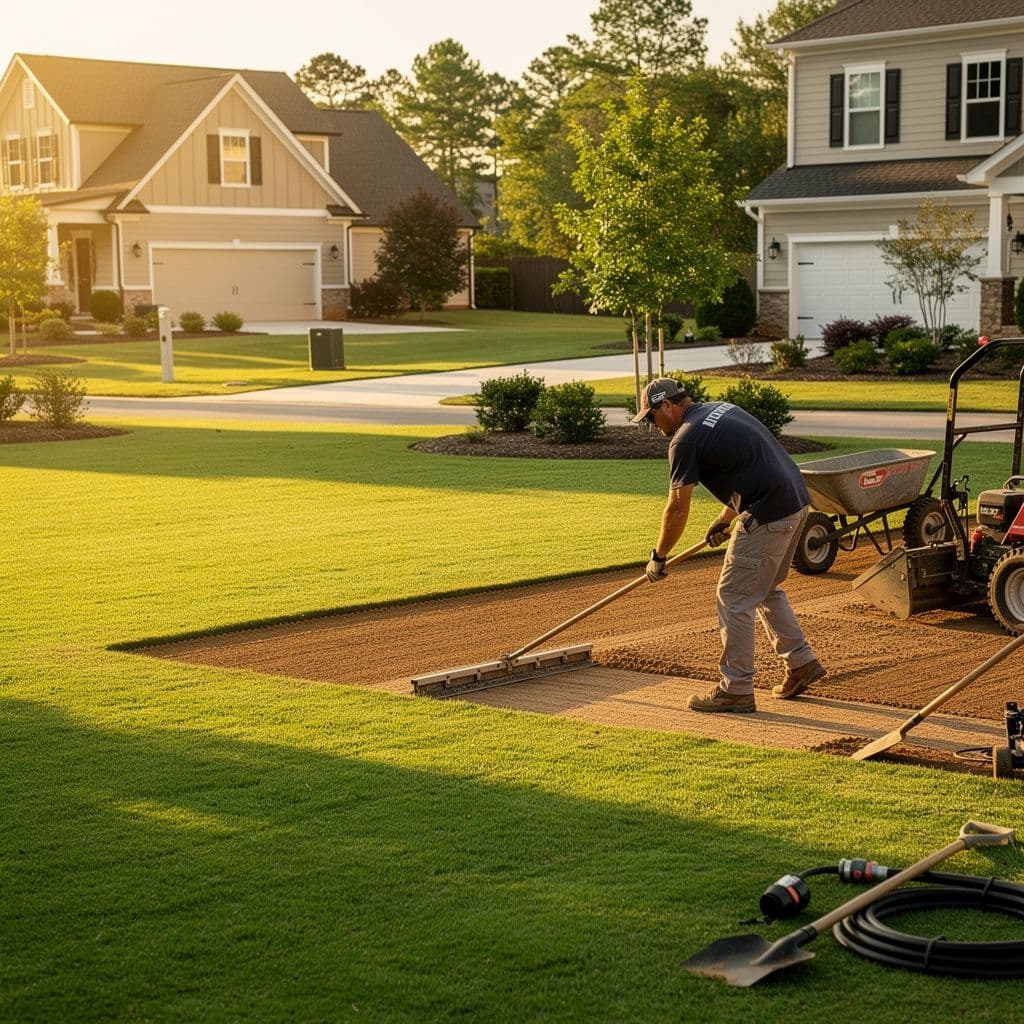
Lawn Leveling Guide: How to Fix an Uneven Yard in Henry County, GA
Published: June 8, 2026
You know the feeling. You're walking across your yard and — thud — your foot catches on a hidden bump. Or you notice that your lawn mower scalps the high spots while the low spots stay soggy and brown after every rain. Maybe you've watched your kids trip running across the backyard, or you're embarrassed every time the neighbors glance over at your wavy, uneven lawn.
Uneven lawns are more than just an eyesore. They're a tripping hazard, a drainage problem, a mowing nightmare, and a sign that something underneath the surface needs attention. And if you live in Locust Grove, McDonough, Stockbridge, or anywhere across Henry County, there's a good chance your lawn isn't as level as it should be.
Georgia's clay soil, heavy rainfall, and the construction practices used in many of our neighborhoods make uneven lawns one of the most common problems we see at Hedgecoth Property Solutions. The good news? Lawn leveling is one of the most transformative improvements you can make to your property. A smooth, even lawn looks better, drains better, mows easier, and is safer for your family.
This guide covers everything you need to know about why your lawn is uneven, what lawn leveling involves, and how to get it done right in Henry County.
Why Henry County Lawns Become Uneven
Uneven lawns don't happen by accident. In Henry County, there are several specific causes that create bumpy, wavy, or sunken yard surfaces.
Georgia Clay Soil Settling
Clay soil is the foundation of most Henry County lawns — literally. And clay does something that sand and loam don't: it shrinks and swells with moisture changes.
How clay creates uneven surfaces:
- During wet periods, clay absorbs water and expands
- During dry periods (especially summer drought), clay shrinks and contracts
- This cycle repeats endlessly, causing the ground surface to shift
- Low spots develop where soil settles, high spots form where soil heaves
- Over several years, a once-level lawn becomes noticeably uneven
Areas most affected:
- Newer subdivisions in Hampton and south Locust Grove where fill dirt was used during construction
- Properties near McDonough with heavy clay content
- Any lawn that doesn't have adequate irrigation during dry spells
Construction and Grading Issues
Many Henry County neighborhoods were built in the last 15-25 years, and the construction process itself creates uneven terrain:
During home construction:
- Heavy equipment compacts soil unevenly across the lot
- Trenching for utilities creates settling zones above buried pipes and lines
- Fill dirt is brought in to establish grade but often isn't properly compacted
- Topsoil is stripped during construction and replaced inconsistently
- The area around the foundation settles differently than the rest of the yard
The result: A lawn that may have looked okay when the house was new gradually develops dips, bumps, and waves as the soil settles at different rates. This is especially common in neighborhoods near J.P. Moseley Park in McDonough, the newer developments along Highway 20 in Locust Grove, and the growing areas around Hampton.
Tree Root Growth and Removal
Henry County has some beautiful mature trees — oaks, pines, and hickories that add character and shade to properties throughout the area. But trees and lawn level don't always coexist peacefully.
Surface root problems:
- Large trees (especially oaks) develop surface roots as they seek water and nutrients
- These roots create ridges and bumps across the lawn surface
- Mowing over surface roots damages both the mower blade and the root
- As roots grow, they lift the soil above them, creating increasingly uneven terrain
After tree removal:
- When a tree is removed, the root system beneath begins decomposing
- As roots decay, the soil above sinks — creating depressions
- Multiple depressions from a single removed tree can make the surrounding area very uneven
- This settling continues for 3-5 years after removal
Erosion from Heavy Rainfall
Henry County receives 48-52 inches of rain per year, much of it in intense thunderstorms. That water doesn't just soak in — it flows across the surface, carrying soil with it.
How rain creates uneven ground:
- Heavy runoff carves channels and ruts across bare or thin lawn areas
- Low spots collect water, killing grass and creating bare mud zones
- Soil washes away from high spots, exposing roots and creating scalping zones
- Each storm makes the problem slightly worse than the last
- Properties without proper drainage suffer the most erosion damage
Animal Damage
Moles and voles are common in Henry County and their tunneling creates raised ridges and sunken channels across lawns. A single mole can create 100+ feet of tunnel in a day, leaving a wake of uneven ground that collapses into depressions over time.
Dogs that dig, run the same paths, or create worn areas contribute to uneven surfaces, especially around fence lines and favorite resting spots.
Lawn Maintenance Practices
Poor mowing and maintenance habits can actually create or worsen uneven lawns:
- Mowing wet grass causes ruts from mower wheels
- Using heavy equipment on saturated soil creates compaction and depressions
- Never aerating allows soil compaction to worsen over time
- Ignoring bare spots leads to erosion that creates low areas
What Uneven Lawns Are Costing You
Safety Hazards
Every dip and bump in your lawn is a potential trip-and-fall hazard. This matters for:
- Children running and playing in the backyard
- Elderly family members who may not see uneven ground
- Guests who aren't familiar with your yard's terrain
- You, carrying groceries, walking the dog, or just crossing the yard at dusk
A serious fall can mean injuries, medical bills, and liability if it happens to a visitor on your property.
Mowing Damage
Uneven ground and lawn mowers are enemies. Here's what happens:
On high spots:
- Mower blades scalp the grass down to bare dirt
- Scalped areas turn brown and are susceptible to weeds
- Repeated scalping kills the grass plant entirely
- Bare spots develop where grass can't recover
On low spots:
- Mower deck drops into depressions and tears grass instead of cutting it
- Wet grass in low spots clogs the mower and leaves clumps
- The mower may bottom out, damaging the blade and deck
- Grass in low spots is often already weakened from standing water
The cycle: Scalped high spots thin out, creating more bare soil that erodes. Low spots collect more water, killing more grass. The lawn gets progressively worse.
Drainage Problems
Uneven lawns create drainage problems, and drainage problems make lawns more uneven. It's a vicious cycle:
- Low spots collect water that kills grass and erodes soil
- Water flows across uneven terrain in unpredictable patterns
- Standing water in depressions creates mosquito breeding grounds
- Water may be directed toward your foundation instead of away from it
- Soil in low areas becomes compacted and degraded from constant saturation
If you're dealing with both uneven ground and drainage issues, professional property maintenance can address both problems together.
Property Value Impact
An uneven lawn signals neglect, even if you've been maintaining it. Potential buyers notice:
- Bumpy terrain that looks unprofessional
- Bare spots from mower scalping
- Standing water in depressions
- Overall poor appearance despite regular care
A level, well-maintained lawn is one of the first things people notice about a property. It sets the tone for the entire home.
How Lawn Leveling Works
Lawn leveling (also called lawn renovation or top dressing) is the process of adding material to low spots and smoothing the overall surface to create an even, uniform grade. Here's how it's done professionally.
Assessment and Planning
Before any leveling work begins, a proper assessment is essential:
Measure the severity:
- Walk the lawn with a leveling rake or straight board to identify high and low spots
- Measure the depth of depressions (anything over 1 inch needs attention)
- Map the overall grade and drainage patterns
- Identify the cause of unevenness (settling, roots, erosion, etc.)
Determine the approach:
- Minor unevenness (less than 1 inch): Top dressing with sand/soil mix
- Moderate unevenness (1-3 inches): Combination of top dressing and spot grading
- Severe unevenness (3+ inches): Full lawn renovation with grading and new grass installation
Identify underlying issues:
- Drainage problems that will undermine leveling work
- Compaction that needs aeration before leveling
- Grub or pest damage that needs treatment
- Tree root issues that need to be addressed
Top Dressing: The Primary Leveling Method
Top dressing is the most common lawn leveling technique. It involves spreading a thin layer of material over the lawn surface to fill low spots and create a smooth, even grade.
The material mix matters enormously in Henry County:
- Sand-based mix: 70% coarse sand / 30% compost — best for lawns with clay soil
- Soil-based mix: 60% topsoil / 40% sand — good for lawns that need nutrient improvement
- Pure compost: For lawns that need organic matter but minimal leveling
Why sand is essential in Henry County:
Clay soil doesn't drain well on its own. Adding more clay or heavy topsoil makes the problem worse. Sand creates pore space in the soil, improving drainage while filling low spots. This is why professional top dressing in Henry County always includes a significant sand component.
The top dressing process:
- Mow the lawn short — cut to about 2 inches so the material can reach the soil surface
- Aerate the lawn — core aeration creates holes that allow top dressing material to integrate with existing soil
- Apply top dressing material — spread ¼ to ½ inch of material across the lawn surface
- Work material into low spots — use a leveling rake or drag mat to distribute material evenly
- Focus on depressions — add extra material to low spots, working it into the existing soil
- Water thoroughly — helps material settle and integrate with the soil
- Allow grass to grow through — in 2-3 weeks, grass pushes through the top dressing layer
- Repeat if needed — deep depressions may require multiple applications
Spot Grading for Deeper Depressions
For low spots deeper than 2 inches, top dressing alone isn't enough. Spot grading addresses individual problem areas:
The process:
- Cut the sod in the depression area and set it aside (if the grass is healthy)
- Add fill soil to bring the area up to the surrounding grade
- Compact the fill soil to prevent future settling
- Replace the sod or seed the area
- Water and monitor for settling
Best fill material for Henry County:
- Sandy loam — drains well and integrates with clay soil over time
- Clean fill dirt — for deeper fills, topped with sandy loam near the surface
- Avoid pure clay fill — it creates the same drainage problems you're trying to solve
Full Lawn Renovation
For severely uneven lawns — those with widespread settling, deep ruts, or extensive damage — a full renovation may be the most cost-effective approach:
- Kill existing vegetation (if lawn is mostly weeds or dead grass)
- Grade the entire yard — heavy equipment to establish proper slope and drainage
- Amend the soil — add organic matter and sand to improve the soil profile
- Install new grass — sod for immediate results, seed for budget-conscious projects
- Establish irrigation and drainage — ensure the new lawn has proper water management
This is the most expensive option but also the most thorough. For lawns that need significant correction, it's often cheaper than years of incremental top dressing.
When to Level Your Lawn in Henry County
Timing matters for lawn leveling. Apply top dressing at the wrong time and you can smother your grass or waste money on material that washes away.
Best Time: Late Spring Through Summer (May-August)
For Henry County's warm-season grasses (Bermuda, Zoysia, Centipede), late spring through mid-summer is the ideal window:
- Grass is actively growing and recovers quickly
- Warm soil temperatures help top dressing integrate
- Multiple applications can be spaced 4-6 weeks apart
- New seed or sod establishes before winter dormancy
June is prime time for lawn leveling in Locust Grove, McDonough, and Stockbridge. The grass is in peak growing mode and can push through top dressing material within 2-3 weeks.
Avoid: Late Fall Through Early Spring (October-March)
During dormancy, grass can't grow through the top dressing layer. Material sits on the surface, potentially smothering the lawn and creating new problems. Wait until the grass is actively growing before leveling.
Work Around Rain
Heavy rain washes top dressing material into low spots (which seems helpful but actually creates uneven distribution) or off the property entirely. Plan leveling work for dry periods with at least 3-4 days of dry weather forecast.
DIY vs. Professional Lawn Leveling
Can You Do It Yourself?
For minor unevenness — small depressions less than an inch deep — a motivated homeowner can tackle lawn leveling as a DIY project.
What you'd need:
- Top dressing material (sand/compost mix): $30-60 per cubic yard
- A leveling rake or drag: $30-80
- Wheelbarrow and shovel for material handling
- A rental spreader for larger areas: $50-75/day
Total DIY cost for a typical quarter-acre lot: $200-500 in materials
Why Most Henry County Homeowners Hire Professionals
DIY lawn leveling has some significant pitfalls, especially in our area:
Material quality: The sand and soil mixes available at big box stores aren't ideal for clay soil. Professionals use custom-blended materials with the right sand-to-compost ratio for Henry County conditions.
Volume calculations: Most homeowners underestimate how much material they need. A typical Henry County lot with moderate unevenness needs 3-5 cubic yards of top dressing material. That's a lot of wheelbarrow trips.
Even distribution: Getting top dressing material spread evenly is harder than it looks. Uneven application creates new high and low spots. Professional equipment (mechanical spreaders and drag mats) produces a much more uniform result.
Soil compaction: The process of hauling and spreading material across your lawn compacts the soil — especially clay soil. Without proper aeration before and after, you can create new problems while trying to solve old ones.
Underlying issues: If your lawn is uneven because of drainage problems, compaction, or pests, leveling without addressing those issues is a temporary fix. Professionals identify and address root causes.
What professional lawn leveling includes:
- On-site assessment of unevenness severity and causes
- Custom material blend designed for your soil conditions
- Core aeration before top dressing
- Professional-grade spreading and leveling equipment
- Multiple passes for even distribution
- Post-leveling fertilization and care instructions
- Follow-up assessment to ensure results
Maintaining a Level Lawn
Once your lawn is level, keep it that way with these maintenance practices:
Annual Top Dressing
Even well-leveled lawns develop minor unevenness over time. An annual light top dressing (¼ inch or less) maintains a smooth surface and improves soil quality. This is especially important on Henry County clay soil, where settling is ongoing.
Regular Aeration
Core aeration relieves compaction and creates channels for water, air, and nutrients to reach the root zone. In clay soil, annual aeration is essential for preventing the compaction that leads to uneven surfaces.
Schedule aeration during peak growing season (May-July) so grass can fill in the aeration holes quickly. Hedgecoth Property Solutions offers aeration as part of our comprehensive lawn care services.
Proper Drainage
Water is the enemy of a level lawn. Ensure your property has:
- Proper grading that directs water away from structures
- Functional downspout extensions (at least 6 feet from foundation)
- No low spots that collect water
- Adequate drainage features if your property has natural water flow issues
If drainage problems caused your uneven lawn in the first place, fixing the drainage is essential before — or alongside — lawn leveling.
Address Problems Promptly
Don't let minor issues become major ones:
- Fill small depressions as they develop
- Treat pest problems before they create extensive tunneling
- Repair bare spots quickly to prevent erosion
- Fix drainage issues as soon as you notice standing water
Regular property maintenance catches these problems early, when they're inexpensive to fix.
FAQ: Lawn Leveling in Henry County, GA
Why is my lawn so bumpy and uneven?
In Henry County, the most common cause of uneven lawns is Georgia's clay soil. Clay shrinks during dry periods and swells during wet periods, causing the ground surface to shift gradually over years. This is worsened by construction practices in newer subdivisions (McDonough, Hampton, south Locust Grove) where fill dirt settles unevenly. Tree roots, erosion from heavy thunderstorms, animal tunneling, and poor drainage also contribute. If your lawn has bumps, dips, or waves that make mowing difficult or create tripping hazards, it's a candidate for professional lawn leveling.
How much does lawn leveling cost in Henry County?
Lawn leveling costs depend on the severity of the unevenness and the size of your property. Light top dressing for minor unevenness on a typical quarter-acre lot runs $500-1,200. Moderate leveling with spot grading and multiple top dressing applications typically costs $1,200-2,500. Full lawn renovation for severely uneven yards can range from $2,500-6,000+ depending on property size and conditions. During your free evaluation, we'll assess your lawn and provide an exact quote — no surprises.
Can I level my lawn myself?
You can tackle minor unevenness (less than 1 inch) as a DIY project using sand/compost top dressing from a home improvement store. However, DIY leveling has limitations: store-bought materials aren't ideal for clay soil, spreading material evenly is difficult without professional equipment, and you may miss underlying issues like drainage problems or compaction. For anything beyond minor touch-ups, professional lawn leveling produces better, longer-lasting results and often costs less than you'd spend on materials and equipment rentals for a DIY attempt.
Will lawn leveling kill my grass?
When done correctly, lawn leveling should not kill your grass. Professional top dressing applies a thin layer (¼ to ½ inch) of material that grass grows through within 2-3 weeks during the growing season. The key is using the right material thickness — too much at once can smother grass. For deeper depressions that require spot grading, we carefully remove and replace the sod so the grass continues growing. We time leveling work during peak growing season (May-August in Henry County) so your lawn recovers as quickly as possible.
How long does it take for a leveled lawn to look good?
Most lawns look significantly improved immediately after professional leveling — the surface is visibly smoother and more even. Within 2-3 weeks, grass grows through the top dressing material and the lawn looks full and level. For lawns that require spot grading or full renovation with new sod, expect 4-6 weeks for full establishment. Spring and summer leveling produces the fastest results because warm-season grasses (Bermuda, Zoysia, Centipede) are in peak growth mode.
Does lawn leveling fix drainage problems?
Lawn leveling can improve minor drainage issues by eliminating low spots where water collects. However, if your property has significant drainage problems — water flowing onto your property from neighboring lots, high water table, or inadequate overall grade — leveling alone won't solve them. The best approach is often combining lawn leveling with drainage solutions like French drains, dry creek beds, or regrading. During our evaluation, we'll assess whether your uneven lawn is connected to drainage issues and recommend the right combination of solutions.
Get a Smooth, Level Lawn with Hedgecoth Property Solutions
An uneven lawn is more than a cosmetic issue — it's a safety hazard, a mowing headache, and a sign of underlying problems that will only get worse over time. Professional lawn leveling is one of the most impactful improvements you can make to your Henry County property.
Our lawn leveling services include:
- Free on-site evaluation — we assess your lawn's unevenness, identify causes, and recommend the right approach
- Custom top dressing blends — material mixed for Henry County clay soil conditions
- Professional application — even distribution with commercial-grade equipment
- Spot grading for deeper depressions and problem areas
- Full lawn renovation for severely uneven properties
- Combined drainage solutions when unevenness and water problems go hand-in-hand
Why Henry County homeowners choose Hedgecoth:
- We've been leveling lawns across Locust Grove, McDonough, Stockbridge, Jonesboro, and Hampton since 2018
- We know Henry County clay soil and what it takes to get lasting results
- Professional equipment and materials that aren't available at home improvement stores
- Transparent pricing with free estimates
- We stand behind every job we do
Don't spend another summer tripping over your own yard.
📞 Call 770-490-9519 for a free lawn leveling evaluation
📍 Serving: Locust Grove, McDonough, Jonesboro, Stockbridge, Hampton, Morrow, and all of Henry County
🌐 Request a quote online: hedgecoth.pro/contact
A level lawn changes everything. Let us show you the difference.
Hedgecoth Property Solutions has served Henry County, GA since 2018 with professional lawn care, landscaping, and property maintenance services. We specialize in solving the unique challenges of Georgia clay soil — from uneven lawns to drainage problems to comprehensive landscape renovation. Call 770-490-9519 for a free estimate.