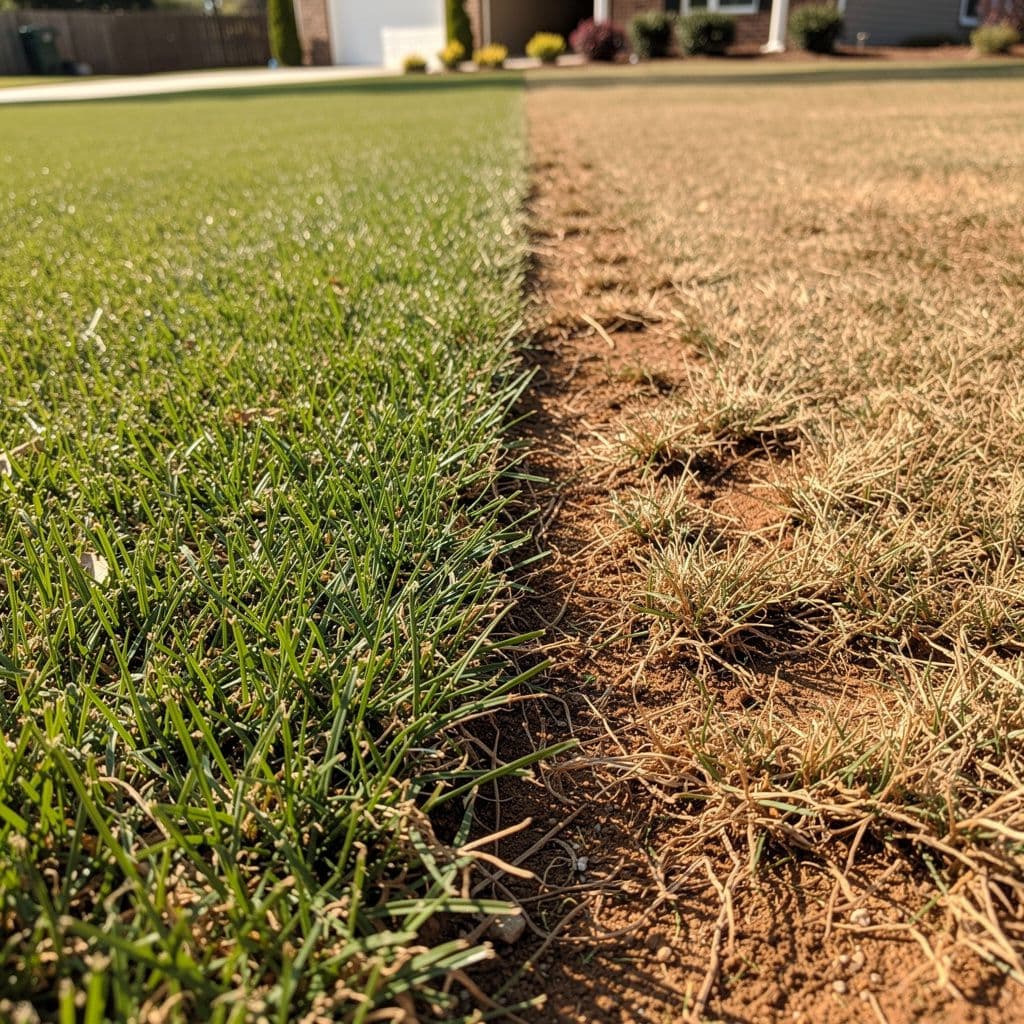
Why Your Grass Turns Brown in Summer: A Complete Diagnosis Guide for Henry County Lawns
Published: May 19, 2026
It starts small. A patch here, a thin spot there. Maybe the grass near the sidewalk looks a little lighter than last week. By the time July rolls around, half your lawn is brown and crispy and you're standing in the yard at 7 AM with a coffee in one hand and a hose in the other, wondering what went wrong.
If this sounds familiar, you're in good company. Brown lawns are the number one complaint from homeowners in Locust Grove, McDonough, Stockbridge, and throughout Henry County during the summer months. And here's the thing most people don't realize: brown grass isn't one problem — it's a symptom with at least seven different possible causes.
Treating brown grass without knowing the cause is like taking random medicine without a diagnosis. You might get lucky, but you'll probably waste time and money — and potentially make things worse.
This guide walks you through every common cause of summer browning in Henry County lawns, how to identify which one you're dealing with, and what professional lawn care can do to fix it.
Why Henry County Lawns Are Especially Vulnerable to Summer Browning
Before we diagnose the problem, it helps to understand why Georgia lawns are so prone to browning in the first place.
Henry County's unique lawn challenges:
- Heavy clay soil — Georgia's famous red clay holds moisture unevenly, creating areas that stay too wet (promoting disease) next to areas that dry out too fast (causing drought stress)
- High humidity — Our 60-80% summer humidity creates perfect conditions for fungal diseases like brown patch and dollar spot
- Extreme heat — Sustained temperatures above 90°F push warm-season grasses to their limits, especially when nighttime temps stay above 75°F
- Unpredictable rainfall — We can go from drought to downpour in a single afternoon, stressing grass that can't adapt fast enough
- Compacted soil — New construction in growing areas like McDonough and Locust Grove often means compacted soil that restricts root growth
These factors combine to create a perfect storm for lawn browning. But knowing which factor is causing your brown grass is the key to fixing it.
The 7 Causes of Brown Grass (And How to Tell Them Apart)
Cause 1: Drought Stress — The Most Common Culprit
What it looks like:
Grass turns a bluish-gray color before going fully brown. Footprints remain visible in the grass long after you walk across it (the blades don't spring back). The browning is usually uniform across sunny, exposed areas while shaded sections stay greener longer.
Why it happens in Henry County:
Even with Georgia's rainfall, extended dry spells in June through August can deplete soil moisture faster than grass roots can absorb it. Clay soil makes this worse — when clay dries out, it becomes hard and almost waterproof, preventing what rain does fall from penetrating to the roots.
The fix:
- Water deeply (1 inch per session) rather than frequent shallow watering
- Water between 4-8 AM to minimize evaporation
- Aerate compacted soil so water actually reaches roots
- Raise mowing height to 3+ inches to shade the soil and reduce evaporation
- Consider a professional irrigation setup for consistent coverage
Professional advantage: A lawn care service monitors soil moisture levels and adjusts watering schedules based on actual conditions, not guesswork.
Cause 2: Heat Stress — Different From Drought
What it looks like:
Unlike drought stress, heat stress causes patchy browning even when the soil is moist. Grass blades fold or roll lengthwise to conserve moisture. You'll see it worst in areas with full afternoon sun exposure, near concrete or asphalt (which radiate heat), and on south-facing slopes.
Why it happens in Henry County:
When air temperatures consistently exceed 90°F and soil surface temperatures climb above 100°F, grass plants go into survival mode. They stop growing, shut down certain cellular processes, and redirect energy to root maintenance. The visible result is brown, dormant-looking grass — even if you're watering correctly.
The fix:
- Avoid mowing during the hottest part of the day
- Keep mower blades sharp (dull blades tear grass, creating more surface area for moisture loss)
- Don't fertilize during extreme heat — it pushes growth that the plant can't sustain
- Reduce foot traffic on stressed areas
- Apply a light layer of compost topdressing to insulate the soil surface
Professional advantage: Professional lawn care teams know exactly when to adjust mowing heights, when to skip a fertilizer application, and how to time treatments to avoid heat damage.
Cause 3: Brown Patch Disease — The Silent Lawn Killer
What it looks like:
Circular patches of brown grass ranging from a few inches to several feet across. The patches often have a distinctive "smoke ring" — a narrow band of dark, wilted grass at the outer edge where the fungus is actively spreading. In the morning when dew is present, you might see white, cobweb-like fungal growth (mycelium) on the grass blades.
Why it happens in Henry County:
Brown patch (Rhizoctonia solani) thrives in exactly our summer conditions: temperatures between 75-85°F, high humidity, and extended leaf wetness. Our clay soil holds moisture against the grass blades, and our humid air keeps them wet for hours. Lawns that are overwatered, over-fertilized with nitrogen, or mowed too short are especially vulnerable.
How to confirm it's brown patch:
- Pull on a brown blade — if it slips easily from the sheath at the base, it's likely brown patch
- Look for the smoke ring at the edge of patches
- Check for mycelium in early morning
- Patches expand rapidly (several inches per day during warm, wet periods)
The fix:
- Reduce nitrogen fertilizer during summer months
- Water only in the early morning (never evening)
- Improve air circulation by thinning nearby shrubs or trees
- Apply fungicide preventively in late spring
- Aerate to improve drainage in chronically wet areas
Professional advantage: Lawn disease requires accurate diagnosis and targeted fungicide applications. Misidentifying the disease leads to ineffective treatments and wasted money. A professional lawn treatment service can identify the specific pathogen and apply the correct product at the right time.
Cause 4: Chinch Bugs and Other Insects
What it looks like:
Irregular patches of yellowing, then browning grass that expand gradually. The damage often starts near driveways, sidewalks, or foundations where heat accumulates. Unlike disease patches, insect damage doesn't have a defined circular shape.
Why it happens in Henry County:
Chinch bugs are active from June through September in Georgia. They feed on grass stems and crowns by piercing the plant and sucking out sap, injecting toxins that cause yellowing and death. Other culprits include sod webworms (which chew grass blades at night), armyworms (which can defoliate a lawn in days), and white grubs (which eat grass roots underground).
How to confirm it's insects:
- Chinch bugs: Part the grass at the edge of a damaged area and look for tiny black insects with white wings on the soil surface. Or use the "coffee can method" — push a coffee can (both ends removed) into the soil at the edge of damage, fill with water, and watch for bugs floating to the surface.
- Sod webworms: Look for small green caterpillars in the thatch layer or small moths flying up when you walk across the lawn at dusk.
- Grubs: Dig up a 1-square-foot section of sod 3 inches deep. If you find more than 5-10 white, C-shaped grubs, you have a problem.
The fix:
- Apply appropriate insecticide based on the specific pest identified
- Water deeply after treatment to move product into the root zone (for grubs)
- Reduce thatch buildup that provides habitat for insects
- Maintain healthy grass that can tolerate minor insect pressure
Professional advantage: Different insects require different treatments at different life stages. A professional applies the right product at the right time for maximum effectiveness with minimum environmental impact.
Cause 5: Improper Mowing — The Self-Inflicted Wound
What it looks like:
The entire lawn looks stressed, with brown tips on grass blades. The browning is most noticeable 1-3 days after mowing. You might see a pattern — brown stripes that follow your mowing path. In severe cases, patches of grass die completely, especially in already-stressed areas.
Why it happens in Henry County:
This is one of the most common and most preventable causes of brown grass. The three mowing mistakes that cause browning:
Scalping (cutting too short): Bermuda should be cut at 1.5-2 inches, Zoysia at 1.5-2.5 inches, and Centipede at 1.5-2 inches. Cutting lower removes too much leaf surface, shocks the plant, exposes the soil to sun (increasing evaporation), and triggers stress responses.
Dull mower blades: Instead of making clean cuts, dull blades tear and shred grass. The torn edges turn brown and become entry points for disease. If your lawn looks brownish-white across the entire surface 1-2 days after mowing, dull blades are the likely culprit.
Infrequent mowing: Removing more than one-third of the grass blade height in a single mowing stresses the plant. During Georgia's peak growing season (May-July), Bermuda may need mowing every 5-7 days. Skipping two weeks means cutting away 50%+ of the plant.
The fix:
- Sharpen mower blades every 20-25 hours of use (at least monthly for most homeowners)
- Never remove more than 1/3 of the grass blade in a single mowing
- Mow at the correct height for your grass type
- During summer heat, raise the mowing height by 0.5 inches
Professional advantage: Professional lawn mowing services maintain sharp equipment, mow at the correct frequency, and adjust heights seasonally. This single service eliminates one of the top causes of lawn browning.
Cause 6: Nutrient Deficiency and Fertilizer Burn
What it looks like:
Deficiency: Grass turns pale green, then yellowish, then tan or brown. The color change is usually gradual and widespread (not patchy). Specific patterns can indicate specific nutrients — yellowing between green veins on individual blades often indicates iron deficiency, while overall pale color suggests nitrogen.
Fertilizer burn: Distinct, often linear patches of brown or yellow grass that appear 1-3 days after fertilizer application. The grass looks scorched, and in severe cases, the soil may have a white, crusty salt residue.
Why it happens in Henry County:
Georgia's clay soil is naturally low in organic matter and can lock up certain nutrients, making them unavailable to grass roots. The high rainfall leaches nutrients faster than in sandier soils. On the flip side, homeowners who apply too much fertilizer, use the wrong type, or apply during hot weather can literally burn their grass with excess salts.
The fix:
- Get a soil test to identify specific deficiencies
- Use slow-release fertilizers that feed gradually without burning
- Follow application rates precisely — more is NOT better
- Water thoroughly after fertilizing to dissolve and distribute nutrients
- Time applications correctly: heavy nitrogen in spring/early summer, low nitrogen in peak summer, potassium in fall
Professional advantage: Professional lawn fertilization uses calibrated equipment and science-based programs tailored to Georgia clay soil. No guesswork, no burned grass, no wasted product.
Cause 7: Soil Compaction and Thatch Buildup
What it looks like:
Grass thins out gradually, with bare soil becoming visible between plants. The remaining grass looks weak, shallow-rooted, and struggles to recover from any stress. Water tends to run off rather than soak in. The lawn feels hard and dense underfoot.
Why it happens in Henry County:
New construction neighborhoods in growing areas around Locust Grove and McDonough often have severely compacted soil from heavy equipment during building. Foot traffic, vehicle parking, and even heavy rainfall on clay soil all contribute to compaction. Compacted soil prevents air, water, and nutrients from reaching grass roots — essentially suffocating the lawn from below.
Thatch — a layer of dead grass stems and roots between the soil surface and green grass blades — compounds the problem. A thin layer (under 0.5 inches) is normal, but excessive thatch (over 1 inch) prevents water and fertilizer from reaching the soil, harbors insects and diseases, and creates a spongy surface that retains too much moisture.
The fix:
- Core aeration once or twice per year (spring and/or fall) to relieve compaction
- Dethatch when the thatch layer exceeds 0.5-1 inch
- Topdress with compost to improve soil structure over time
- Reduce foot traffic on stressed areas
- Address drainage problems that contribute to compaction
Professional advantage: Core aeration requires professional-grade equipment that most homeowners don't own. The timing, depth, and pattern of aeration directly impact results. A professional property maintenance service ensures it's done right.
The Quick Diagnosis Chart
Use this chart to narrow down your browning cause before you spend money on the wrong fix.
Symptoms → Likely Cause
| Symptoms | Likely Cause |
|---|---|
| Blue-gray color, footprints stay, mostly in full sun | Drought stress |
| Patchy browning despite adequate moisture, near pavement | Heat stress |
| Circular patches with dark edge, gets worse fast | Brown patch disease |
| Irregular yellow-to-brown, starts near driveways/sidewalks | Chinch bugs or other insects |
| Brown tips everywhere, appears after mowing | Improper mowing |
| Pale green → yellow → brown, gradual and widespread | Nutrient deficiency |
| Brown patches 1-3 days after product application | Fertilizer burn |
| Hard soil, thin grass, water runs off | Soil compaction |
If you're looking at this chart and thinking "mine could be two or three of these" — you're probably right. Most brown lawns in Henry County have multiple contributing factors. Drought-stressed grass is more susceptible to disease. Compacted soil makes drought worse. Poor mowing practices weaken the grass, making it vulnerable to everything else.
That's why professional lawn care is so effective — it addresses the whole system, not just one symptom.
Your Step-by-Step Summer Lawn Recovery Plan
If your lawn is already showing brown patches as summer approaches, here's what to do right now.
Step 1: Diagnose Before You Treat
Don't guess. Walk your lawn in the morning when dew is present and look for:
- Fungal growth (white cobweb-like strands)
- Insects on the soil surface or in the thatch
- Soil hardness (try pushing a screwdriver into the ground — it should go in easily)
- Grass blade condition (torn vs. cut, folded vs. flat)
Step 2: Stop Making It Worse
Common mistakes that worsen brown lawns:
- Overwatering — promotes disease and shallow roots
- Applying more fertilizer — can burn already-stressed grass
- Mowing shorter to "even things out" — causes more stress
- Ignoring it — most lawn problems get exponentially harder to fix the longer they're left
Step 3: Call for Professional Help
Most summer lawn problems are fixable, but timing matters. The sooner a professional can diagnose and treat the issue, the faster your lawn recovers — and the less money you'll spend on wrong solutions.
At Hedgecoth Property Solutions, we serve homeowners throughout Locust Grove, McDonough, Stockbridge, Jonesboro, Morrow, and all of Henry County. Our lawn care programs are built specifically for Georgia's climate and soil conditions.
How Professional Lawn Care Prevents Summer Browning
The best time to fix a brown lawn is before it turns brown. Here's how a professional lawn care program keeps your grass green all summer.
Spring preparation (March-May):
- Soil testing and amendment to correct nutrient imbalances
- Pre-emergent weed control to prevent competition
- Fertilization timed for strong root development before heat arrives
- Aeration to relieve compaction from winter
- Fungicide prevention for disease-prone lawns
Summer maintenance (June-August):
- Adjusted mowing heights and frequencies for heat conditions
- Targeted treatments for insects and diseases at first sign
- Proper irrigation management
- Slow-release fertilizer applications that won't burn
- Monitoring and early intervention before problems spread
Fall recovery (September-November):
- Core aeration and overseeding to repair summer damage
- Fall fertilization to rebuild root reserves
- Weed control to reduce competition during recovery
- Soil amendments based on seasonal soil test results
This systematic approach addresses every cause of browning before it becomes visible. It's the difference between reacting to problems and preventing them.
Real Costs: DIY vs. Professional Lawn Care
Many homeowners try to handle summer lawn problems themselves before calling a professional. Here's what that typically looks like in terms of cost and results.
DIY approach:
- Bag of fungicide: $30-60 (but which one? Brown patch, dollar spot, and large patch all need different products)
- Bag of insecticide: $25-50 (but what insect? Wrong product = wasted money)
- Fertilizer: $30-80 per application (over-fertilize and you make things worse)
- Aerator rental: $75-100 per day (plus the labor of operating it)
- Soil test kit: $15-30
- Total for one attempt at diagnosis and treatment: $175-320
- Success rate without accurate diagnosis: Low
Professional approach:
- Accurate diagnosis: Included
- Targeted treatment with professional-grade products: Effective
- Ongoing monitoring to catch problems early: Included
- Proper timing of all applications: Included
- Monthly lawn care program: Often less than the cost of one DIY attempt
When you factor in the cost of products you didn't need, treatments that didn't work, and the time spent researching, shopping, and applying — professional lawn care services are typically less expensive than DIY.
FAQ: Brown Grass and Summer Lawn Care in Henry County, GA
Why does my grass turn brown every summer even though I water it?
Watering alone doesn't prevent brown grass if the underlying cause is disease, compaction, insects, or improper mowing. In fact, overwatering is one of the leading causes of brown patch disease in Henry County. If you're watering regularly but still seeing browning, you need a professional diagnosis to identify the actual cause. Common culprits include compacted clay soil that prevents water from reaching roots, fungal diseases that thrive in consistently wet conditions, and mowing too short which stresses the grass regardless of how much you water.
Can brown grass turn green again?
Yes — in most cases, brown grass can recover if the underlying cause is addressed promptly. Warm-season grasses like Bermuda and Zoysia can go dormant (brown) during extreme heat and drought as a survival mechanism, then green up when conditions improve. However, if the grass is truly dead (not dormant), it won't recover and will need to be replaced through seeding or sod installation. The difference is in the crown: if the base of the grass plant at soil level is still green and firm, the grass is alive and can recover. If the crown is brown and mushy or dry and brittle, that section is dead.
How much water does my Henry County lawn need in summer?
Most warm-season grasses in Henry County need 1-1.5 inches of water per week during summer, either from rainfall or irrigation. This should be applied in 1-2 deep watering sessions rather than daily shallow watering. Deep watering encourages deep root growth, which makes grass more drought-resistant. To measure, place a straight-sided container (like a tuna can) on the lawn while watering — when it collects 1 inch of water, you've applied enough. Sandy soils may need more frequent watering; clay soils may need less. Water between 4-8 AM for maximum absorption and minimum disease risk.
What's the difference between dormant grass and dead grass?
Dormant grass is a survival strategy — the grass plant shuts down above-ground growth to conserve energy while waiting for better conditions. The blades turn brown but the crown (at soil level) and roots remain alive. Dead grass has been killed by disease, insects, chemical burn, or prolonged stress. To tell the difference: grab a handful of brown grass and pull gently. If the blades break off but the crown stays anchored, the grass is likely dormant. If whole sections lift easily from the soil, or if the crown is brown and mushy, the grass is dead. A professional lawn inspection can give you a definitive answer.
When should I call a professional about my brown lawn?
Call a professional if your lawn has circular brown patches that are expanding, if browning persists despite regular watering, if you see insects or fungal growth on the grass, or if more than 25% of your lawn is brown. The earlier you catch and treat the problem, the faster and less expensive the recovery. Waiting until late summer often means the damage is too severe for recovery before fall dormancy, requiring lawn renovation that costs significantly more than early intervention.
Is it too late to save my lawn if it's already brown in June?
No — June is actually early in the summer season for Georgia. Warm-season grasses are actively growing through September, giving you three full months to diagnose and treat the problem. If the cause is identified and addressed in June, most lawns show significant recovery within 4-6 weeks. The key is getting an accurate diagnosis quickly so you're not wasting time on the wrong treatment. Contact a professional lawn care service for an assessment — it's faster and more cost-effective than trial and error.
Don't Spend Another Summer Staring at Brown Grass
A green lawn isn't a luxury — it's the foundation of your home's curb appeal, a space for your family to enjoy, and a reflection of how you care for your property. Summer browning is common in Henry County, but it's not inevitable.
At Hedgecoth Property Solutions, we've helped hundreds of homeowners in Locust Grove, McDonough, Stockbridge, Jonesboro, and Morrow diagnose and fix the exact causes of their brown grass. Our lawn care programs are designed specifically for Georgia's climate, clay soil, and the unique challenges of Henry County properties.
What you get with our lawn care service:
- Accurate diagnosis of what's causing your lawn problems
- Targeted treatments with professional-grade products
- Seasonal programs that prevent problems before they start
- Experienced technicians who know Henry County lawns
- Transparent pricing with no surprises
Stop guessing. Start growing.
📞 Call today for a free lawn assessment: 770-490-9519
🌐 Request a quote online: hedgecoth.pro/contact
📍 Serving: Locust Grove, McDonough, Stockbridge, Jonesboro, Morrow, Hampton, and all of Henry County
Hedgecoth Property Solutions — Your Lawn, Our Expertise. Henry County's Trusted Lawn Care Professionals.