Tree Stump Removal in Henry County: Costs, Methods, and Why It Matters
Published: June 16, 2026
You had a tree cut down. The crew hauled away the limbs, chipped the branches, and ground the trunk into mulch. Your yard looks better — except for one thing. That stump. It's still sitting there, roughly eighteen inches across, sticking up four inches above the soil line like a rotting tooth.
Maybe you've been meaning to deal with it. Maybe you're not sure whether it's worth the trouble. Maybe you're wondering if you can just leave it and let nature take its course.
Here's the short answer: removing a tree stump is almost always worth it. Stumps attract pests, create mowing hazards, take up valuable yard space, and drag down your property's appearance. In Henry County's warm, humid climate, a stump can become a serious problem faster than you might think.
This guide covers everything you need to know about tree stump removal in Locust Grove, McDonough, Stockbridge, and throughout Henry County — including methods, costs, timing, and why professional stump grinding is usually the right call for Georgia homeowners.
If you're ready to get that stump gone, call Hedgecoth Property Solutions at 770-490-9519 or reach us through our contact page. We handle stump removal as part of our complete tree service offerings across Henry County.
Why Tree Stumps Need to Go
Let's start with the obvious question: does it really matter if you leave the stump? Your tree is gone. The stump is just sitting there. What's the harm?
Plenty, as it turns out.
Pest Magnet
In Georgia's warm climate, a tree stump is an open invitation for pests. Termites, carpenter ants, beetles, and wood-boring insects are drawn to decaying wood. Once they've colonized a stump, they don't stay there — they spread to nearby structures, fences, and even your home's foundation.
Subterranean termites are active throughout Henry County, and a rotting stump in your yard is essentially a termite feeding station. The closer the stump is to your house, the bigger the risk. Pest control professionals routinely recommend stump removal as a preventive measure against termite infestations.
Fungal Growth and Disease
Stumps don't just attract insects. They also grow fungi. In our humid climate — where summer humidity regularly exceeds 80% — mushrooms and bracket fungi can colonize a stump within weeks. Some of these fungi are harmless. Others, like Armillaria (oak root fungus), can spread through the soil to nearby healthy trees and shrubs, killing them from the roots up.
If you lost the tree to disease in the first place, leaving the stump means the pathogen is still in your soil. Removing the stump and as much of the root system as possible helps prevent the disease from spreading to other plants in your landscape.
Mowing Obstacle
Anyone who's mowed around a stump knows the frustration. You have to weave around it, trim carefully near it, and hope you don't clip it with the mower deck. Hitting a stump with a mower can damage the blade, bend the crankshaft, and send dangerous debris flying.
Over time, grass grows up around the stump, camouflaging it. That's when it becomes genuinely dangerous — an invisible hazard that can trip children, damage equipment, or twist an ankle.
Space and Aesthetics
A tree stump takes up space you could be using for something better. In a typical Henry County yard — where lot sizes range from a quarter acre in the subdivisions around Locust Grove to several acres in the rural areas near Hampton — that space matters. A stump in the middle of your backyard could be the spot where a patio goes, where a garden bed sits, where your kids play.
And then there's the appearance. A rotting stump isn't attractive. It signals neglect, and if you're planning to sell your home, it's the kind of detail that buyers notice. A clean, stump-free yard looks maintained and cared for.
Sprouting and Regrowth
Some tree species don't give up easily. If you cut down a sweetgum, maple, or crepe myrtle in Georgia, the stump will likely produce new shoots within weeks. These suckers grow rapidly — sometimes several feet in a single season — and they draw energy from the remaining root system underground.
Left unchecked, you end up with a bushy cluster of new growth sprouting from the stump, essentially giving you a smaller, uglier version of the tree you just paid to remove. The only way to stop this cycle is to remove the stump entirely.
Tree Stump Removal Methods
There are four main ways to deal with a tree stump. Each has its place, but for most Henry County homeowners, one method stands above the rest.
1. Stump Grinding (Professional Standard)
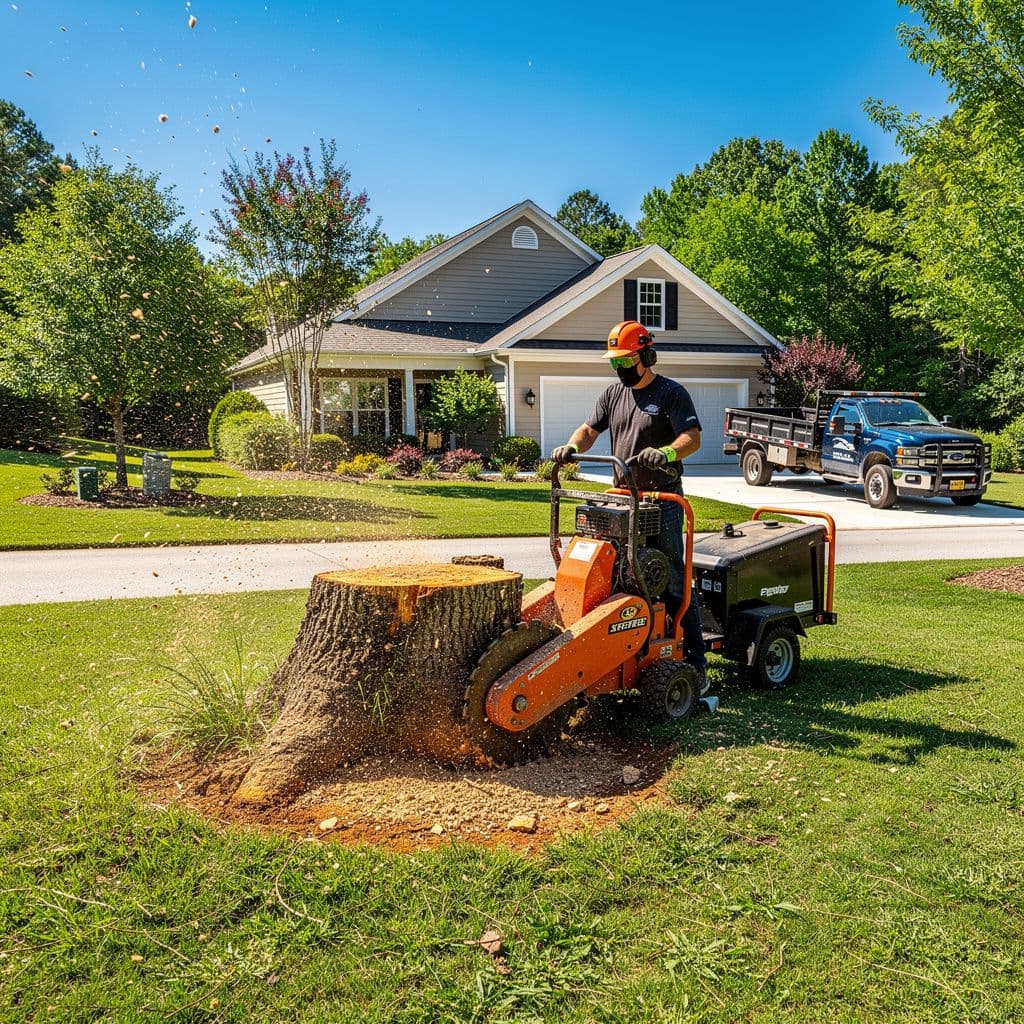
Stump grinding is exactly what it sounds like: a machine called a stump grinder uses a rotating cutting wheel with carbide teeth to systematically reduce the stump to wood chips. The grinder cuts the stump down below ground level — typically 6 to 12 inches deep, sometimes deeper for large root systems.
The process:
- The grinder is positioned over the stump
- The cutting wheel is lowered into the wood
- The operator moves the wheel side to side, systematically grinding away the stump
- Wood chips and soil are mixed together as backfill
- The area is raked smooth and can be sodded or seeded immediately
Why it's the preferred method:
- Fast — most stumps take 30 minutes to 2 hours
- Clean — no excavation, no massive hole in your yard
- Thorough — grinds below grade so the stump is invisible
- Affordable — less expensive than full extraction
- Immediate — you can landscape the area the same day
What's left behind: A mixture of wood chips and soil where the stump used to be. This settles over a few weeks and can be topped with topsoil and planted over. The remaining root system underground decays naturally over several years.
2. Chemical Stump Removal
Chemical stump removal involves drilling holes into the stump and applying a high-nitrogen fertilizer or potassium nitrate compound that accelerates decomposition. The stump softens over 4-6 weeks and can then be broken apart with an axe or burned.
Pros: Inexpensive, minimal labor, no heavy equipment
Cons: Very slow (weeks to months), still leaves roots underground, chemical runoff concerns, not suitable for stumps near water sources or in areas with children and pets
Chemical removal works as a last resort for small stumps in out-of-the-way areas, but it's not practical for most Henry County homeowners who want the stump gone now — not in three months.
3. Manual Removal (Digging)
Manual stump removal involves digging around the stump with a shovel, cutting through the major roots with an axe or saw, and using a lever or winch to pull the stump out of the ground.
Pros: Removes the entire stump and root ball, no chemicals, no machinery
Cons: Extremely labor-intensive, can take a full day or more for a single stump, requires specialized tools (mattock, digging bar, chainsaw, winch), and risks injury
For stumps larger than 8-10 inches in diameter, manual removal is impractical without heavy equipment. Henry County's dense red clay makes digging especially difficult — the clay grips roots like concrete and doesn't give easily.
4. Natural Decay (Do Nothing)
You can simply leave the stump alone and let nature decompose it. In Georgia's warm, moist climate, a small stump (under 12 inches) may rot away in 3-5 years. Larger stumps can take 10+ years.
This is the "free" option, but it comes with all the downsides we discussed earlier — pest attraction, fungal growth, mowing hazards, and visual blight — for years.
How Much Does Stump Removal Cost in Henry County?
Pricing for stump grinding in the Locust Grove, McDonough, and Stockbridge area typically falls within these ranges:
Small stumps (under 12 inches diameter): $75 – $150 per stump
Medium stumps (12 – 24 inches diameter): $150 – $300 per stump
Large stumps (24 – 36 inches diameter): $300 – $500 per stump
Extra-large stumps (36+ inches diameter): $500 – $800+ per stump
Several factors affect the final cost:
Accessibility — If the stump is in a backyard with a narrow gate, behind landscaping features, or on a steep slope, the equipment needs change and the price goes up. Stumps that a standard grinder can reach via a wide pathway are the most affordable.
Number of stumps — Most contractors offer discounts for multiple stumps on the same property. If you have three or more stumps, ask about batch pricing.
Root system extent — Wide-spreading root systems (common in oaks and pecans) require more grinding time. Surface roots that create tripping hazards can be ground down at the same time.
Debris removal — Some services haul away the wood chips. Others leave them as backfill. At Hedgecoth Property Solutions, we typically leave the grindings as backfill (which saves you money) but can remove them for an additional fee if you prefer a clean slate for landscaping.
Soil conditions — Henry County's clay soil is tough on equipment. Rocky soil (common in the ridge areas near Jonesboro) can damage grinder teeth and increase costs.
For the most accurate pricing, it's best to have someone assess the stump in person. Call us at 770-490-9519 for a free estimate, and we'll give you a straightforward quote with no surprises.
DIY vs Professional Stump Grinding
Renting a stump grinder from a home improvement store might seem like a money-saver. The rental costs $100-$200 per day. But before you go that route, consider what you're signing up for.
Rental Grinders vs Professional Equipment
Rental stump grinders are typically smaller, less powerful machines. They cut more slowly, struggle with hardwood stumps (oak, hickory, maple — very common in Henry County), and may not reach the same depth as professional equipment. A job that takes a professional 45 minutes with a commercial grinder might take you an entire day with a rental.
Safety Concerns
Stump grinders are serious pieces of equipment. The cutting wheel spins at high RPM and can throw rocks, debris, and wood chips significant distances. Professional operators wear face shields, hearing protection, steel-toed boots, and protective clothing. They know how to handle kickback, buried rocks, and foreign metal (nails, fence posts, old pipes) that may be embedded in the stump.
If you've never operated a stump grinder, the learning curve is steep and the consequences of a mistake are severe. A thrown rock can break a window. A kickback can cause loss of control. Flying debris can cause eye injuries.
The Hidden Costs
- Transportation: Commercial stump grinders are heavy. You'll need a truck and trailer to transport one.
- Fuel: Gas-powered grinders use significant fuel, especially on hardwood stumps.
- Cleanup: You're responsible for raking, backfilling, and disposal.
- Your time: A professional completes the job while you do something else.
- Risk: If you damage underground utilities (irrigation lines, gas, water, cable), repairs can cost thousands.
For a single small stump in an open area with no hazards, an experienced DIYer might handle it. For anything larger, near structures, or involving hardwood, professional stump grinding pays for itself in time saved and problems avoided.
When Is the Best Time to Remove a Stump?
The honest answer: whenever you're ready. Stump grinding can be done year-round in Georgia. But there are practical considerations by season.
Spring and Summer (Best for Immediate Landscaping): After grinding in spring or summer, you can immediately plant grass seed or sod over the area. The warm soil means quick germination and root establishment. By the end of the growing season, the spot where the stump stood will blend seamlessly with your lawn.
Fall (Ideal for Complete Projects): Fall stump removal lets you grade the area, add topsoil, and overseed just before grass goes dormant. The seed establishes roots over winter and fills in during spring green-up.
Winter (Off-Season Advantages): Some companies offer lower rates in winter when business is slower. Frozen ground (rare but possible in January) makes equipment access easier without tearing up the lawn. You'll have the stump gone before spring, ready for the growing season.
For most Henry County homeowners, the best time is now — whenever you're reading this. Every month a stump sits in your yard, it's decomposing, attracting pests, and becoming more integrated with the surrounding root system. The sooner it's removed, the sooner you can use that space.
What Happens After Stump Grinding?
Once the stump is ground below grade, you're left with a shallow depression filled with wood chips and soil. Here's how to handle the aftermath:
-
Remove excess wood chips. Leave about 2-3 inches of the chip/soil mix as backfill. Remove any excess — too much woody material can tie up nitrogen in the soil as it decomposes, making it hard for grass to grow.
-
Add topsoil. Fill the remaining depression with quality topsoil, slightly mounding it to account for settling. Henry County clay soil works fine if mixed with the existing material, but a layer of sandy loam topsoil improves drainage and grass establishment.
-
Seed or sod. Spread grass seed matching your existing lawn (Bermuda, Zoysia, or Centipede for most Henry County yards). Keep the area watered for 2-3 weeks until germination. For instant results, lay a piece of sod cut to fit the area.
-
Monitor settling. Over the next few months, the underground wood chips will decompose and the soil will settle. You may need to add more topsoil once or twice to keep the area level.
-
Watch for sinkage. Over a period of 1-2 years, the remaining underground root system decays. Minor settling is normal. If a significant depression forms, fill it with topsoil and reseed.
Why Henry County Homeowners Trust Hedgecoth Property Solutions
Stump removal seems simple until you're staring at a 30-inch oak stump in your backyard with roots spreading in every direction. That's when experience matters.
Hedgecoth Property Solutions provides professional stump grinding as part of our complete tree service and property maintenance offerings. We serve homeowners across Henry County — from the established neighborhoods of McDonough to the growing subdivisions of Hampton and the rural properties around Locust Grove.
When you call us, you're not just getting someone with a grinder. You're getting a team that understands Henry County's clay soil, knows how to navigate tight yard access, and can handle everything from small sweetgum stumps to massive oak remnants. We arrive on time, protect your surrounding landscaping, grind the stump below grade, and clean up after ourselves.
We can also handle the full scope of tree work — from tree trimming and removal to complete lot clearing. No need to coordinate multiple contractors.
Ready to reclaim that yard space? Call us at 770-490-9519 or visit our contact page to schedule stump removal. We'll assess the stump, give you a fair price, and get it done.
Frequently Asked Questions
How deep does stump grinding go?
Professional stump grinding typically reaches 6 to 12 inches below the soil surface. This is deep enough to eliminate the visible stump and the immediate root flare, allowing you to plant grass or landscape over the area. The remaining root system underground decays naturally over several years. If you need deeper removal — for example, to build a structure over the stump site — let us know and we can discuss full root ball extraction.
Will the tree grow back after stump grinding?
For most species, no. Grinding the stump below the soil line removes the growing point and the stored energy reserves the tree needs to produce new shoots. However, some aggressive species (like Chinese privet or certain maples) may attempt to send up suckers from the remaining root system. If sprouts appear, they can be treated with a brush killer or simply mowed off until the roots exhaust their energy supply.
Can I plant a new tree in the same spot?
It's possible but not ideal. The decaying root system underground creates voids in the soil and ties up nitrogen as it decomposes. A new tree planted directly over an old stump site may struggle with soil subsidence and nutrient competition. If possible, plant the new tree at least 3-5 feet away from the old stump location. If you must plant in the same spot, remove as much of the old root system as possible and add fresh topsoil.
How long does stump grinding take?
Most residential stumps take between 30 minutes and 2 hours of actual grinding time. Setup, cleanup, and equipment positioning add another 30-60 minutes. The total time depends on stump size, wood hardness, root spread, and site accessibility. We can give you a time estimate along with your price quote.
Does stump grinding damage the surrounding lawn?
Minimal impact when done professionally. The grinder is positioned directly over the stump, and the cutting happens below ground level. We protect surrounding lawn care areas with barriers and carefully manage debris. Some grass near the stump may need to be reseeded, but the impact is typically limited to a 2-3 foot radius around the stump.
Is stump removal covered by homeowners insurance?
Generally, no. Most homeowners insurance policies don't cover stump removal unless the tree was damaged by a covered peril (like a storm that knocked the tree down and the policy covers debris removal). If you're filing a claim for storm damage, ask your adjuster whether stump grinding is included. For routine stump removal, it's an out-of-pocket expense — but at $75-$300 for most stumps, it's far less than the cost of pest damage or a tripping injury.