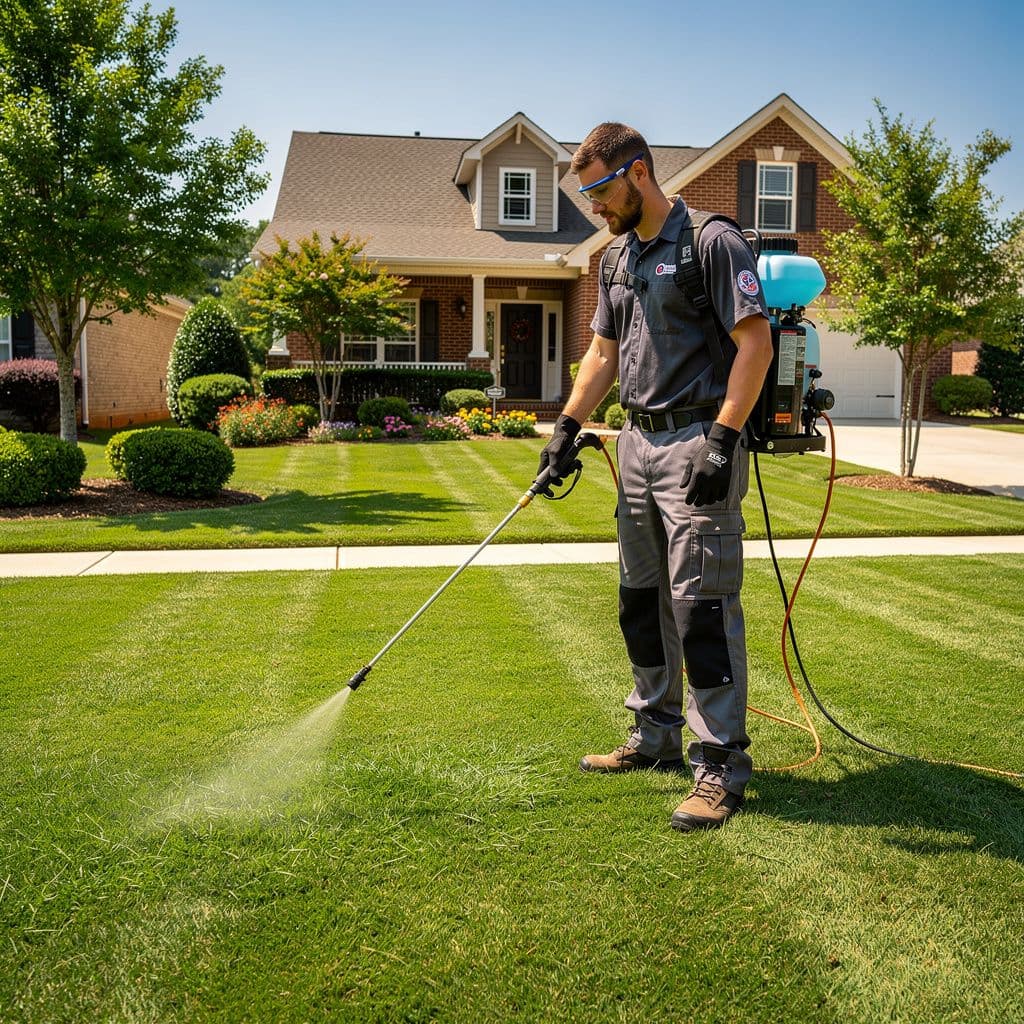
Professional Weed Control Services in Locust Grove, Stockbridge & McDonough, GA
Published: June 4, 2026
Weeds don't wait. One week your Locust Grove lawn looks clean, and the next you're staring at crabgrass creeping along the sidewalk, dandelions popping up in the flower beds, and clover taking over the bare patches near the mailbox. In Henry County's warm, humid climate, weeds germinate fast, spread faster, and choke out the healthy grass you've been working so hard to maintain.
If you've been searching for "weed control service near me" or "weed control service in Locust Grove," you already know that DIY weed treatments from the home improvement store only go so far. They might knock back the visible weeds for a week or two, but the root systems survive, the seeds keep germinating, and before long you're right back where you started. Professional weed control takes a different approach — one that eliminates existing weeds, prevents new ones from sprouting, and protects your lawn's health in the process.
At Hedgecoth Property Solutions, we provide professional lawn care and weed control services to homeowners throughout Locust Grove, Stockbridge, McDonough, and all of Henry County. Our weed management programs are designed specifically for Georgia's climate, soil conditions, and the specific weed species that thrive in our area. Whether you need a one-time treatment to get a weed problem under control or a year-round program to keep your property weed-free, this guide explains everything you need to know about professional weed control services in Henry County.
Why Henry County Lawns Are Prone to Weeds
Georgia's Climate Creates the Perfect Storm for Weeds
Henry County sits in USDA Hardiness Zone 8a, which means long, hot summers and mild winters. That combination creates ideal growing conditions for both warm-season turfgrasses and the weeds that compete with them. Our area receives 45-55 inches of rainfall per year, often in heavy downpours during spring and summer, which spreads weed seeds across properties rapidly.
The neighborhoods around McDonough and Stockbridge — from Eagle's Landing to Cotton Fields, from Flippen Road to the communities near Panola Mountain State Park — all share similar weed pressure. The warm-season grasses (Bermuda, Zoysia, Centipede) that thrive here go dormant in winter, leaving bare soil exposed for winter annual weeds like chickweed, henbit, and annual bluegrass to colonize. When spring arrives, the weeds have a head start over your dormant grass.
Clay Soil Compounds the Problem
Henry County's infamous red clay soil doesn't just make landscaping challenging — it actively helps weeds. Clay soil compacts easily, which restricts root growth for turfgrass while weeds like crabgrass, dallisgrass, and nutsedge thrive in compacted conditions. Poor drainage creates standing water in low spots, where moisture-loving weeds like sedges and pennywort establish quickly.
Professional weed control services address the soil conditions that allow weeds to flourish, not just the weeds themselves. This is a critical difference between spraying weeds yourself and hiring a professional.
Types of Weed Control Treatments
Pre-Emergent Weed Control
Pre-emergent herbicides are the foundation of any effective weed management program. These treatments create a chemical barrier in the soil that prevents weed seeds from germinating. Think of it as an invisible shield that stops weeds before they ever break the surface.
In Henry County, pre-emergent applications are critical at two key times:
- Spring pre-emergent (February-March): Prevents summer annual weeds like crabgrass, goosegrass, and spurge from germinating as soil temperatures rise. This is the single most important weed control application of the year. If you miss the spring pre-emergent window, you'll be fighting crabgrass all summer long.
- Fall pre-emergent (September-October): Prevents winter annual weeds like annual bluegrass (Poa annua), chickweed, henbit, and Carolina geranium from establishing when your warm-season grass goes dormant.
Professional pre-emergent applications use commercial-grade products with longer residual activity than consumer products. The timing and application rate are calibrated to your specific lawn conditions — something that's difficult to achieve with store-bought products.
Post-Emergent Weed Control
Post-emergent treatments target weeds that are already growing in your lawn. These herbicides are absorbed through the leaves and translocated to the roots, killing the entire plant rather than just burning off the top growth.
Different weeds require different post-emergent approaches:
- Broadleaf weeds (dandelions, clover, plantain, wild violets) respond to selective broadleaf herbicides that kill the weeds without harming your turfgrass
- Grassy weeds (crabgrass, dallisgrass, goosegrass) require specific herbicides and often multiple treatments
- Sedges (nutsedge, kyllinga) need specialized treatments because they're not true grasses and resist standard weed killers
The key to effective post-emergent treatment is proper identification. A professional weed control service can identify the specific weed species in your lawn and apply the correct treatment at the right growth stage for maximum effectiveness.
Targeted Treatments for Tough Weeds
Some weeds in Henry County are particularly aggressive and require specialized approaches:
- Nutsedge (nutgrass): This sedge produces underground tubers (nutlets) that can survive for years in the soil. Standard weed killers won't touch it. Professional treatment requires specific sedge-active herbicides applied at precise intervals.
- Dallisgrass: A clumping perennial grassy weed that spreads by seed and short rhizomes. It's resistant to most pre-emergent treatments and requires targeted post-emergent applications.
- Wild violets: These broadleaf weeds have waxy leaves that repel standard herbicides. They spread by seeds and rhizomes, forming dense mats that crowd out turfgrass.
- Bermuda grass in flower beds: Ironically, Bermuda — a desirable lawn grass — becomes an aggressive weed when it invades planting beds, hardscaping edges, and landscape areas. Professional spot treatments can control it without damaging ornamental plants.
What to Expect from Professional Weed Control Service
Initial Lawn Assessment
A reputable weed control service begins with a thorough assessment of your property. At Hedgecoth Property Solutions, we evaluate:
- Weed species identification — what weeds are present and at what density
- Turfgrass type and health — Bermuda, Zoysia, Centipede, or Fescue, and its current condition
- Soil conditions — compaction, drainage issues, and thatch buildup
- Shade patterns — shaded areas promote different weeds than full-sun areas
- Property size and terrain — flat, sloped, fenced, or wooded areas affect treatment approaches
This assessment determines your customized treatment plan, including which products to use, when to apply them, and whether additional services like aeration or fertilization would improve results.
Year-Round Treatment Schedule
Effective weed control in Henry County requires a year-round approach. Here's what a professional program typically includes:
Spring (February - May):
- Pre-emergent application for summer annual weeds
- Post-emergent treatment for any emerged broadleaf weeds
- Spot treatments for perennial weeds like dallisgrass and wild violets
- Fertilization to strengthen turfgrass and help it outcompete weeds
Summer (June - August):
- Post-emergent treatments for crabgrass breakthrough and summer weeds
- Nutsedge monitoring and treatment as it emerges
- Spot spraying for weeds in landscape beds and along hardscape edges
- Ongoing evaluation of lawn health and weed pressure
Fall (September - November):
- Pre-emergent application for winter annual weeds
- Post-emergent treatment for remaining summer weeds
- Fall fertilization to prepare turfgrass for dormancy
- Assessment of lawn density to identify areas needing overseeding
Winter (December - January):
- Selective post-emergent treatments for winter weeds while turfgrass is dormant
- Planning for spring applications
- Soil testing for properties with persistent weed issues
Professional Equipment and Products
Professional property maintenance companies use commercial-grade equipment and products that aren't available to homeowners. These include:
- Backpack sprayers with calibrated nozzles for precise application rates
- Broadcast spreaders for even pre-emergent distribution
- Commercial-strength herbicides with longer residual activity and better weed control
- Surfactants and adjuvants that improve herbicide absorption and effectiveness
- Marking dyes that show exactly where treatments have been applied
This equipment ensures consistent, complete coverage — no missed spots where weeds can establish and spread.
Weed Control for Specific Henry County Communities
Locust Grove
Locust Grove properties face unique weed pressure from the area's mix of established neighborhoods and newer developments. Older properties near downtown Locust Grove and the areas around Tanger Outlets often have mature landscapes with established weed seed banks in the soil. Newer subdivisions typically have disturbed soil from construction — a perfect environment for pioneer weed species like crabgrass, spurge, and purslane.
If you're searching for "weed control service Locust Grove," look for a provider who understands the difference between treating an established lawn near Locust Grove city center versus a newly sodded yard in a recently built neighborhood. The treatment protocols are significantly different.
Stockbridge
Stockbridge homeowners deal with heavy weed pressure thanks to the area's dense clay soil and mature tree canopy. Properties near Panola Mountain State Park and the neighborhoods off Fairview Road often have significant shade, which promotes different weed species than full-sun lawns. Shaded areas are prone to creeping Charlie, moss, and annual bluegrass — weeds that thrive in low-light, moist conditions.
Stockbridge's mix of residential developments, from the well-established communities near downtown to newer construction along Highway 138, means weed control programs need to be tailored to each property's specific conditions rather than applied as a one-size-fits-all treatment.
McDonough
McDonough is Henry County's largest city and has the widest variety of property types — from small residential lots near the historic square to acreage properties along the outskirts. Each type of property has different weed management needs:
- Small residential lots benefit from consistent pre-emergent and post-emergent programs that keep turfgrass thick and competitive
- Larger properties may need specialized treatment for fence lines, drainage areas, and landscape borders where weeds establish and spread into the lawn
- Properties near agricultural areas face pressure from windblown weed seeds that require more aggressive management
DIY Weed Control vs. Professional Service
The Real Cost of Doing It Yourself
Many Henry County homeowners try to handle weed control themselves before calling a professional. Here's what that typically looks like:
- $40-80 per trip to the home improvement store for weed killer products
- 3-5 trips per year for different products (pre-emergent, broadleaf killer, grassy weed killer, sedge treatment)
- 4-8 hours per application for a typical quarter-acre lot (including mixing, applying, and cleanup)
- Inconsistent results because timing is difficult to nail without experience
- Potential turf damage from over-application, wrong products, or poor timing
Over a year, DIY weed control often costs $200-400 in products alone, plus 20-40 hours of your time — and the results rarely match what a professional achieves with commercial products and proper timing.
What Professional Service Costs
Professional weed control in Henry County typically costs:
- $50-85 per treatment for an average quarter-acre residential lot
- 6-8 treatments per year for a comprehensive program
- $300-600 per year total for full-service weed management
That includes commercial-grade products, proper timing, expert application, and the peace of mind that comes with knowing your lawn is being treated correctly. When you factor in the cost of products, equipment, and your time, professional service is often less expensive than doing it yourself — with significantly better results.
How to Choose a Weed Control Service in Henry County
Not all weed control providers are equal. When evaluating services in Locust Grove, Stockbridge, or McDonough, ask these questions:
Licensing and Insurance
Georgia requires a commercial pesticide applicator's license for anyone applying herbicides for hire. Ask to see current licensing. Insurance should include general liability and pesticide application coverage. Hedgecoth Property Solutions maintains all required state licensing and insurance for weed control services in Henry County.
Treatment Approach
The best weed control services offer integrated programs that combine pre-emergent and post-emergent treatments with fertilization and cultural practices like proper mowing and watering. Weed-only treatments without attention to overall lawn health provide temporary results at best.
Local Knowledge
A provider based in Henry County understands the specific weed species, soil conditions, and seasonal patterns that affect lawns in Locust Grove, Stockbridge, and McDonough. National franchise companies often use generic treatment schedules that aren't optimized for Georgia's unique conditions. Local lawn care providers deliver better results because they know the area.
Service Guarantees
Reputable providers stand behind their work. Look for companies that offer retreatment guarantees — if weeds persist between scheduled treatments, they should return to address the issue at no additional charge.
Combining Weed Control with Lawn Care for Best Results
Weed control works best when it's part of a comprehensive lawn care program. A thick, healthy lawn is the best weed prevention there is — dense turfgrass shades the soil surface, preventing weed seeds from germinating, and outcompetes any weeds that do sprout for water, nutrients, and sunlight.
The most effective approach combines:
- Pre-emergent weed control to prevent weed germination
- Proper fertilization to maintain turfgrass density and vigor
- Correct mowing height — Bermuda at 1-2 inches, Zoysia at 1.5-2.5 inches, Centipede at 1-2 inches
- Adequate watering — deep, infrequent irrigation promotes deep roots
- Annual aeration to relieve soil compaction and improve drainage
- Post-emergent spot treatments for any weeds that break through
When all these elements work together, weed problems become manageable rather than overwhelming. That's why Hedgecoth Property Solutions offers integrated property maintenance programs that address weed control alongside fertilization, mowing, aeration, and seasonal leaf removal services.
Frequently Asked Questions
When is the best time to apply pre-emergent weed control in Henry County?
Spring pre-emergent should be applied in late February to mid-March, before soil temperatures reach 55°F consistently — the trigger for crabgrass germination. Fall pre-emergent goes down in September through mid-October, before nighttime temperatures drop low enough for winter annual weed seeds to germinate. Timing varies slightly each year based on weather patterns.
How long does it take for weed control treatments to work?
Post-emergent treatments typically show visible results within 7-14 days as weeds yellow, curl, and die. Pre-emergent treatments work invisibly — you won't see anything because they prevent weeds from germinating in the first place. The real measure of pre-emergent success is what you don't see in your lawn during the growing season.
Is professional weed control safe for pets and children?
Yes, when applied by a licensed professional following label directions. Most modern herbicides dry within 1-2 hours and are safe for people and pets to contact after drying. Your weed control provider should give you specific instructions about re-entry times after each treatment.
Can weed control damage my grass?
When applied correctly by a trained professional using the right products at the right rates, selective herbicides kill weeds without harming your turfgrass. The risk of turf damage comes from misidentification (using the wrong product), over-application, or treating grass that's stressed by drought, disease, or extreme heat. Professional applicators know how to avoid these issues.
How often should weed control be applied?
A comprehensive program includes 6-8 treatments per year in Henry County: two pre-emergent applications (spring and fall), monthly post-emergent spot treatments during the growing season, and winter treatments for cool-season weeds. Properties with heavy weed pressure may benefit from more frequent initial treatments to get the problem under control.
Do I need weed control if I already fertilize my lawn?
Yes. Fertilization feeds both your grass AND the weeds — it doesn't discriminate. Without weed control, fertilized weeds grow just as aggressively as fertilized turfgrass, often outcompeting the grass for space and resources. The most effective programs combine fertilization with weed control to ensure nutrients are going to your lawn, not the weeds.
Get Professional Weed Control in Henry County
Don't let weeds take over your lawn this summer. Whether you're in Locust Grove, Stockbridge, McDonough, or anywhere in Henry County, Hedgecoth Property Solutions provides professional weed control services tailored to your property's specific needs. Our licensed applicators use commercial-grade products, proven treatment schedules, and local expertise to keep your lawn weed-free and healthy all year long.
Call 770-490-9519 for a free estimate or contact us online to schedule your lawn assessment. We'll identify the weeds in your yard, evaluate your turf conditions, and recommend a treatment program that fits your property and budget.
Your lawn deserves better than weeds. Let us help you get it there.