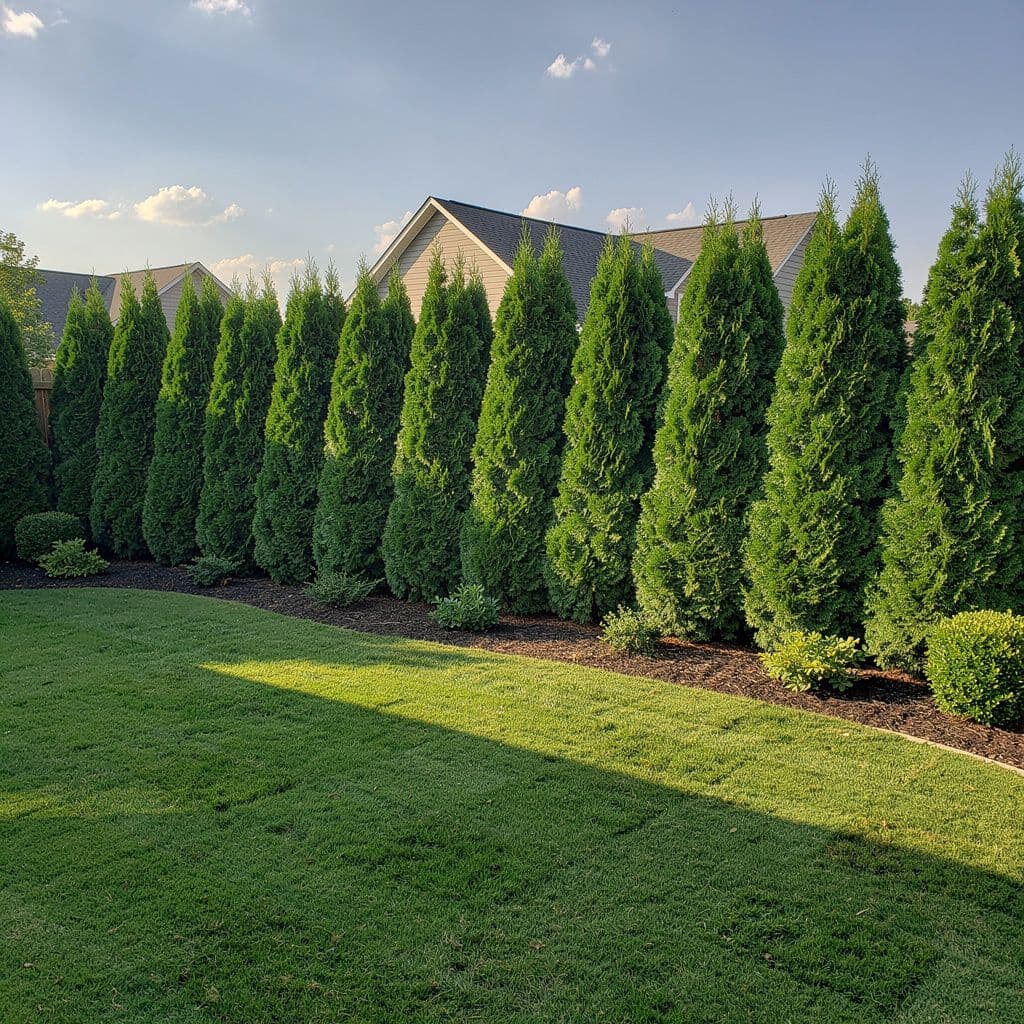
Privacy Trees & Hedges: The Complete Screening Guide for Henry County Yards
Published: July 13, 2026
You moved to Henry County for the space. The bigger lots, the rolling hills, the breathing room that you just can't get inside the Perimeter. But then the vacant lot next door sold, and now someone is building a two-story home that looks straight into your backyard. Or the neighbor's trampoline went up and suddenly every afternoon sounds like a parade. Or you're sitting on your patio trying to enjoy a quiet evening, and three houses down someone's motion light keeps flicking on every time a car passes.
Privacy is one of the top reasons homeowners in Locust Grove, McDonough, Stockbridge, and throughout Henry County call us about landscaping services. A well-designed privacy screen using trees and hedges doesn't just block unwanted views — it reduces noise, buffers wind, creates wildlife habitat, and can increase your property value by 5-15%.
But here's what most people get wrong: they run to the nearest big-box store, buy the fastest-growing tree they can find, plant them three feet apart, and discover two years later that those trees are now 20 feet tall, blocking all their sunlight, invading their driveway with roots, and half of them are dying because they were planted too close together.
This guide covers everything you need to know about privacy trees and hedges for Henry County properties — the best species for Georgia's climate, proper spacing, planting timing, maintenance requirements, and when to call in professionals. Whether you live near Heritage Park in McDonough, out toward Noah's Ark Animal Sanctuary in Locust Grove, or in the growing subdivisions around Stockbridge, this guide will help you create a living privacy screen that actually works.
Why Natural Privacy Beats Fences in Henry County
Before we get into plant species, let's talk about why natural privacy screens are often a better investment than fences — especially in Henry County.
Fences Have Limits
In most Henry County jurisdictions, residential fences are capped at 6-8 feet depending on the zoning district and whether you're in an HOA. That's fine for blocking the view from a ground-level patio, but it does nothing when your neighbor's second-story windows look down into your yard. A 6-foot fence also does nothing for noise reduction — sound waves travel right over it.
Fences also have aesthetic downsides. A solid privacy fence around a half-acre lot can feel like living inside a stockade. It blocks light, creates dark corners that collect moisture and grow mold, and honestly? Most of them aren't that attractive after a few Georgia summers warp and weather the wood.
Living Screens Grow Higher and Look Better
The right privacy trees can reach 30-60 feet at maturity, providing screening that no fence can match. They filter wind instead of blocking it completely (which reduces turbulence). They absorb sound. They provide shade that lowers your cooling bills. And they look like they belong in the landscape — because they're plants, not structures.
A mature Leyland cypress screen along a property line adds an average of $5,000-$15,000 to a home's resale value in Henry County, according to local real estate agents. Compare that to a wood fence, which typically adds $1,500-$3,000 and starts depreciating the day it's installed.
HOA and Permit Advantages
Many HOAs in Henry County subdivisions — particularly in McDonough and Stockbridge — have strict rules about fence heights, materials, and styles. Some don't allow solid privacy fences at all. But nearly all HOAs allow trees and shrubs, because they're considered landscaping rather than structures. A well-designed privacy screen made of hedges gives you the privacy you want without the HOA battle.
That said, always check your HOA covenants before planting. Some have rules about how close trees can be planted to property lines, and you don't want a fast-growing species causing issues with a neighbor's foundation or driveway.
Best Privacy Trees for Henry County, GA
Henry County sits in USDA Hardiness Zone 8a, which means our winters rarely drop below 10-15°F. Our summers are hot and humid, and our soil is typically heavy red clay — which is nutrient-rich but drains poorly. The best privacy trees for our area handle these conditions without complaint.
Leyland Cypress (× Cuprocyparis leylandii)
The undisputed king of Southern privacy screens. Leyland cypress is what you see lining property boundaries in subdivisions across Locust Grove, McDonough, and Stockbridge — and for good reason.
- Growth rate: 3-4 feet per year (fastest of any screening evergreen)
- Mature height: 60-70 feet
- Mature width: 15-25 feet (if left untrimmed)
- Spacing: 6-10 feet apart for a dense screen
- Sun: Full sun to partial shade
- Soil: Tolerates clay but benefits from amended planting holes
Leyland cypress creates a dense, feathery, blue-green wall that blocks wind, noise, and views year-round. It's evergreen, so you get screening 12 months a year. The main downside is that it grows FAST — if you don't trim annually, it will quickly outgrow its space. We recommend planting 8 feet apart and committing to yearly tree trimming to keep them dense and contained.
Pro tip: Leyland cypress is susceptible to canker diseases in poorly drained soil. If your Henry County property has heavy, waterlogged clay, consider one of the alternatives below or plan to amend the soil significantly at planting time.
Nellie R. Stevens Holly
If you want privacy with personality, Nellie R. Stevens holly is a fantastic choice. These dense, dark-green evergreens produce bright red berries in winter and have a natural pyramidal shape that looks beautiful even without trimming.
- Growth rate: 2-3 feet per year
- Mature height: 25-40 feet
- Mature width: 10-15 feet
- Spacing: 5-8 feet apart
- Sun: Full sun to partial shade
- Soil: Highly adaptable, handles clay well
Nellie Stevens hollies are excellent for tighter spaces where Leyland cypress would overwhelm. They're also remarkably disease-resistant and drought-tolerant once established. The berries attract birds throughout winter — cardinals and cedar waxwings love them.
We frequently recommend these to homeowners in Hampton and Jonesboro who want a more refined, formal look than Leyland cypress provides.
Thuja Green Giant (Thuja plicata × standishii)
The Leyland cypress alternative that's gaining popularity across Georgia. Green Giant arborvitae grows almost as fast as Leyland but is far more disease-resistant and handles Henry County's heavy clay soil without the canker issues.
- Growth rate: 3 feet per year
- Mature height: 30-50 feet
- Mature width: 12-15 feet
- Spacing: 5-8 feet apart
- Sun: Full sun to partial shade
- Soil: Highly adaptable
Green Giant has a uniform, conical shape that looks great in both formal and natural landscapes. The foliage is a rich, dark green that holds its color through winter without the bronzing that affects some arborvitae varieties. It's also more deer-resistant than Leyland cypress, which matters in the more rural parts of Locust Grove and Hampton.
Eastern Red Cedar (Juniperus virginiana)
For homeowners who want a native option, Eastern red cedar is a Georgia native that's perfectly adapted to our climate. It's the rugged, irregularly shaped evergreen you see along fence rows and old-field edges throughout rural Henry County.
- Growth rate: 1-2 feet per year
- Mature height: 30-40 feet
- Mature width: 10-15 feet
- Spacing: 6-10 feet apart
- Sun: Full sun
- Soil: Extremely adaptable — handles drought, clay, and poor soil
Eastern red cedar isn't as uniform as the other options on this list, but it provides unmatched wildlife value. The berries feed dozens of bird species through winter, and the dense foliage provides nesting sites. It's perfect for larger properties where a slightly wilder, more naturalized screen fits the aesthetic.
Cryptomeria (Cryptomeria japonica 'Yoshino')
A Japanese cedar that has adapted beautifully to the Southeast. Yoshino cryptomeria offers a softer, more textured look than Leyland cypress with better disease resistance.
- Growth rate: 2-3 feet per year
- Mature height: 30-40 feet
- Mature width: 10-15 feet
- Spacing: 6-10 feet apart
- Sun: Full sun to light shade
- Soil: Prefers well-drained but tolerates clay
Cryptomeria has feathery, soft-to-the-touch foliage that turns a beautiful bronze-purple in winter — one of the few evergreens that provides seasonal color change. It's an excellent choice for homeowners who want something a little different from the standard Leyland cypress wall.
Best Privacy Hedges and Shrubs for Lower Screens
Not every privacy situation requires a 40-foot tree. If you need to screen a 4-8 foot area — blocking a neighbor's ground-level view, hiding a utility area, or defining a patio space — these hedge options work beautifully in Henry County.
Lorepetalum (Chinese Fringe Flower)
One of the most versatile landscaping shrubs in Georgia. Loropetalum grows quickly, produces pink or white fringe flowers in spring, and maintains deep purple or green foliage year-round.
- Mature height: 6-15 feet depending on variety
- Spacing: 4-6 feet apart
- Best for: Medium-height screens, foundation plantings, patio borders
Wax Myrtle (Morella cerifera)
A Georgia native that's gained enormous popularity as a screening plant. Fast-growing, evergreen, and aromatic — the leaves have a pleasant bayberry scent when brushed.
- Mature height: 10-15 feet
- Spacing: 5-6 feet apart
- Best for: Informal screens, wildlife gardens, coastal-style landscapes
Tea Olive (Osmanthus fragrans)
One of our favorite recommendations for Henry County landscapes. Tea olive stays smaller and more refined than most screening plants, but its tiny white flowers produce an incredible apricot-like fragrance that drifts across the entire yard in fall and early spring.
- Mature height: 10-15 feet
- Spacing: 5-6 feet apart
- Best for: Patio areas, entry gardens, spaces where fragrance matters
Banana Shrub (Magnolia figo)
A slower-growing but incredibly charming evergreen that produces small, creamy flowers that smell exactly like ripe bananas. Perfect for intimate screening near patios or windows where you want both privacy and scent.
- Mature height: 6-10 feet
- Spacing: 4-5 feet apart
- Best for: Small yards, patio screening, foundation plantings
How to Plan Your Privacy Screen
Choosing the right plants is only half the equation. How you plan, space, and plant your screen determines whether it thrives or fails.
Step 1: Identify What You're Screening
Different privacy needs require different solutions:
- Second-story windows looking into your yard: Need tall trees (30+ feet)
- Ground-level patio visibility: 6-10 foot hedges work well
- Road noise: Dense evergreen trees planted in two staggered rows
- Utility area screening (AC units, trash cans): 4-6 foot shrubs
- Property line definition: Medium-height hedges or tree allees
Walk outside and stand where you want privacy. What exactly can you see? What's the height of the thing you're trying to block? Measure it if you can — this determines your plant height requirements.
Step 2: Check Your Space
Before falling in love with a species, measure your available space:
- How wide is the planting area? Keep plants at least 3 feet from property lines, fences, and structures
- Are there overhead power lines? If yes, stick to species that stay under 20 feet
- Is there underground drainage or septic? Don't plant aggressive-rooted species near drain fields
- How much sun does the area get? Most screening evergreens need at least 6 hours of direct sun
Step 3: Plan Your Spacing
The biggest mistake we see in Henry County is planting privacy trees too close together. It's tempting — you buy small 6-foot trees and space them 3 feet apart because they look sparse. Five years later, they're 20 feet tall, fighting for sunlight, and the inner branches are dying from lack of air circulation.
Proper spacing for the most popular options:
| Tree/Shrub | Recommended Spacing | Time to Full Screen |
|---|---|---|
| Leyland Cypress | 8 feet apart | 3-4 years |
| Thuja Green Giant | 6 feet apart | 3-5 years |
| Nellie R. Stevens Holly | 6 feet apart | 4-6 years |
| Cryptomeria | 8 feet apart | 5-7 years |
| Eastern Red Cedar | 8 feet apart | 6-8 years |
| Wax Myrtle | 5 feet apart | 3-4 years |
| Loropetalum | 4 feet apart | 2-3 years |
If you need faster coverage, plant in a staggered double row rather than cramming plants closer together in a single row. A zigzag pattern with plants 10 feet apart in two offset rows creates a denser screen faster than a single row at 5-foot spacing — and the plants stay healthier.
Step 4: Time Your Planting Right
In Henry County, the best time to plant privacy trees and hedges is:
- October through March — Cool temperatures and winter rainfall help roots establish before summer heat arrives
- March through April — Spring planting works but requires diligent watering through the first summer
- Avoid May through September — Summer planting is stressful for new trees and requires daily watering
If you're reading this in July, now is the perfect time to plan your fall planting project. Choose your species, mark your planting locations, amend your soil in advance, and schedule installation for October. Your plants will have months of cool weather to establish roots before facing their first Georgia summer.
Privacy Screen Maintenance: Keeping Your Screen Healthy
A privacy screen is a 20+ year investment. Like any landscape feature, it needs ongoing care to stay dense, healthy, and attractive.
Watering Schedule for New Privacy Trees
First growing season (fall planting through following summer):
- Water deeply twice per week from April through October
- Each tree needs 10-15 gallons per watering session
- Use a slow trickle from a hose at the root zone — sprinklers don't water deeply enough
- Apply 3 inches of mulch around (but not touching) the trunk to retain moisture
Second growing season:
- Water once per week during dry spells
- Roots are establishing but still need supplemental water during Henry County's summer dry periods
Third year and beyond:
- Most privacy trees are self-sufficient after establishment
- Water only during extended drought (2+ weeks without rain in summer)
Trimming and Shaping
Annual trimming keeps privacy screens dense and contained:
- Leyland cypress: Trim sides back by 6-12 inches annually in late winter (February). Never cut into old, bare wood — it won't regrow.
- Hollies: Light shaping in late winter. Heavier pruning after berry season if needed.
- Thuja Green Giant: Light annual trim in late winter. Tolerates shearing well.
- Loropetalum and wax myrtle: Trim after spring flowering to control size and encourage branching.
For hedges and shrubs, professional shrub and hedge trimming makes a significant difference in long-term health. Improper shearing — cutting the top wider than the bottom, for example — causes the lower branches to lose sunlight and die out, leaving you with a bare-bottomed hedge.
Fertilizing
Most privacy trees in Henry County's clay soil benefit from a balanced slow-release fertilizer in early spring (March). We recommend a 10-10-10 or similar balanced formula applied at the drip line. Avoid high-nitrogen fertilizers after July — they stimulate late-season growth that's vulnerable to winter damage.
For established screens (5+ years), fertilization may only be needed every 2-3 years. A soil test through the Henry County UGA Extension Office will tell you exactly what your soil needs.
Pest and Disease Monitoring
Common issues in Henry County privacy screens:
- Bagworms on Leyland cypress and arborvitae — Look for small cone-shaped bags hanging from branches. Hand-pick in winter or treat with Bt in spring.
- Spider mites during hot, dry summers — Cause interior browning. Hose off with a strong spray of water or treat with horticultural oil.
- Canker diseases in Leyland cypress — Caused by poorly drained soil and overhead watering. Improve drainage and avoid overhead irrigation.
- Scale insects on hollies — Look for white or gray bumps on stems. Treat with horticultural oil in early spring.
Regular inspections catch these problems before they spread. Our property maintenance programs include monitoring privacy screens and landscape plants for early signs of trouble.
Cost of Installing a Privacy Screen in Henry County
Budget is obviously a factor. Here's what to expect for professional privacy screen installation in the Locust Grove, McDonough, and Stockbridge area:
Tree Installation (per tree, including labor)
- 6-7 foot Leyland cypress: $85-$125 per tree
- 8-10 foot Leyland cypress: $150-$225 per tree
- 6-7 foot Thuja Green Giant: $95-$140 per tree
- 5-6 foot Nellie R. Stevens Holly: $110-$160 per tree
- 7-8 foot Cryptomeria: $130-$190 per tree
Additional Costs
- Soil amendment (compost mixed into clay): $25-$40 per planting hole
- Mulch: $4-$8 per tree
- Staking and tree guards: $5-$15 per tree
- Delivery: Often included for orders of 10+ trees, otherwise $50-$100
Example Project: 100-Foot Property Line Screen
For a typical 100-foot property line using Leyland cypress spaced 8 feet apart (13 trees):
- 13 trees at 6-7 feet: $1,105-$1,625
- Soil amendment: $325-$520
- Mulch: $65-$104
- Installation labor: $400-$650
- Total project: $1,895-$2,899
Compare this to a 100-foot wood privacy fence at $35-$55 per linear foot ($3,500-$5,500) that starts deteriorating immediately and maxes out at 8 feet tall.
When to Call a Professional
While planting a few trees might be a DIY-friendly project, larger privacy screen installations benefit from professional help:
- Site assessment — A professional evaluates soil conditions, drainage patterns, sun exposure, and sight lines that aren't obvious to the untrained eye
- Species selection — Matching the right plant to the right microclimate prevents costly failures
- Proper planting technique — The #1 reason privacy trees die in Henry County is being planted too deep in heavy clay soil. Professional installation ensures correct depth, soil amendment, and initial watering
- Bulk sourcing — We source trees directly from wholesale growers, often at 30-40% less than retail nursery prices
- Irrigation planning — New privacy screens need consistent water for the first year. We can integrate drip irrigation into the planting plan
At Hedgecoth Property Solutions, we handle complete privacy screen design and installation across Henry County. From the initial site visit to the final mulch, our team manages every detail. We also provide ongoing lawn care and property maintenance to keep your screen — and the rest of your landscape — looking its best for years to come.
Frequently Asked Questions About Privacy Trees in Henry County
How close to my property line can I plant privacy trees?
In most Henry County jurisdictions, you can plant right up to the property line, but we recommend keeping trees at least 3-5 feet inside your line. This prevents branches from overhanging a neighbor's property and avoids future disputes. Check your HOA covenants and local zoning ordinances for specific setback requirements, and always call 811 (Georgia Utility Protection Center) before digging to mark underground utilities.
What is the fastest-growing privacy tree for Georgia?
Leyland cypress is the fastest-growing screening evergreen for Henry County, adding 3-4 feet of growth per year with proper watering and fertilization. Thuja Green Giant is a close second at 3 feet per year and offers better disease resistance. For rapid summer coverage, consider mixing fast-growing evergreens with temporary screening like ornamental grasses or tall perennials that fill in within the first season while the trees establish.
Can I plant privacy trees in summer in Henry County?
Summer planting (June through September) is risky for privacy trees in Georgia. The extreme heat and humidity stress newly planted trees before their roots can establish, requiring daily watering and still resulting in higher failure rates. The ideal planting window is October through March. If you must plant in summer, choose container-grown trees (not balled-and-burlapped), plant in the early morning, apply a thick mulch layer, and commit to watering every single day for the first month.
How far apart should I plant Leyland cypress for a privacy screen?
Plant Leyland cypress 8 feet apart for a solid screen that fills in within 3-4 years. If you need faster coverage, use a staggered double-row pattern with trees 10 feet apart in each row and the rows offset by 5 feet. Avoid the common mistake of planting 4-5 feet apart — the trees will compete for sunlight and nutrients, leading to thin, unhealthy growth and higher mortality rates.
Do privacy trees increase property value in Henry County?
Yes. Mature privacy landscaping consistently ranks among the top features buyers look for in Henry County real estate. A well-established evergreen screen can add $5,000-$15,000 to your home's value depending on the length and maturity of the planting. Real estate agents in McDonough and Locust Grove specifically note that properties with natural privacy screens sell faster than those without — privacy is a premium feature in our growing suburban market.
How much does professional privacy tree installation cost in Henry County?
For a typical 100-foot property line screen with Leyland cypress, expect to invest $1,900-$2,900 including trees, soil amendment, mulch, and professional installation. Costs vary based on tree species, size at planting, soil conditions, and accessibility. Larger projects or premium species like cryptomeria may cost more. Call us at 770-490-9519 for a free, no-obligation estimate tailored to your specific property.
Ready to Create Your Private Backyard Oasis?
Whether you're tired of waving to the neighbor every time you step outside, want to muffle road noise from Highway 42 or I-75, or just want your patio to feel like a retreat instead of a fishbowl, a well-designed privacy screen transforms your Henry County property.
The team at Hedgecoth Property Solutions has installed hundreds of privacy screens across Locust Grove, McDonough, Stockbridge, Jonesboro, Hampton, and Henry County. We know which species thrive in our clay soil, how to space them for long-term health, and how to design a screen that enhances your property's beauty while giving you the privacy you deserve.
Call us today at 770-490-9519 or visit our contact page to schedule a free consultation. We'll assess your property, recommend the best screening options for your specific situation, and provide a detailed estimate — all with no pressure and no obligation.
Your private backyard is one phone call away. Let's make it happen.