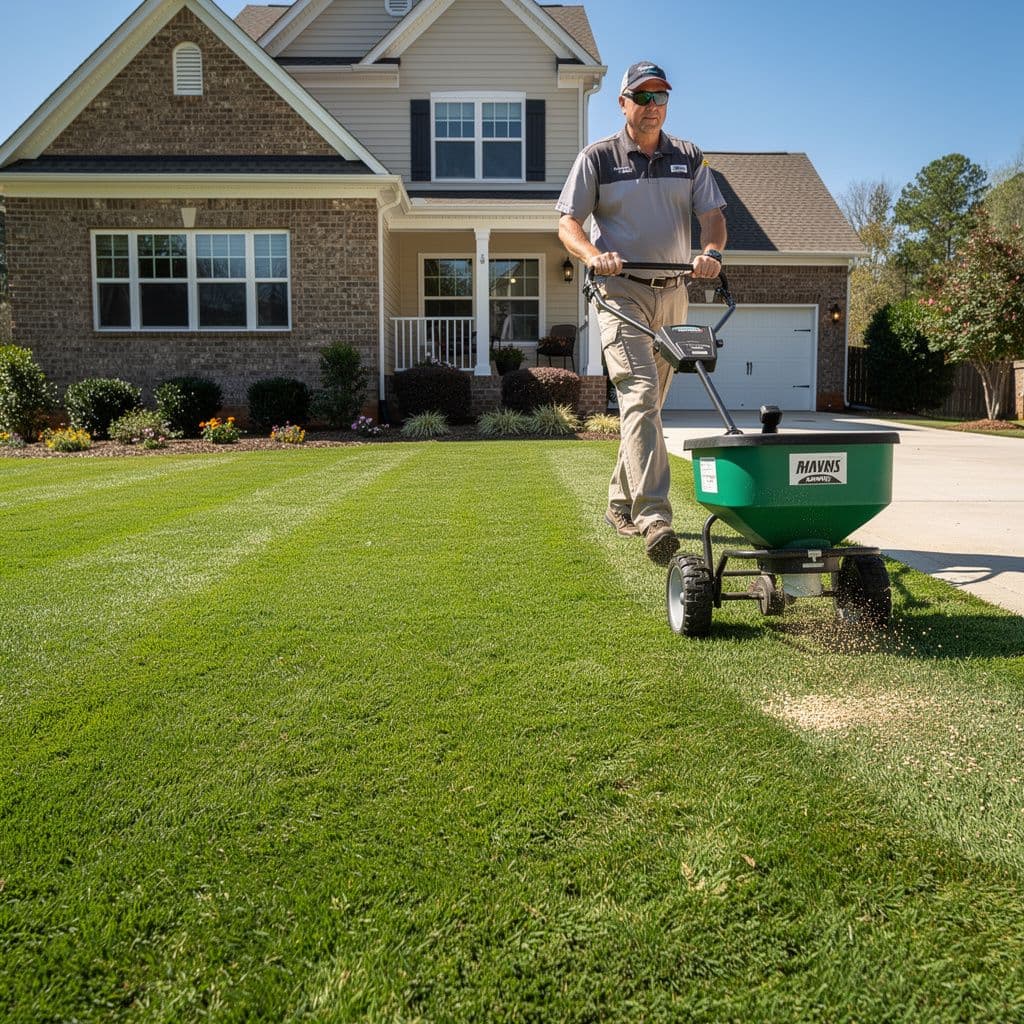
Lawn Fertilization & Weed Control in Stockbridge, GA: The Complete Homeowner's Treatment Guide
Published: June 26, 2026
If you live in Stockbridge and your lawn looks tired — thin grass, stubborn weeds, brown patches that won't go away no matter how much you water — the problem probably isn't your mower. It's your treatment plan. Or more likely, the lack of one.
Stockbridge homeowners deal with some of the toughest lawn conditions in Henry County. The combination of dense Georgia red clay, intense summer heat, humidity that fuels fungus, and aggressive warm-season weeds means that mowing alone will never produce the lush, green lawn you want. You need a strategic fertilization and weed control program designed specifically for your soil, your grass type, and our local climate.
Whether you're searching for a "lawn fertilizer service in Stockbridge," need help with "weed control in Stockbridge," or you're comparing "lawn care companies in Stockbridge" to find the right fit, this guide walks you through everything you need to know about professional lawn treatments in our area.
Why Stockbridge Lawns Struggle Without Treatment
The Red Clay Reality
Stockbridge sits on some of the heaviest clay soil in Henry County. If you've ever tried to dig a hole in your backyard, you already know this. That dense red clay creates several problems for your lawn:
- Compaction — Clay particles pack tightly together, squeezing out oxygen and restricting root growth. Shallow roots mean weak grass that can't handle drought or disease.
- Poor drainage — Water pools on the surface instead of soaking in, creating standing water that suffocates grass and breeds fungus. After heavy rains near South Stockbridge or around the reservoir area, this becomes especially visible.
- Nutrient lock-up — Clay soil holds nutrients but doesn't always release them effectively. Your fertilizer may be sitting in the soil, unavailable to your grass, because the pH or biology isn't right.
- Acidic pH — Georgia clay soils naturally trend acidic (pH 5.0-6.0), which limits nutrient availability and favors certain weeds over desirable turfgrass.
Without soil amendments — especially lime to adjust pH — fertilizer applications are far less effective. A professional lawn treatment service starts with soil testing to understand exactly what your Stockbridge lawn needs.
The Warm-Season Grass Challenge
Most lawns in Stockbridge use warm-season grasses: Bermuda, Zoysia, and occasionally Centipede or St. Augustine. These grasses thrive in Georgia's hot summers but go dormant (brown) from roughly November through April. Their nutrient needs, weed pressures, and disease vulnerabilities follow a specific calendar that's very different from cool-season grasses:
- Spring green-up (April-May): Grass emerges from dormancy hungry for nitrogen. Pre-emergent herbicides must be applied before soil temperatures hit 55°F to prevent summer weeds.
- Peak growing season (June-August): Heavy feeding, frequent mowing, and active weed competition. This is when armyworms, chinch bugs, and brown patch fungus are most active.
- Transition (September-October): Growth slows. Fertilizer shifts from nitrogen-heavy to potassium-heavy to prepare for winter. Post-emergent weed control targets summer annuals before they go to seed.
- Dormancy (November-March): Grass is brown but still alive. Pre-emergent applications in fall prevent winter weeds like annual bluegrass and henbit.
Generic fertilizer schedules from big-box stores don't account for this calendar. A local lawn treatment service that understands Stockbridge conditions adjusts applications to match what your grass actually needs — when it needs it.
Professional Fertilization: What Stockbridge Lawns Actually Need
The NPK Breakdown — It's Not Just "Nitrogen"
Walk into any hardware store on Highway 138 and you'll see shelves of fertilizer bags with confusing numbers: 10-10-10, 29-0-4, 16-4-8. Those numbers represent the percentage of Nitrogen (N), Phosphorus (P), and Potassium (K) in the bag. Choosing the wrong blend can waste money and actually harm your lawn.
Nitrogen (N) drives green, leafy growth. It's what makes your grass look lush and dark green. But too much nitrogen — especially in fast-release forms — causes excessive growth that weakens the plant, increases disease susceptibility, and creates heavy thatch buildup. In Stockbridge's humid climate, excess nitrogen is a primary trigger for brown patch fungus.
Phosphorus (P) supports root development. Many Stockbridge soils already test high in phosphorus from years of generic fertilizer applications. Adding more when it's not needed contributes to water pollution without helping your lawn. Georgia law actually restricts phosphorus in lawn fertilizers unless a soil test confirms deficiency.
Potassium (K) is the stress-relief nutrient. It strengthens cell walls, improves drought tolerance, enhances cold hardiness, and boosts disease resistance. For Stockbridge lawns dealing with summer heat and occasional drought, potassium is arguably as important as nitrogen.
Slow-Release vs. Quick-Release Fertilizer
This is where professional lawn treatment services separate themselves from DIY approaches. Professional-grade fertilizers typically use slow-release or controlled-release nitrogen sources that feed your lawn gradually over 6-10 weeks. Benefits include:
- Consistent growth instead of growth spikes followed by starvation
- Reduced burn risk — slow-release nitrogen won't scorch your grass during hot Stockbridge summers
- Environmental protection — less nitrogen leaching into groundwater and nearby streams
- Fewer applications needed — one professional application can replace two or three DIY treatments
Big-box store fertilizers often rely heavily on quick-release urea nitrogen. Your lawn greens up fast for about two weeks, then crashes. This boom-bust cycle stresses the grass and creates the perfect conditions for weeds to move in during the recovery period.
Micro-Nutrients and Soil Amendments
Beyond NPK, Stockbridge lawns often need:
- Lime — to raise soil pH from acidic to the 6.0-6.5 range that warm-season grasses prefer. Most Stockbridge soils need 40-50 pounds of lime per 1,000 sq ft annually.
- Iron — essential for deep green color, especially in soils with high pH or high phosphorus levels. Iron deficiency causes yellowing even when nitrogen is adequate.
- Manganese and zinc — trace elements that support enzyme function and chlorophyll production. Deficiencies are common in Georgia clay.
- Humic acid — improves soil structure, increases microbial activity, and enhances nutrient availability in compacted clay soils.
A professional lawn treatment program tests your soil and includes amendments tailored to what's actually missing — not a one-size-fits-all blend.
Weed Control in Stockbridge: A Year-Round Battle
Georgia's long growing season means weeds never really stop. The key to effective weed control isn't spraying everything in sight — it's applying the right product at the right time to prevent weeds before they establish.
Pre-Emergent Herbicides: Prevention Is Everything
Pre-emergent herbicides create a chemical barrier in the soil that prevents weed seeds from germinating. They're the single most effective weed control tool available — but timing is critical.
Spring pre-emergent (late February to mid-March): Targets summer annual weeds before they germinate. This application is your primary defense against:
- Crabgrass — the most common summer weed in Stockbridge lawns. One plant can produce 150,000 seeds.
- Goosegrass — a tough, clumping weed that thrives in compacted soil (very common in Stockbridge's clay).
- Sandbur — produces painful seed heads that make barefoot walking impossible.
- Spurge — a low-growing, spreading weed that fills in thin areas of turf.
Apply too early and the barrier breaks down before peak germination. Apply too late and the weeds have already sprouted. A local Stockbridge lawn service monitors soil temperatures and times applications perfectly.
Fall pre-emergent (September to October): Targets winter annual weeds:
- Annual bluegrass (Poa annua) — bright green clumps that stand out against dormant Bermuda.
- Henbit — a broadleaf weed with purple flowers that invades thin turf.
- Chickweed — a low, mat-forming weed that thrives in moist, shaded areas.
- Wild onion/garlic — those familiar clumps of wild allium that pop up every winter in Stockbridge neighborhoods.
Post-Emergent Weed Control: Treating What's Already There
Even with perfect pre-emergent timing, some weeds break through. Post-emergent herbicides target actively growing weeds. Different products work for different weed types:
Grassy weeds like dallisgrass, nutsedge, and bahiagrass require specific selective herbicides. Nutsedge (sometimes called nutgrass) is particularly aggressive in Stockbridge's moist clay soils and requires specialized products like SedgeHammer or halosulfuron. It looks like grass but grows faster and lighter green, ruining an otherwise uniform lawn.
Broadleaf weeds like dandelions, clover, dollarweed, and knotweed respond to broadleaf herbicides containing 2,4-D, dicamba, or mecoprop. These can be applied as spot treatments or broadcast applications depending on severity.
The professional advantage: Lawn care professionals have access to commercial-grade herbicides that aren't available at retail stores. They know which products work on which weeds, what rates to use, and how to avoid damaging your desirable grass. One wrong application with a non-selective herbicide can kill patches of your lawn that take months to recover.
Lawn Pests and Diseases: The Hidden Threat in Stockbridge
Fertilization and weed control are the foundation, but Stockbridge lawns also face biological threats that can undo months of careful treatment.
Common Summer Pests
Armyworms — These caterpillars can devastate a healthy lawn in 2-3 days. They march across the turf in literally army-like formations, eating grass blades down to the stems. Armyworm outbreaks typically occur from July through September in Henry County. If you notice birds congregating on your lawn in large numbers, check for armyworms immediately.
Grubs — White grubs (beetle larvae) feed on grass roots underground. By the time you see the damage — brown, spongy patches that peel up like carpet — the grubs have already destroyed the root system. Preventive grub control applications in late spring/early summer are far more effective than curative treatments.
Chinch bugs — These tiny insects suck sap from grass blades and inject toxins that cause yellow, irregular patches. They're most active in hot, dry weather and prefer St. Augustine grass, but will attack Bermuda and Zoysia as well.
Fungal Diseases
Brown patch — The most common lawn disease in Stockbridge. It thrives in hot, humid conditions and appears as circular patches of brown, thinning grass 1-10 feet in diameter. Overwatering, excessive nitrogen, and poor drainage all contribute. Prevention through proper fertilization and watering practices is key — fungicide applications are a last resort.
Large patch — Similar to brown patch but affects grass in the spring and fall during transition periods. It's especially damaging to Centipede grass.
Dollar spot — Small, silver-dollar-sized spots of dead grass that can merge into larger patches. It's most common on lawns with low nitrogen levels — another reason proper fertilization matters.
Building a Year-Round Treatment Calendar for Stockbridge
Here's what a professional lawn treatment schedule looks like for a typical Stockbridge lawn with Bermuda or Zoysia grass:
Early Spring (Late February - March)
- Soil test to determine nutrient needs and pH
- Pre-emergent herbicide application for summer annual weeds
- Lime application if pH is below 6.0
- Starter fertilizer with slow-release nitrogen as grass begins to green up
Spring (April - May)
- Post-emergent broadleaf weed control for anything that broke through
- First round of slow-release fertilizer to support active growth
- Monitor for early disease pressure as humidity increases
Early Summer (June)
- Fertilizer application with balanced NPK for peak growing season
- Nutsedge treatment as it emerges
- Grub preventive application
- Fungal disease monitoring — brown patch pressure begins
Mid-Summer (July - August)
- Low-nitrogen, high-potassium fertilizer to maintain health during heat stress
- Armyworm monitoring and treatment as needed
- Spot treatment for persistent weeds
- Irrigation assessment — proper watering is critical during this period
Fall (September - October)
- Fall pre-emergent for winter weeds
- Post-emergent for remaining summer weeds
- High-nitrogen fertilizer to help lawn recover from summer damage
- Core aeration and overseeding if needed (Bermuda lawns benefit from aeration in Stockbridge's compacted clay)
Late Fall/Winter (November - February)
- Winterizer application (high potassium) to strengthen roots for dormancy
- Soil amendments as needed
- Plan for next season based on results
DIY Treatment vs. Professional Lawn Care Service in Stockbridge
Many Stockbridge homeowners start with DIY lawn treatment — a trip to Home Depot on Highway 138, a spreader, and a bag of weed-and-feed. Here's why most of them eventually switch to professional service:
The DIY Hidden Costs
- Product waste — Applying the wrong product, at the wrong rate, at the wrong time wastes the entire investment
- Equipment costs — Quality spreaders, sprayers, and safety gear add up quickly
- Lawn damage — One misapplication of herbicide can create dead zones that take a full season to repair
- Storage and safety — Storing fertilizers and herbicides in your garage poses risks to kids, pets, and the environment
- Time investment — Researching products, purchasing, applying, and cleaning up takes 2-3 hours per application. With 5-7 applications per year, that's 15-20 hours you could spend with family or on other projects
What a Professional Stockbridge Lawn Treatment Service Provides
- Soil testing — Science-based recommendations instead of guesswork
- Commercial-grade products — Professional fertilizers and herbicides that outperform retail options
- Precise application — Calibrated equipment ensures even coverage at the correct rate
- Timely scheduling — Applications timed to weather, soil temperature, and growth stage
- Expert diagnosis — When problems appear, you have a professional to identify and treat them
- Guaranteed results — Most professional services include free service calls if issues arise
Why Stockbridge Homeowners Choose Hedgecoth Property Solutions
Hedgecoth Property Solutions provides professional lawn care and treatment services throughout Stockbridge and all of Henry County. We're based locally in Locust Grove — just a few miles up the road — and we understand Stockbridge's specific soil conditions, grass types, and weed pressures because we work in them every day.
Our lawn treatment program includes:
- Customized fertilization schedule based on your grass type, soil test results, and property conditions
- Pre-emergent and post-emergent weed control timed for maximum effectiveness
- Soil amendments including lime and micronutrients specific to your lawn's needs
- Pest monitoring and treatment for grubs, armyworms, and other common threats
- Disease identification and management to protect your turf from fungal damage
- Seasonal adjustments that keep your lawn healthy year-round
We also offer complete property maintenance, landscaping, leaf removal, and hardscaping services — so your entire property can be maintained by one trusted local team.
Frequently Asked Questions About Lawn Treatment in Stockbridge
How much does professional lawn fertilization cost in Stockbridge, GA?
Pricing varies based on your lawn size, grass type, and the specific treatments needed. Most Stockbridge homeowners invest between $50-85 per treatment visit, with 5-7 visits per year for a complete program. We provide free, no-obligation estimates tailored to your property. Call 770-490-9519 or visit our contact page to schedule yours.
When should I start a lawn treatment program in Stockbridge?
The ideal time to start is late winter (February) with your first pre-emergent application. However, it's never too late to begin. If you're starting mid-season, we'll assess your lawn's current condition and build a plan from there. The sooner you start, the sooner you'll see results.
What's the difference between lawn care and lawn treatment?
Lawn care typically refers to mowing, edging, and cleanup — the maintenance tasks that keep your property looking tidy. Lawn treatment involves fertilization, weed control, pest management, and soil health — the science-based applications that actually improve your lawn's condition. Both are important, and most Stockbridge homeowners benefit from combining them.
Can you fix a lawn that's mostly weeds?
Yes. A lawn that's more than 50% weeds usually requires a renovation approach: killing existing vegetation, amending the soil, and starting fresh with sod or seed. For lawns that are 30-50% weeds, an aggressive treatment program combined with proper mowing and watering can usually restore healthy turf within one growing season. We'll assess your situation and recommend the most cost-effective path.
Is it safe for my kids and pets to play on the lawn after treatment?
We use EPA-registered products applied at label rates. After each treatment, we provide specific re-entry instructions — typically keeping people and pets off the lawn until the product has been watered in and the grass is dry (usually 1-2 hours for liquid applications, immediate re-entry for granular). Safety is always our top priority.
How is Hedgecoth different from other lawn care companies in Stockbridge?
We're a locally owned Henry County business — not a national franchise. Every treatment decision is based on what works in Stockbridge's clay soil and Georgia climate, not a corporate playbook. We know the neighborhoods around Eagle's Landing, the drainage issues near the reservoir, and the specific weed pressures that pop up along Highway 138. Our team is licensed, insured, and committed to results you can see.
Start Your Stockbridge Lawn Treatment Program Today
A beautiful lawn doesn't happen by accident. It takes the right treatments, applied at the right time, by professionals who understand Stockbridge's unique growing conditions.
Whether your lawn needs a complete overhaul or just a better treatment plan to reach its potential, Hedgecoth Property Solutions is ready to help. We serve Stockbridge, Locust Grove, McDonough, Jonesboro, Morrow, Hampton, and all of Henry County.
Call 770-490-9519 today or contact us online for a free estimate. Let's build a treatment plan that transforms your Stockbridge lawn into the healthiest, greenest yard on your street.
Hedgecoth Property Solutions provides professional lawn care, landscaping, property maintenance, leaf removal, and hardscaping services throughout Henry County, Georgia — including Stockbridge, Locust Grove, McDonough, Jonesboro, Morrow, and Hampton. Licensed, insured, and locally owned.
Local Treatment Programs for Stockbridge Lawns
Hedgecoth Property Solutions serves Stockbridge (30281) from our Locust Grove home base at 1890 Sipka Road, Locust Grove, GA 30248. Call or text 770-490-9519 — our Google Business Profile is verified with reviews from Henry County homeowners.
More local resources:
- Stockbridge service area — neighborhoods we treat in 30281
- Lawn care in McDonough and Locust Grove lawn care — nearby cities we serve
- Professional lawn care services — fertilization and weed control programs