Lawn Care for Shaded Yards in Henry County: How to Grow Grass Where the Sun Doesn't Shine
Published: June 18, 2026
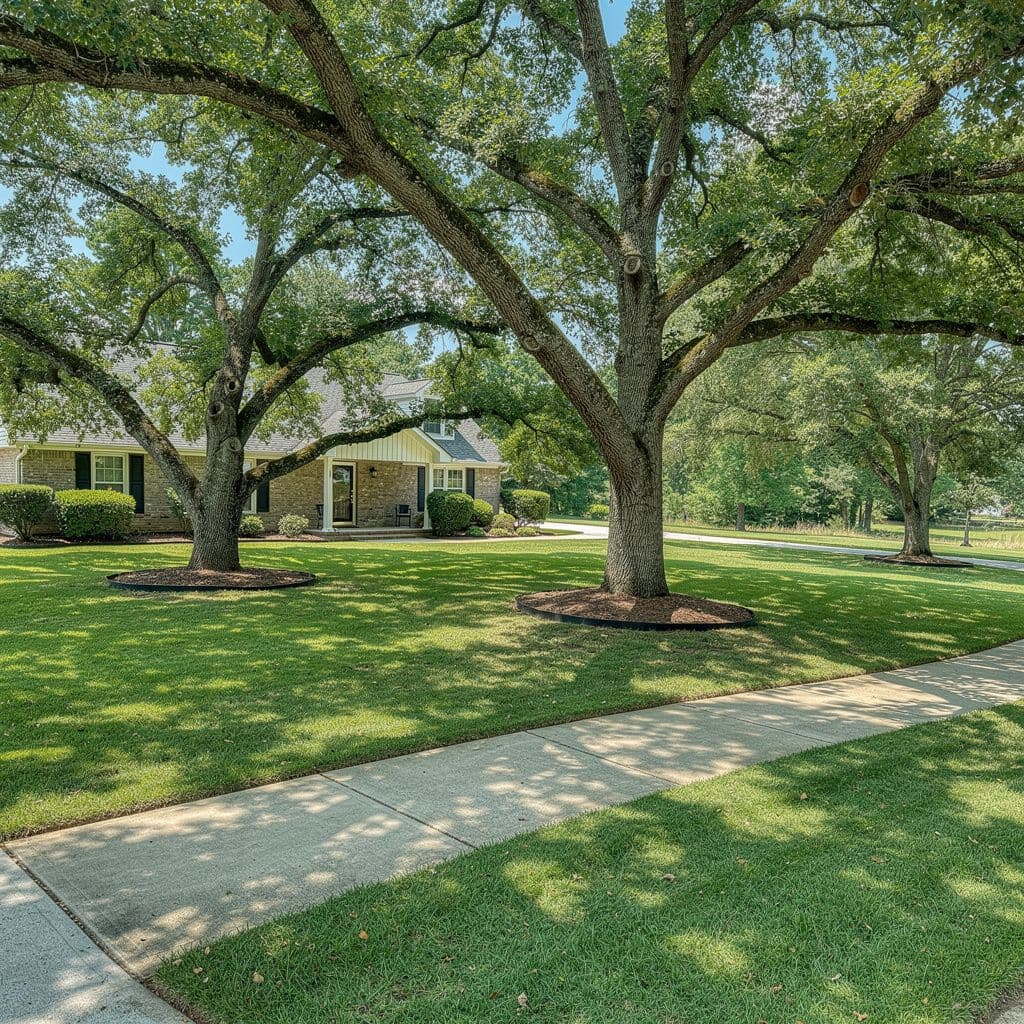
If you live in Henry County, there's a good chance you have mature trees on your property. Pecan groves in Locust Grove, towering oaks in McDonough, and mature pines throughout Stockbridge are part of what makes this area beautiful. But they also cast shadows — and grass doesn't love shadows.
Maybe you've noticed the grass thinning out under your oak tree. Maybe the side of your house that faces north stays patchy no matter how much fertilizer you throw at it. Maybe you've reseeded the same bare spot three years in a row and it keeps dying back by midsummer.
You're not doing anything wrong. You're just fighting biology. Turf grass needs sunlight — and when it doesn't get enough, it gets weak, thin, and eventually disappears. But that doesn't mean you're stuck with a mud pit under your favorite tree.
This guide walks through everything that works for shaded lawns in Henry County: the best shade-tolerant grass types for our climate, how to prune trees to let in more light without killing them, soil improvements that make a real difference, and lawn alternatives that look better than struggling turf ever will.
If you'd rather have professionals assess your yard and build a plan, call Hedgecoth Property Solutions at 770-490-9519 or reach out through our contact page. We provide lawn care, landscaping, and property maintenance throughout Henry County.
Why Grass Struggles in Shade (The Science, Simplified)
Photosynthesis Never Sleeps
Grass is a sun plant. It evolved in open meadows and prairies where it received full sun all day. When you put grass under a tree, you're asking a sun-loving plant to survive on a fraction of the energy it needs.
Turf grasses use photosynthesis to produce the sugars that fuel root growth, blade development, and disease resistance. In shade, that process slows dramatically. The grass produces fewer sugars, grows more slowly, develops shallower roots, and becomes vulnerable to every stress you can think of — drought, heat, foot traffic, fungal diseases, and weed invasion.
The result is exactly what you see in your yard: thin, pale, patchy turf that gets worse every year.
It's Not Just Light — It's Competition
Trees don't just block sunlight. They also compete with grass for water and nutrients. A mature oak can drink 50-100 gallons of water on a hot summer day. The root system under your tree is essentially a massive sponge that pulls moisture and fertilizer away from your grass before it ever reaches the roots.
This is why fertilizing shaded grass often makes things worse, not better. The tree absorbs the fertilizer, grows more leaves, casts more shade, and the cycle continues. You're feeding the problem.
Henry County's Tree Canopy Makes This a Local Issue
Henry County sits in Georgia's Piedmont region, which means we have a mix of hardwood forests (oak, hickory, maple) and southern pines. Our neighborhoods were largely carved out of forest, which means most homes have at least a few mature trees — and those trees create significant shade patterns.
In older neighborhoods near downtown Locust Grove and around the Hampton area, lots are often heavily wooded. Even newer developments in McDonough and Stockbridge typically have builder-planted trees that are now reaching maturity and casting much more shade than they did ten years ago.
The Best Shade-Tolerant Grass Types for Henry County
If you're going to grow grass in shade, you need the right species. Not all grass handles low light the same way. Here's what works in central Georgia:
1. Tall Fescue (Best for Heavy Shade)
Tall fescue is the most shade-tolerant cool-season grass available, and it's widely used throughout Henry County. It needs only 4 hours of direct sunlight (or equivalent filtered light) to maintain a healthy stand.
Pros: Excellent shade tolerance, deep root system, handles drought better than other cool-season grasses, stays green year-round in mild winters.
Cons: Struggles in extreme summer heat — July and August in Georgia can stress it. Needs overseeding every fall to maintain density. Not as spreading as warm-season grasses, so bare spots don't fill in on their own.
Best varieties for Henry County: turf-type tall fescue blends like Titan, Falcon, or Rebel. Buy a blend, not a single variety — blends handle variable conditions better.
2. Zoysia (Best Warm-Season Option for Moderate Shade)
Zoysia is a warm-season grass that handles shade better than Bermuda but still prefers full sun. It needs about 6 hours of direct sunlight to truly thrive, though it can survive on 4-5 hours.
Pros: Dense growth habit that naturally resists weeds, good heat and drought tolerance, spreads to fill bare spots, creates a lush carpet-like lawn.
Cons: Slower to establish than Bermuda, goes dormant (brown) in winter, more expensive to install as sod.
Best varieties: Zeon and Zorro have the best shade tolerance among Zoysia varieties. Emerald Zoysia also performs well in dappled shade.
3. St. Augustine (Limited Use in Henry County)
St. Augustine is the most shade-tolerant warm-season grass, but it's better suited to coastal Georgia than the Piedmont. It can work in protected microclimates in Henry County but isn't reliable for widespread use here due to winter kill risk.
4. What About Bermuda and Centipede?
Bermuda needs full sun — at least 8 hours of direct light. It will fail in shaded areas, period. If you have Bermuda grass thinning out under a tree, it's not diseased. It just doesn't have enough light.
Centipede handles light, dappled shade okay but thins out in moderate to heavy shade. It's better than Bermuda but worse than Zoysia or fescue for shaded conditions.
Practical Solutions: How to Improve Grass in Shaded Areas
Step 1: Assess and Improve Sunlight
Before changing your grass type or dumping money into products, look at what's blocking the light.
Tree Pruning and Canopy Thinning
Selectively pruning the lower branches and thinning the interior canopy of mature trees can significantly increase the amount of filtered light reaching your grass. This is called "canopy raising" and it's one of the most effective things you can do for shaded turf.
For oaks and hardwoods, removing the bottom 8-12 feet of branches can let in surprising amounts of light without harming the tree's health. Thinning interior branches — removing selective cross-branches to create more open space in the canopy — allows dappled light through rather than solid shade.
Important: Never remove more than 25% of a tree's canopy in a single year. Over-pruning stresses trees and can lead to decline. For mature oaks, consider hiring a certified arborist to evaluate which branches can safely be removed.
If you need professional tree trimming in the McDonough or Locust Grove area, call us at 770-490-9519. We can assess your trees and recommend a pruning plan that improves grass health without compromising your trees.
Remove Unnecessary Vegetation
Sometimes the shade problem isn't your trees — it's overgrown shrubs, volunteer saplings, or a fence covered in invasive vines. Clearing underbrush and removing plants that aren't adding value to your landscape can open up surprising amounts of light.
Step 2: Adjust Your Lawn Care Practices for Shade
Shaded grass needs different care than grass in full sun. If you're treating your shaded areas the same as your sunny areas, you're probably hurting the shaded grass.
Mow Higher
Set your mower blade 0.5-1 inch higher in shaded areas. Taller grass blades mean more leaf surface area for photosynthesis — which is critical when light is limited. For tall fescue in shade, mow at 3.5-4 inches. For Zoysia in shade, mow at 2-2.5 inches.
Fertilize Less, Not More
Shaded grass grows slowly. It needs fewer nutrients, not more. Applying high-nitrogen fertilizer to shaded grass pushes weak, leggy growth that's even more susceptible to disease. Reduce fertilizer applications to shaded areas by 30-50% compared to your sunny lawn.
Water Deeply and Infrequently
Shaded soil tends to stay moist longer (less evaporation), but tree roots compete aggressively for water. Water shaded areas deeply but less frequently — 1 inch of water every 5-7 days rather than the standard 1 inch every 3-4 days for full-sun lawns. This encourages deep root growth in the grass.
Reduce Foot Traffic
Shaded grass is already stressed. Foot traffic compacts the soil and damages already-weak grass. Consider adding a stepping stone path through high-traffic shaded areas to take the pressure off the turf.
Step 3: Overseed Regularly (For Fescue Lawns)
If you have tall fescue in shaded areas, plan to overseed every fall. Fescue doesn't spread laterally like warm-season grasses, so when individual plants die from summer stress, they leave bare spots that won't fill in on their own.
When to overseed in Henry County: Late September to mid-October. Soil temperatures are still warm enough for germination, but air temperatures are cooling enough that seedlings won't cook.
How to overseed shaded areas:
- Mow the existing grass short (2 inches) to expose soil
- Rake vigorously or use a dethatcher to remove dead material
- Aerate with a core aerator (this also helps with the compaction that's common under trees)
- Spread seed at 6-8 lbs per 1,000 sq ft (heavier than the standard 4-5 lbs for sunny areas)
- Top-dress with a thin layer of compost (0.25 inch) to improve seed-to-soil contact
- Water lightly twice daily until germination (10-14 days)
For professional lawn care including aeration and overseeding, contact Hedgecoth Property Solutions. We serve all of Henry County.
Step 4: Improve the Soil
Soil under trees tends to be compacted, nutrient-poor, and dry (because tree roots drink everything). Improving soil conditions gives shaded grass a fighting chance.
Core Aeration
Aerating shaded areas twice per year (spring and fall) relieves compaction and allows water, air, and nutrients to penetrate the soil. This is especially important under mature trees where root competition has compacted the soil over decades.
Compost Top-Dressing
Spreading a thin layer (0.25-0.5 inch) of quality compost over shaded turf once or twice per year improves soil structure, adds organic matter, and provides slow-release nutrients that trees won't strip out as aggressively as synthetic fertilizer.
Soil Testing
Before amending soil, test it. The UGA Extension office in McDonough offers soil tests for about $15. The results will tell you exactly what your soil needs — and just as importantly, what it doesn't need. Guessing at soil amendments wastes money and can make shade problems worse.
When to Stop Fighting and Switch to Alternatives
Sometimes the honest answer is that grass just isn't going to work in a particular spot. Heavy, dense shade under a mature tree with surface roots is one of those spots. Instead of spending money on grass that will fail, consider alternatives that look intentional and attractive.
Mulch Rings
A properly installed mulch ring around the base of shade trees looks clean, protects the tree from mower damage, and eliminates the struggle of growing grass where it can't survive. Extend the ring to the drip line of the tree for a polished look.
Use hardwood mulch (not dyed) at 2-3 inches depth. Avoid piling mulch against the trunk — keep a 3-4 inch gap to prevent rot. For professional mulch installation in Henry County, give us a call.
Shade-Tolerant Ground Covers
Several plants thrive in shade and provide a green, maintained look without the maintenance demands of turf grass:
Mondo Grass (Ophiopogon japonicus) — Looks like grass, handles deep shade, evergreen in Henry County, needs no mowing. Plant plugs 6-8 inches apart and they'll fill in over 1-2 seasons.
Liriope (Lilyturf) — Tough, evergreen, handles shade and drought. Spreads steadily. Available in green and variegated varieties. Mow once in late winter before new growth starts.
Creeping Jenny (Lysimachia nummularia) — Low-growing, bright chartreuse foliage, handles shade and moist soil. Goes dormant in winter but comes back strong each spring.
Ajuga (Bugleweed) — Forms a dense mat of foliage in shades of green, bronze, or purple. Spikes of blue flowers in spring. Handles shade well but can spread aggressively — contain it with edging.
Ferns (Japanese Painted Fern, Autumn Fern) — Perfect for naturalized areas under heavy shade. Combine with rocks and shade-tolerant perennials for a woodland garden look.
Hardscaping and Pathways
For high-traffic shaded areas, consider converting to hardscaping. A flagstone path through a shaded garden area looks intentional and eliminates the maintenance battle. Paver patios under the canopy of a large tree create usable outdoor living space where grass wouldn't grow anyway.
Explore our hardscaping services for patios, walkways, and retaining walls in the Locust Grove and Henry County area.
Common Shade Lawn Mistakes to Avoid
Mistake 1: Planting the Wrong Grass Seed
Big-box stores sell "shade mix" seed blends that are often formulated for northern climates. If you're planting shade-tolerant grass in Henry County, make sure you're buying turf-type tall fescue blends specifically rated for the Southeast. Generic shade mixes often contain ryegrass or fine fescue that will burn out in Georgia's summer heat.
Mistake 2: Topsoil Over Tree Roots
Spreading 4-6 inches of topsoil over tree roots to create a planting bed for grass might seem like a quick fix, but it can suffocate tree roots. Most tree roots are in the top 12-18 inches of soil, and adding a thick layer of soil on top reduces oxygen availability. If you need to add soil over tree roots, keep it to 1-2 inches maximum and use a well-draining compost blend.
Mistake 3: Installing Shade Cloth or Reflectors
Some homeowners try to bounce light into shaded areas using mirrors or reflective surfaces. This doesn't work and can create hot spots that scorch plants. Focus on practical solutions: prune for better light penetration, choose the right grass type, and accept that some areas won't grow turf.
Mistake 4: Ignoring Fungal Diseases
Shaded grass stays damp longer than grass in full sun, which creates ideal conditions for fungal diseases like brown patch, dollar spot, and Pythium blight. If you see circular patches of dead or dying grass in shaded areas, the cause is often fungal — not lack of light.
Fungal issues in shaded lawns should be treated with cultural practices first: improve air circulation by pruning low branches, water only in the morning (never evening), and apply a fungicide if the problem persists.
Seasonal Shade Lawn Care Calendar for Henry County
Spring (March-May)
- Rake leaves and debris that accumulated over winter
- Apply pre-emergent herbicide to shaded areas (weeds love shade too)
- Begin monitoring for fungal disease as humidity rises
- Core aerate if you didn't do it in fall
- Resist the urge to fertilize heavily — light applications only
Summer (June-August)
- Mow shaded grass 0.5-1 inch higher than sunny areas
- Water deeply once per week (more if drought is severe)
- Monitor for pest damage (armyworms and grubs can finish off already-stressed shaded grass)
- Accept some thinning as normal during peak heat — don't panic
Fall (September-November)
- Overseed fescue lawns — this is the most important task of the year for shaded lawns
- Core aerate before overseeding
- Apply a fall fertilizer formulated for root development (high phosphorus, moderate nitrogen)
- Keep leaves raked — a layer of wet leaves on shaded grass will kill it quickly
Winter (December-February)
- Stay off frozen shaded grass (it's more easily damaged than grass in full sun)
- Prune deciduous trees while dormant — this is the best time to thin canopies for improved light
- Plan spring projects — order seed, schedule mulch delivery, plan new bed layouts
For seasonal lawn care and property maintenance in Henry County, call Hedgecoth Property Solutions at 770-490-9519.
Frequently Asked Questions
How much sun does grass need to survive?
Most warm-season grasses (Bermuda, Centipede) need 8+ hours of direct sunlight. Zoysia needs 5-6 hours. Tall fescue can survive on 4 hours of direct sun or equivalent filtered light. If an area gets less than 4 hours of direct sun, grass will struggle regardless of what you do — consider shade-tolerant ground covers or mulch instead.
Can I grow grass under a pine tree?
It's difficult but not impossible. Pine trees cast dense shade AND create very acidic soil conditions (pH 4.5-5.5). Tall fescue is your best bet, but you'll need to apply lime regularly to counteract the acidity. Core aerate twice per year and plan to overseed every fall. If the pine tree has low branches all the way to the ground, consider a mulch ring instead.
Why does my grass look fine in spring but die back in summer under my trees?
In spring, deciduous trees haven't fully leafed out, so more light reaches the grass. Once the canopy fills in (late April to May), light levels drop dramatically. The grass that was growing happily in March suddenly doesn't have enough energy and starts to decline. This is normal — the solution is to choose a more shade-tolerant grass type or accept seasonal thinning.
Should I remove a tree to improve my lawn?
Tree removal should be a last resort. Trees add significant property value, provide cooling shade that reduces energy costs, and create wildlife habitat. Before removing a tree for lawn purposes, try canopy thinning, switching to shade-tolerant grass, or converting the area to mulch or ground cover. If a tree is dead, diseased, or dangerous, however, removal makes sense — and the lawn will benefit from the new sunlight.
How do I know if my shaded lawn has a fungal disease?
Look for circular or irregular patches of brown, thinning grass. You may see a gray or white "cobweb" growth on the grass blades in the early morning. Brown patch (caused by Rhizoctonia fungus) is the most common shade lawn disease in Henry County — it thrives in humid conditions with temperatures between 75-85°F. If you suspect fungal disease, reduce watering, improve air circulation through pruning, and contact a professional for treatment options.
What's the cost to have a professional handle my shaded lawn?
Every yard is different, which is why we offer free estimates. A typical lawn care program in Henry County ranges from $45-85 per visit depending on lot size and services needed. Overseeding and aeration projects typically run $150-400. Shaded lawn renovation — which may include tree pruning, soil amendment, overseeding, and mulch installation — varies based on scope. Call 770-490-9519 for a free, no-obligation estimate.
Stop Fighting Your Shade — Start Working With It
If you've been battling thin grass under your trees for years, it's time for a different approach. The right grass type, proper pruning, adjusted maintenance practices, and strategic use of ground covers and mulch can transform your shaded areas from eyesores to assets.
At Hedgecoth Property Solutions, we've helped homeowners throughout Henry County solve their shade lawn problems. We'll assess your yard, identify what's causing the thinning, and recommend practical solutions that fit your budget — whether that's overseeding, tree pruning, landscape renovation, or a complete redesign of shaded areas.
We serve Locust Grove, McDonough, Stockbridge, Jonesboro, Morrow, Hampton, and all of Henry County.
Call 770-490-9519 or contact us online to schedule your free estimate. Let's turn your shaded areas into the best part of your yard.