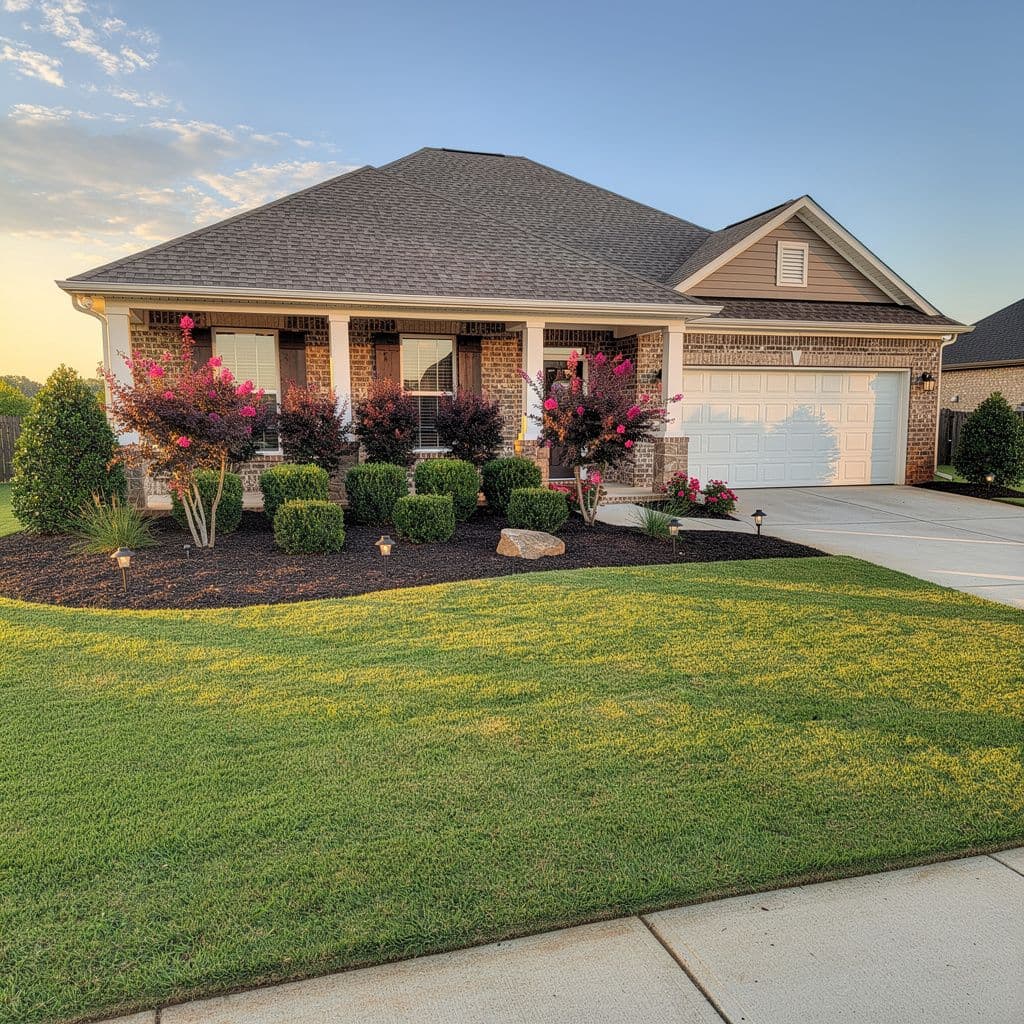
Landscaping on a Budget in Henry County: How to Transform Your Yard Without Breaking the Bank
Published: May 14, 2026
You don't need a six-figure budget to have the best-looking yard on your block. Some of the most stunning landscapes in Henry County were built piece by piece, season by season, with smart planning and a clear understanding of where to spend and where to save.
Whether you've just moved into a new build near Heritage Station in McDonough, you're tired of being the only house on your Locust Grove street without flower beds, or you want to boost your Stockbridge home's value before listing, this guide breaks down exactly how to get the most landscaping impact for every dollar you spend.
At Hedgecoth Property Solutions, we've helped hundreds of Henry County homeowners create beautiful outdoor spaces at every price point. Here's what we've learned works best when you're working with a budget.
Why Budget Landscaping Works in Henry County
Georgia's Climate Is Your Secret Weapon
Here's something most landscaping guides won't tell you: Henry County's climate is actually ideal for budget-friendly landscaping. Our long growing season, abundant rainfall, and mild winters mean plants establish quickly, grass grows aggressively, and nature does a lot of the heavy lifting for you.
A well-planted shrub in Locust Grove will grow twice as fast as the same plant in a colder climate. A sod lawn that takes two full seasons to establish up north can be fully rooted here in one Georgia summer. Our warm-season grasses — Bermuda, Zoysia, and Centipede — spread naturally and fill in bare spots without reseeding.
The key is working with our climate instead of against it. Choose plants that thrive in Georgia's red clay soil. Plant at the right time. Focus on perennials that come back year after year instead of expensive annuals you replace every season.
The Return on Investment for Landscaping
Before we get into specific strategies, understand that landscaping isn't just spending — it's investing. According to the National Association of Realtors, quality landscaping can increase your home's value by 15-20%. For a $350,000 home in Henry County, that's $52,000 to $70,000 in added value.
Even smaller projects deliver returns:
- Fresh mulch and edging — recoups 100%+ of cost in curb appeal alone
- Foundation plantings — adds $2,000-5,000 in perceived value
- A defined lawn with healthy grass — the single biggest visual impact per dollar
- Strategic tree planting — reduces cooling costs by 15-25% within 5 years
The trick is doing these projects in the right order, at the right time, for the right price.
The Budget Landscaping Priority List: What to Do First
Priority 1: Get Your Lawn Healthy (Cost: $0-$150/month)
Your lawn is the canvas everything else sits on. A thick, green lawn makes even the most basic landscape look polished, while a patchy, weedy lawn makes even expensive hardscaping look neglected.
Free things you can do today:
- Mow at the right height — Bermuda at 1.5-2 inches, Zoysia at 1.5-2.5 inches, Centipede at 1.5-2 inches. Cutting too short is the #1 mistake Henry County homeowners make.
- Water deeply, not frequently — 1 inch of water per week in one or two sessions. Shallow daily watering creates shallow roots that die in summer heat.
- Leave grass clippings — they return nitrogen to the soil, equivalent to one free fertilization per year.
Low-cost investments:
- Soil test ($10-15 through UGA Extension in McDonough) — tells you exactly what your lawn needs instead of guessing
- Pre-emergent herbicide ($30-50 for a bottle that covers 5,000 sq ft) — prevents crabgrass and annual weeds before they start
- Slow-release fertilizer ($25-40 per application) — feeds grass steadily instead of causing growth spikes
When to hire professionals:
If your lawn has widespread bare spots, heavy weed infestation, or signs of disease, professional lawn care pays for itself by avoiding costly mistakes. Our Henry County lawn care programs start at rates that are competitive with DIY when you factor in product costs and your time.
Priority 2: Clean Up and Edge Everything (Cost: $0-$100)
This is the highest-impact, lowest-cost thing you can do for your yard. A clean, well-edged property looks professional and maintained, even if you haven't spent a dime on new plants.
The clean-up checklist:
- Remove all debris — fallen branches, old mulch piles, broken pots, unused equipment
- Trim existing shrubs — rounded or natural shapes, remove dead wood
- Edge all landscape beds — a clean trench between mulch and grass
- Edge along driveway and sidewalks — crisp lines make everything look intentional
- Power wash hard surfaces — driveway, walkway, porch, mailbox
- Remove weeds from all beds and cracks — nothing says "neglected" like weeds
Tools you'll need (under $100 total):
- String trimmer ($40-60 at any home improvement store)
- Half-moon edger ($20-30)
- Putty knife for crack weeds ($5)
If you'd rather have it done right the first time, our property maintenance team handles complete yard clean-ups throughout Henry County.
Priority 3: Fresh Mulch (Cost: $50-$200)
After clean-up, fresh mulch is the single most transformative landscaping investment you can make. It's the cosmetic equivalent of painting a room — everything looks better immediately.
How to get the most from your mulch budget:
- Buy in bulk instead of bags — bulk mulch from local suppliers in Locust Grove or McDonough costs 40-60% less per cubic yard
- Apply 2-3 inches thick — thinner layers don't suppress weeds; thicker layers can suffocate plants
- Dark brown or black mulch looks more expensive and creates better contrast than red or orange
- Don't mulch volcanoes — keep mulch pulled back 3-4 inches from tree trunks and plant stems
- Edge before mulching — defined edges make mulch look three times as expensive as it is
A single cubic yard of mulch covers about 100 square feet at 3 inches deep. Most Henry County homes need 3-6 cubic yards for all landscape beds. At $30-45 per cubic yard delivered, you're looking at $90-270 for materials.
We offer mulch delivery and installation throughout Henry County if you'd rather skip the wheelbarrow work.
Priority 4: Foundation Plantings (Cost: $100-$500)
Foundation plantings — the shrubs and small plants along the front of your house — are what give a home that "finished" look. Without them, even a beautiful house looks naked.
Budget-friendly foundation planting strategy:
- Choose slow-growing evergreens — Dwarf yaupon holly, Carissa holly, or dwarf buford holly stay compact without constant pruning. They're $15-25 each at local nurseries.
- Space them properly — plant 3-4 feet apart and 3-4 feet from the house foundation. They'll fill in within 2-3 seasons.
- Add a contrasting accent — one loropetalum (purple plum) or a dwarf nandina adds color contrast without extra cost
- Use curving bed lines — curved beds look more natural and expensive than straight lines
Total cost for a typical front foundation planting in Henry County:
- 6-8 dwarf hollies at $20 each: $120-160
- 1-2 accent plants at $25 each: $25-50
- Mulch for new beds: $30-50
- Total: $175-260
Priority 5: Define Your Outdoor Spaces (Cost: $50-$300)
The difference between a "yard" and a "landscape" is defined spaces. You don't need expensive hardscaping to create distinct areas in your yard.
Budget space-defining techniques:
- Stone or brick edging — create borders between lawn and beds for $2-4 per linear foot
- Gravel pathways — a 3-foot wide path of crusher run gravel costs about $3-5 per linear foot
- Landscape timbers — treated 6x6 timbers create clean raised bed borders for $10-15 each
- Decorative fence sections — 4-foot picket fence sections define garden areas for $25-40 each
If you want something more permanent, our hardscaping services include affordable options like paver walkways and small patios that can be built in phases as your budget allows.
Plants That Give You the Most Bang for Your Buck in Henry County
Best Low-Cost, High-Impact Plants for Georgia
Not all plants are created equal when you're on a budget. These species thrive in Henry County's red clay soil, require minimal maintenance, and deliver maximum visual impact:
Shrubs (Budget: $15-35 each)
- Dwarf yaupon holly — evergreen, drought-tolerant, stays 3-4 feet tall. The workhorse of Georgia landscapes.
- Loropetalum — purple foliage year-round, pink flowers in spring. Fast-growing and eye-catching.
- Knockout roses — bloom from April to December in Georgia, disease-resistant, nearly indestructible.
- Gardenia (Frost Proof variety) — fragrant white flowers, evergreen, handles Henry County winters.
- Indian hawthorn — compact evergreen with pink or white spring flowers, pest-resistant.
Trees (Budget: $50-150 each for young trees)
- Crape myrtle — Henry County's signature landscape tree. Summer blooms in white, pink, red, or purple. $40-80 for a 5-gallon specimen.
- Eastern red cedar — native evergreen, grows fast, provides year-round screening. $30-50 for a small tree.
- Dogwood — native flowering tree, spring blooms, shade-tolerant. $50-100.
- Japanese maple — stunning fall color, excellent accent tree. $75-150 for a 5-7 gallon tree.
Groundcovers (Budget: $5-15 per plant, spread quickly)
- Mondo grass — evergreen, spreads to fill gaps, no mowing required. Perfect for shady areas where grass struggles.
- Liriope — tolerates sun and shade, purple flower spikes in summer, spreads steadily.
- Creeping jenny — bright chartreuse groundcover for moist areas, trails beautifully over walls.
Where to Buy Plants on a Budget in Henry County
Skip the premium garden centers for large purchases. These local and regional options offer better prices:
- local farmer's markets in McDonough and Stockbridge often have plant vendors with great prices on locally grown stock
- Big box stores (Home Depot, Lowe's in McDonough and Stockbridge) — good prices on common shrubs, especially during seasonal sales
- Online nurseries — bare-root trees and shrubs ship cheaply and establish well in Georgia's long growing season
- Plant swaps and neighborhood groups — Henry County Facebook groups often have plant giveaways and swaps
Pro tip: Buy plants in late summer (August-September) when nurseries clear inventory. You'll find 30-50% discounts on healthy plants that just need a season to establish before spring growth.
The Phase Approach: Building Your Landscape Over Time
Phase 1 (Month 1-2): Clean Slate — $200-$500
- Complete yard clean-up and debris removal
- Edge all existing beds and hardscape boundaries
- Apply fresh mulch to all beds
- First round of lawn care: mow, edge, treat weeds
- Pressure wash driveway, walkway, and porch
Impact: Your yard immediately looks 50% better. Neighbors notice.
Phase 2 (Month 3-4): Structure — $300-$700
- Install foundation plantings along the front of the house
- Define bed lines with edging material
- Add 1-2 specimen trees (crape myrtle, dogwood)
- Begin regular lawn treatment program
- Add landscape lighting (solar path lights: $15-25 each)
Impact: Your property starts looking intentional and designed rather than random.
Phase 3 (Month 5-8): Fill In — $200-$600
- Plant groundcovers in bare areas
- Add perennial flowers for seasonal color
- Install a gravel pathway or small patio area
- Add container gardens at the front entry
- Continue lawn care program
Impact: Your landscape feels complete and established.
Phase 4 (Month 9-12): Polish — $100-$400
- Add finishing touches: window boxes, hanging baskets, decorative containers
- Install landscape lighting upgrade (low-voltage system)
- Plant additional trees for shade and screening
- Address any problem areas that emerged during the year
- Establish ongoing maintenance schedule
Impact: Your yard looks professionally designed and maintained.
Total investment over 12 months: $800-$2,200 — a fraction of what a single professional landscape installation costs, with better results because each phase builds on the last.
DIY vs Hiring Professionals: Where to Save and Where to Spend
DIY Projects (Save Money)
These projects are straightforward, low-risk, and don't require specialized knowledge:
- Mulching — buy bulk, spread yourself
- Planting shrubs and small trees — dig a hole, amend soil, plant, water
- Edging — physical labor but no special skills
- Weed control — hand-pulling and spot spraying
- Lawn mowing — if you enjoy it and have time
Hire Professionals (Get More Value)
These projects benefit from expertise, equipment, or efficiency that professionals provide:
- Lawn treatment programs — proper timing and product selection for Georgia lawns requires knowledge that saves money long-term by avoiding damage
- Tree service — pruning large trees, removing trees, and stump grinding are dangerous without proper equipment and training
- Hardscaping — patios, retaining walls, and drainage solutions require proper base preparation to avoid costly failures
- Major grading and drainage work — fixing water problems permanently requires understanding how water moves across Henry County's terrain
The sweet spot for most Henry County homeowners is handling the simple, repetitive tasks yourself while hiring professionals for the skilled work. Our team at Hedgecoth Property Solutions offers flexible service options — from full-service weekly maintenance to project-specific work like tree trimming, hardscaping, and seasonal clean-ups.
Common Budget Landscaping Mistakes to Avoid
1. Planting Without a Plan
Random plants placed randomly look random. Even a simple sketch of your front yard with planned bed locations, plant types, and spacing will save you from costly do-overs. Measure your space, note sun and shade patterns, and choose plants accordingly.
2. Buying the Cheapest Plants
A $10 plant that dies in one season costs more than a $25 plant that thrives for 15 years. Buy healthy plants from reputable sources, and choose species suited to Henry County's climate and soil.
3. Ignoring Drainage
Henry County's clay soil and heavy rainfall create drainage challenges. Before spending money on plants and mulch, observe how water flows across your property during rain. Address drainage issues first — everything else depends on it.
4. Overplanting
That cute 1-gallon shrub will be 6 feet wide in five years. Read plant tags and space accordingly. Overcrowded plants compete for water and nutrients, look messy, and eventually need removal — all wasted money.
5. Skipping Soil Preparation
Georgia clay soil needs amendment before planting. Dig generous holes, mix in compost or soil conditioner, and mulch after planting. Skipping this step is the #1 reason new plants fail in Henry County.
6. Neglecting Maintenance
A $2,000 landscape that's maintained looks better than a $20,000 landscape that's ignored. Budget time or money for regular lawn care and upkeep — it's the highest-return investment you can make in your property.
Seasonal Budget Tips for Henry County Homeowners
Spring (March-May)
- Best time to plant shrubs and trees — they establish before summer heat
- Apply pre-emergent to prevent summer weeds — $30 prevents $200 in weed control later
- Refresh mulch before summer heat stresses plants
- Start lawn care program — early treatment prevents problems that cost more to fix later
Summer (June-August)
- Focus on maintenance — watering, mowing, weed control
- Avoid major planting — heat stress kills new plants and wastes money
- Watch for lawn disease — hot, humid Henry County summers create perfect conditions for fungus
- Plan fall projects — order materials during summer sales
Fall (September-November)
- Second planting window — ideal for trees, shrubs, and cool-season annuals
- Overseed thin lawns — fall seeding in Henry County gives grass time to establish before summer
- Plant spring-blooming bulbs — daffodils and tulips planted in October reward you in March
- Schedule fall clean-up — leaf removal prevents lawn damage
Winter (December-February)
- Plan and design — use downtime to plan next year's projects
- Prune dormant trees and shrubs — plants are bare so you can see structure
- Order materials — winter pricing on mulch, stone, and plants is often lower
- Get on professionals' schedules — spring bookings fill up fast in Henry County
Frequently Asked Questions About Budget Landscaping in Henry County
How much should I budget for landscaping my front yard?
For a typical Henry County front yard (quarter-acre lot), expect to spend $500-$2,000 for a basic DIY landscape with foundation plantings, mulch, and edging. Professional installation runs $3,000-$8,000 depending on materials and complexity. The key is tackling it in phases rather than trying to do everything at once.
What's the cheapest way to improve my yard fast?
Clean it up, edge everything, and add fresh mulch. These three steps cost under $200 for most properties and deliver more visual impact than any other investment. A clean, well-edged yard with fresh mulch looks professional and maintained, even without new plants.
When is the best time to start a landscaping project in Henry County?
Spring (March-May) and fall (September-November) are ideal for planting in Henry County. Spring gives plants a full growing season to establish before winter. Fall planting takes advantage of cooler temperatures and reliable rainfall. Avoid major planting projects during June-August when heat stress kills new transplants.
Can I get a nice yard without hiring a landscaping company?
Absolutely. Many beautiful Henry County landscapes were built entirely by homeowners. The key is starting with a plan, choosing the right plants for our climate, and being consistent with maintenance. Where professionals add the most value is in lawn treatment programs, tree work, and hardscaping — tasks where expertise prevents costly mistakes.
How do I maintain my landscape on a budget?
Focus on the basics: mow weekly during growing season, apply mulch annually, prune shrubs twice per year (spring and fall), and address weeds promptly before they spread. A consistent maintenance routine prevents expensive problems. Our property maintenance plans are designed to fit various budgets and keep your investment looking great.
What plants grow best in Henry County's red clay soil?
Native and adapted plants perform best: crape myrtles, dwarf hollies, loropetalum, knockout roses, mondo grass, and liriope all thrive in Georgia clay with minimal soil amendment. The key is amending the planting hole with compost and maintaining a layer of mulch to regulate soil temperature and moisture.
Ready to Transform Your Henry County Yard?
Creating a beautiful landscape on a budget isn't about cutting corners — it's about making smart choices, working with Georgia's climate instead of against it, and investing in the right projects at the right time.
Whether you want to handle the work yourself and just need guidance, or you'd prefer professional help to get it done right the first time, Hedgecoth Property Solutions is here for you. We serve homeowners throughout Locust Grove, McDonough, Stockbridge, Jonesboro, Morrow, Hampton, and all of Henry County.
Call us at 770-490-9519 or contact us online for a free estimate on any of our services:
- Lawn care and lawn treatment programs
- Landscaping design and installation
- Property maintenance plans
- Hardscaping — patios, walkways, retaining walls
- Leaf removal and seasonal clean-up
- Tree service and shrub trimming
Your dream yard doesn't require a dream budget. It requires a plan — and we'll help you build one.