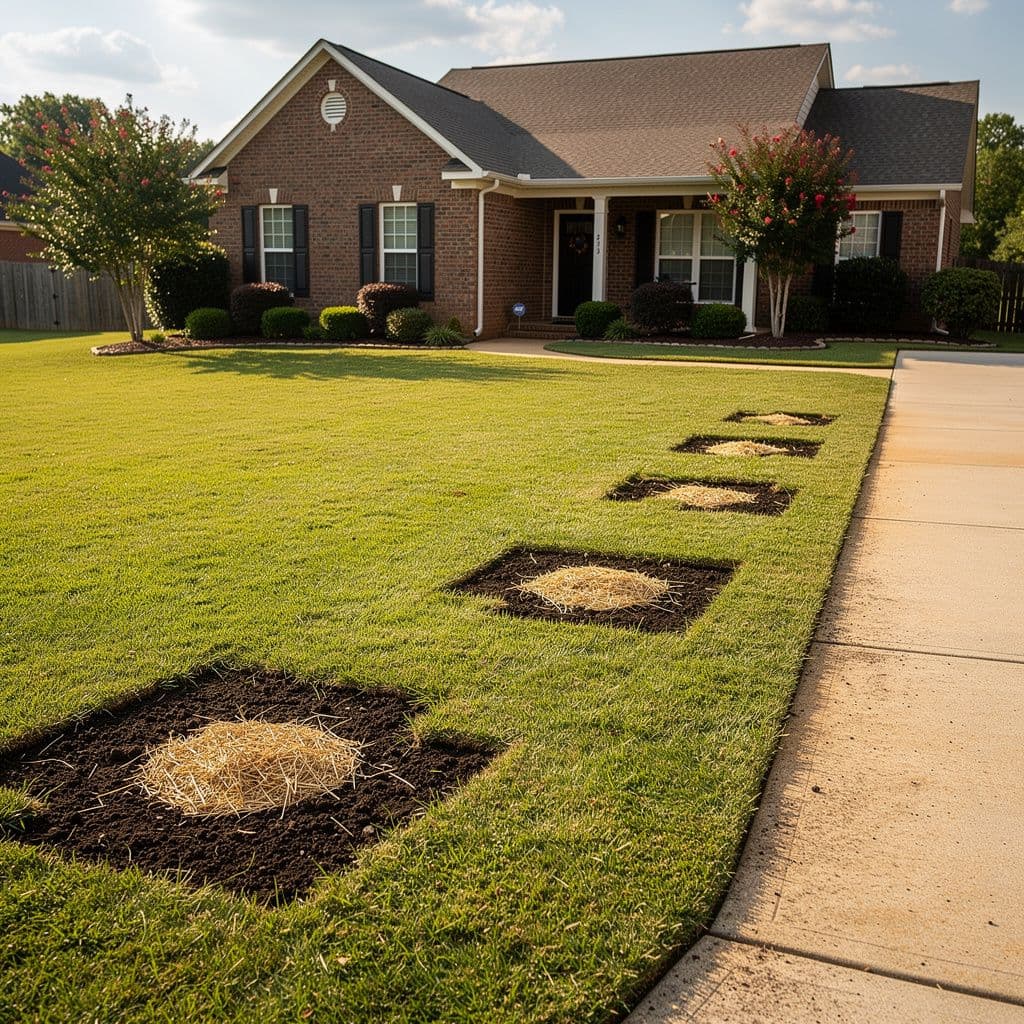
How to Fix Bare Spots in Your Lawn: Complete Repair Guide for Henry County, GA
Published: June 24, 2026
You look out at your yard and see them — bare patches where grass should be growing. Maybe they appeared after the summer heat hit. Maybe your lawn never fully came in this spring. Maybe heavy rain washed out a section near the driveway, or that shady corner under the oak tree has been thin for years.
Whatever caused them, bare spots are more than just an eyesore. They're open real estate for weeds, they expose Georgia clay soil to cracking and erosion, and they drag down your entire property's curb appeal. Every day you wait, those patches get harder to fix.
The good news? Repairing bare spots in a Henry County lawn is absolutely doable — if you use the right method for the right cause. Bermuda, Zoysia, Tall Fescue, and Centipede grass all have different recovery patterns, and the heavy clay soil in Locust Grove, McDonough, and Stockbridge adds its own set of challenges.
This guide walks through every step of patchy lawn repair — from diagnosing what caused the bare spots to choosing the right repair method, timing it correctly, and preventing them from coming back.
Why Your Lawn Has Bare Spots: Common Causes in Henry County
Before you throw seed on dirt and hope for the best, you need to understand why the bare spots appeared. Fixing the symptom without addressing the cause guarantees the patch comes back.
Heat and Drought Stress
Georgia summers are brutal on lawns. When temperatures consistently exceed 90°F and rainfall drops off — which happens every June through August in Henry County — cool-season grasses like Tall Fescue go into survival mode. They stop growing, pull nutrients from leaf tissue, and sections of the lawn thin out or die completely.
Warm-season grasses like Bermuda and Zoysia handle heat better, but even they struggle during extended dry spells. If your bare spots appeared suddenly during a hot, dry stretch in July or August, drought stress is the likely culprit.
Signs: Brown or straw-colored patches that feel dry and crunchy underfoot. Grass blades may have a purplish tint before browning — that's the plant's last signal before dormancy.
Heavy Foot Traffic
If the bare spots follow a path — from the patio to the garage, from the driveway to the front door, or where the dog runs back and forth along the fence — compaction and traffic are the issue. Georgia clay soil compacts easily under repeated pressure, squeezing out the oxygen and water roots need to survive.
This is especially common in newer subdivisions around Locust Grove and Hampton where the topsoil was stripped during construction and replaced with compacted clay.
Shade From Trees and Structures
Grass needs sunlight — even shade-tolerant varieties like Tall Fescue need at least four hours of direct sun. If your bare spots are under trees, along the north side of your house, or near a fence line, insufficient light is likely the cause.
Oak trees (common throughout McDonough and Jonesboro) are particularly tough on grass because their dense canopies block light AND their shallow roots compete aggressively for water and nutrients.
Soil Compaction and Poor Drainage
Henry County's clay soil holds water when wet and turns rock-hard when dry. Both extremes kill grass roots. If water pools in the bare area after rain, the roots suffocate. If the soil is so hard that water runs off instead of soaking in, roots can't establish.
Poor drainage is a common problem in flat yards throughout Stockbridge and McDonough where water has nowhere to go after heavy storms.
Pest Damage
Armyworms, grubs, and mole crickets can destroy sections of lawn seemingly overnight. Grubs feed on grass roots just below the surface, creating dead patches that pull up like loose carpet. Armyworms chew through grass blades in distinct patterns, often marching across the lawn in lines.
If bare spots appeared suddenly in late summer or early fall and the dead grass pulls up easily, pest damage is a prime suspect.
Pet Damage
Dog urine contains high concentrations of nitrogen and salts that burn grass. The result is circular dead spots — sometimes with a ring of darker green, faster-growing grass around the edge where diluted nitrogen acted as fertilizer. If you have a dog that uses the yard, this is likely contributing to your bare spots.
Fungal Disease
Georgia's heat and humidity create perfect conditions for lawn fungi. Brown patch, dollar spot, and large patch can kill sections of lawn quickly. These diseases often start as small circular spots that expand outward, leaving bare soil behind.
How to Repair Bare Spots: Step-by-Step Methods
Once you've identified the cause, it's time to fix the damage. Here are the three most effective methods for repairing bare spots in Henry County lawns.
Method 1: Spot Seeding (For Small Patches Under 6 Inches)
Best for: Minor thinning, small dead spots, pet damage repair.
Tools and materials:
- Hard-tine rake
- Quality grass seed matching your existing lawn
- Starter fertilizer
- Topsoil or compost (avoid raw clay)
- Water source
Step 1: Prepare the area. Rake the bare spot aggressively to remove dead grass, thatch, and debris. You want to expose bare, loosened soil. If the soil is compacted, use a garden fork to aerate the top 2-3 inches.
Step 2: Add a thin layer of topsoil or compost. Spread a 1/2-inch layer over the bare spot. This creates a better seedbed than compacted clay. Don't bury the surrounding healthy grass.
Step 3: Apply seed. Broadcast seed evenly across the prepared area at a rate slightly heavier than the bag recommends for new lawns. Press the seed into the soil with your rake or by walking on it.
Step 4: Apply starter fertilizer. Use a phosphorus-rich starter fertilizer to encourage root development. Avoid weed-and-feed products — the herbicide will kill germinating grass seed.
Step 5: Water lightly and frequently. Keep the seeded area consistently moist — not soaked — for two to three weeks. Water 2-3 times daily for 5-10 minutes each time. Reduce frequency as seedlings establish.
Method 2: Sod Patch Repair (For Instant Results)
Best for: High-visibility areas, time-sensitive repairs, large bare spots.
Sod provides instant coverage and is the most reliable repair method for Henry County lawns. It's more expensive than seed but eliminates the waiting and watering commitment.
Step 1: Cut out the damaged area. Use a sharp spade to cut a square or rectangle around the bare spot, extending 2-3 inches into healthy grass. Remove the dead sod and soil to a depth of 2 inches.
Step 2: Prepare the bed. Loosen the exposed soil and add a thin layer of topsoil or compost. Level it so the new sod will sit flush with the surrounding lawn.
Step 3: Cut and install sod. Purchase fresh sod matching your grass type. Cut a piece to fit the prepared area. Press it firmly into place, ensuring edges are tight against the existing lawn with no gaps.
Step 4: Water deeply. Soak the patched area immediately after installation. Water daily for the first week, then reduce to every other day for week two. Avoid walking on the new sod for at least 10 days.
For a professional approach, Hedgecoth Property Solutions offers sod installation and spot repair throughout Henry County — call 770-490-9519 for pricing.
Method 3: Plug or Sprig Repair (For Warm-Season Grasses)
Best for: Bermuda and Zoysia lawns with bare spots in full sun.
Bermuda and Zoysia spread by stolons (above-ground runners) and rhizomes (below-ground stems). You can accelerate repair by planting plugs — small sections of established grass — in the bare areas.
Step 1: Prepare the soil as described above.
Step 2: Plant plugs every 6-12 inches across the bare area. Press each plug firmly into the soil.
Step 3: Water daily for two weeks. The plugs will send out runners that fill in the gaps over 4-8 weeks.
This method works from late spring through mid-summer in Georgia. Don't attempt plug repair after August — the grass won't have time to establish before dormancy.
Timing Lawn Repairs in Henry County
Timing is everything. Plant grass at the wrong time and you'll waste seed, effort, and money.
Cool-Season Grasses (Tall Fescue)
Best repair window: September 15 – October 31
Second best: Late February – March 15
Tall Fescue seed needs soil temperatures between 60°F and 75°F to germinate. Fall is ideal because the soil is still warm from summer, days are cooling, and rainfall is typically adequate. Spring repairs work but the new grass faces summer heat before it's fully established.
Never seed Tall Fescue in June, July, or August unless you have irrigation and can keep the seed bed continuously moist. Even then, success rates are low.
Warm-Season Grasses (Bermuda, Zoysia, Centipede)
Best repair window: May 1 – August 15
Warm-season grasses are actively growing during summer, making this the ideal time to repair bare spots. Seed, sod, and plugs all establish quickly when soil temperatures are above 70°F.
If you're reading this in June or July, now is the perfect time to repair bare spots in a Bermuda or Zoysia lawn. Don't wait until fall — warm-season grasses go dormant in October and won't recover until the following spring.
Preventing Bare Spots From Coming Back
Fixing bare spots once doesn't prevent them from returning. Here's how to address the root causes.
Aerate Compacted Soil Annually
Core aeration relieves compaction, improves drainage, and creates channels for air, water, and nutrients to reach the root zone. For Henry County's clay soil, annual aeration is one of the most impactful things you can do for your lawn.
When to aerate:
- Bermuda and Zoysia: May – July
- Tall Fescue: September – October
Hedgecoth Property Solutions provides professional lawn aeration and overseeding throughout Locust Grove, McDonough, Stockbridge, and Jonesboro. Call 770-490-9519 to schedule.
Improve Drainage in Problem Areas
If standing water kills your grass after every heavy rain, you need drainage solutions. Options include:
- Grading adjustments to redirect water flow
- Installing French drains or catch basins
- Creating a rain garden in chronically wet areas
For standing water and drainage issues, professional yard drainage solutions can transform chronically wet areas into healthy, growing lawn.
Manage Tree Canopy for Better Light
If shade is the issue, selective tree pruning can let more light reach the grass. Remove lower branches and thin the canopy to allow dappled sunlight through. For areas under large oak or maple trees where grass simply won't grow, consider shade-tolerant ground covers or landscape beds instead.
Maintain Proper Mowing Height
Scalping the lawn weakens grass and invites bare spots. Mow at the correct height for your grass type:
- Bermuda: 1-1.5 inches
- Zoysia: 1-2 inches
- Tall Fescue: 3-4 inches
- Centipede: 1-2 inches
Never remove more than 1/3 of the grass blade in a single mowing. Professional lawn mowing services ensure consistent, correct-height cuts throughout the growing season.
Follow a Fertilization and Weed Control Program
A healthy, dense lawn naturally resists bare spots. Weeds exploit thin areas, and once they establish, they spread aggressively — creating more bare spots as they crowd out desirable grass.
A year-round program of fertilization and weed control keeps your lawn thick enough to prevent bare spots from developing. Pre-emergent herbicide in late winter stops weeds before they germinate. Post-emergent treatments clean up anything that breaks through. Regular feeding gives grass the nutrients it needs to fill in naturally.
When to Call a Professional for Lawn Repair
Some bare spot problems are DIY-friendly. Others need professional intervention. Here's when to call the pros:
Call a professional if:
- Bare spots cover more than 25% of your lawn
- You've seeded the same area twice with no success
- Bare spots keep returning in the same locations
- You suspect pest or disease damage
- Your soil is so compacted that water runs off instead of soaking in
- You're preparing to sell your home and need the lawn looking its best fast
A professional lawn care service can diagnose underlying issues that aren't obvious to homeowners — soil pH imbalances, hidden pest problems, nutrient deficiencies, or drainage failures. What looks like a simple bare spot might be a symptom of a deeper problem that no amount of seed will fix.
Hedgecoth Property Solutions has been repairing lawns across Henry County for years. We know the soil conditions in Locust Grove, the shade challenges in McDonough neighborhoods, the drainage issues in Stockbridge developments, and the pest pressures that hit Jonesboro and Hampton lawns each season.
We offer free property assessments. We'll walk your lawn, identify what's causing the bare spots, and give you a straightforward repair plan — whether that's something you can handle yourself or work you'd like us to handle for you.
Call 770-490-9519 or contact us online to schedule your free assessment.
Frequently Asked Questions About Fixing Bare Spots in Georgia Lawns
Can I just throw grass seed on bare spots?
Throwing seed on bare, unprepared soil almost always fails. Seed needs soil contact, consistent moisture, and the right temperature to germinate. Always rake the area to expose loose soil, add a thin layer of compost or topsoil, press the seed in, and keep it moist until germination — typically 7-21 days depending on grass type.
What's the fastest way to fix bare spots in my lawn?
Sod installation is the fastest repair method — it provides instant coverage and eliminates the germination waiting period. For warm-season grasses (Bermuda, Zoysia) in summer, sod establishes in 7-10 days. For cool-season grasses (Tall Fescue) in fall, sod establishes in 10-14 days. Professional sod installation ensures proper soil preparation and variety matching.
Why does grass keep dying in the same spot in my yard?
Recurring bare spots indicate an underlying issue that was never resolved: compacted soil, poor drainage, excessive shade, pest pressure, or a soil pH problem. If grass dies in the same place twice, you need to diagnose and fix the root cause before re-seeding or re-sodding. A professional lawn assessment can identify issues that aren't visible on the surface.
Can I repair bare spots in my lawn during summer in Henry County?
Yes, for warm-season grasses (Bermuda, Zoysia, Centipede) — summer is actually the best time to repair bare spots because these grasses are actively growing. For cool-season grasses (Tall Fescue), summer repair is risky due to heat stress. If you must repair Tall Fescue in summer, use sod rather than seed and water aggressively.
How much does professional lawn repair cost in Henry County?
Costs vary based on the repair method and area size. Spot seeding with topsoil preparation typically runs $150-400 for an average residential lawn section. Sod patch repair costs $200-600 depending on sod variety and area size. Full lawn renovation including aeration, overseeding, and topdressing ranges from $500-1,500+ depending on lawn size. Hedgecoth Property Solutions offers free assessments and upfront pricing — call 770-490-9519.
Will fertilizer fix bare spots in my lawn?
Fertilizer alone won't fix bare spots — there's no grass left to feed. However, a proper fertilization program prevents bare spots by keeping existing grass thick and healthy enough to fill in small gaps naturally. Once you've repaired the bare spot with seed or sod, starter fertilizer helps the new grass establish. Then ongoing fertilization keeps it strong.