Fall Lawn Preparation Guide for Henry County, GA: Everything You Need to Do Before Cool Weather Arrives
Published: July 27, 2026
If you think fall is the time to put your lawn equipment away and forget about your yard until spring, you're missing the most important season for lawn care in Henry County. What you do — or don't do — in September, October, and November directly determines how your lawn looks for the next six months. Fall lawn preparation is the single biggest factor in whether your grass comes back thick and green next spring or starts the year already behind.
At Hedgecoth Property Solutions, we provide professional lawn care and property maintenance services to homeowners throughout Locust Grove, McDonough, Hampton, Stockbridge, and the surrounding communities. After years of preparing Henry County lawns for the seasonal transition, we've developed a precise, locally calibrated approach that accounts for our unique clay soil, warm-season grass varieties, and the specific weather patterns that define fall in middle Georgia.
This guide walks through everything you need to know about fall lawn preparation in Henry County — when to start, what treatments matter most, and why this season is more important than you might think.
Why Fall Is the Most Critical Season for Your Lawn
There's a common misconception in Georgia that spring is the most important time for lawn care. While spring gets all the attention — green-up, first mow, pre-emergent treatments — the reality is that what happens in fall sets the entire foundation for the following year.
Here's why fall preparation matters more than any other season for Henry County homeowners:
Your Grass Is Storing Energy for Winter
Warm-season grasses — the Bermuda, Zoysia, and Centipede that thrive across Locust Grove, McDonough, and Hampton — go dormant when soil temperatures drop below 55°F. Before they shut down for winter, they enter a critical storage phase where they pull nutrients into their root systems to survive the cold months. If your lawn doesn't receive the right fertilization and soil treatments during this window, it enters dormancy weak and depleted. When spring arrives, it struggles to green up, fills in slowly, and is far more susceptible to weeds, disease, and insect damage.
Think of fall fertilization as packing a lunch for your lawn's winter hibernation. Skip it, and your grass wakes up hungry in March with nothing to eat.
Soil Compaction Peaks in Fall
After a full summer of foot traffic, mowing equipment, heavy thunderstorms, and heat expansion, Henry County's already-dense clay soil reaches maximum compaction by early fall. This compaction prevents water, oxygen, and nutrients from reaching the root zone right when your grass needs them most.
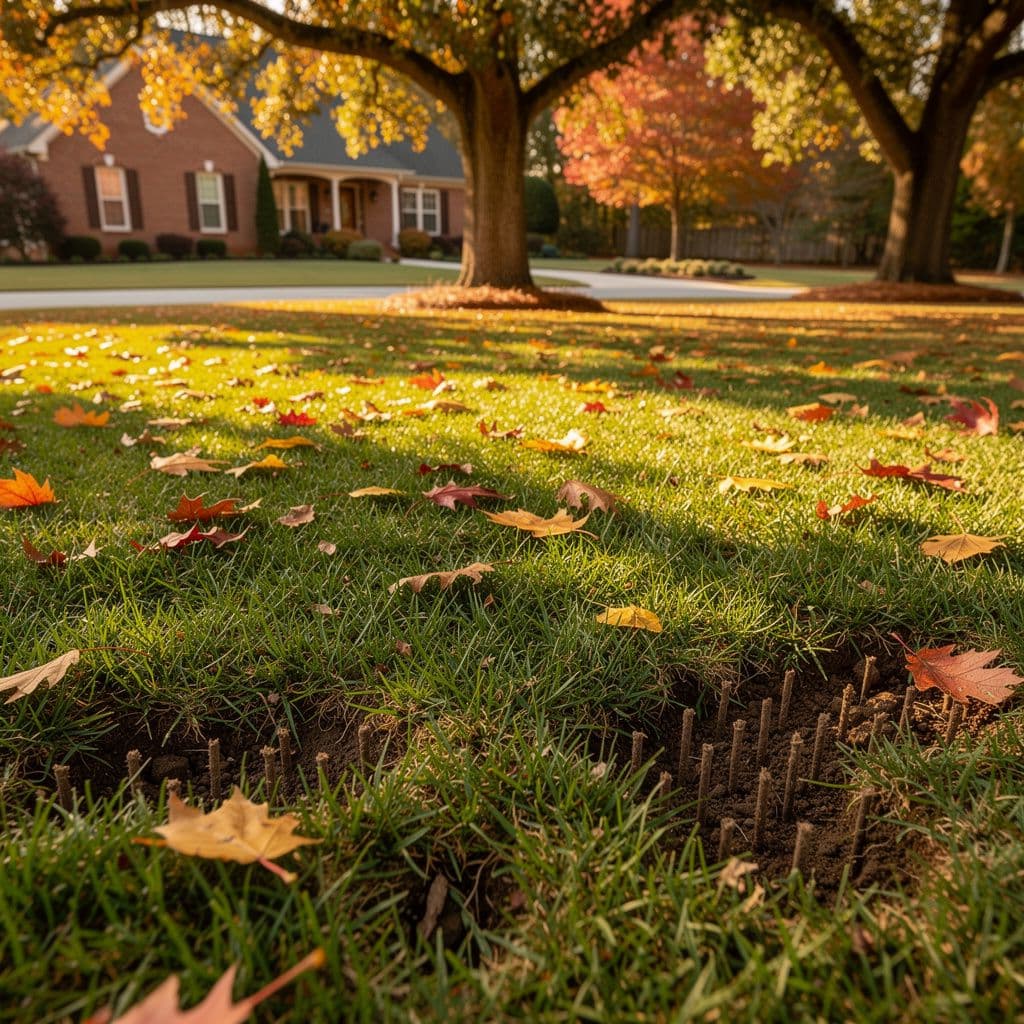
Fall is the ideal time for core aeration because warm-season grasses are still actively growing enough to recover from the process. The holes created by aeration allow fall fertilizers, rainfall, and organic matter to penetrate deep into the root zone, setting up stronger root development through the winter.
Weed Prevention Starts Now
The weeds you battle next spring are germinating this fall. Annual bluegrass (Poa annua), chickweed, henbit, and other winter weeds sprout when soil temperatures cool in September and October. Once they're established, they compete with your dormant grass for moisture and nutrients all winter long, then drop thousands of seeds before dying in spring.
A fall pre-emergent application stops these winter weeds before they germinate. This single treatment prevents months of weed problems and dramatically reduces the amount of herbicide needed in spring. If you've ever wondered why some lawns in your neighborhood stay relatively weed-free all winter while others are overrun by February — fall pre-emergent is the answer.
The Henry County Fall Lawn Preparation Timeline
Timing matters enormously in fall lawn care. Apply treatments too early and you may interfere with your lawn's late-season growth. Apply them too late and the window for effectiveness has closed. Here's the timeline we follow for Henry County properties, calibrated for our specific climate zone and soil conditions.
Late August Through Early September: Assessment and Soil Testing
Before applying any treatments, you need to know what your soil actually needs. This is the time to:
Conduct a soil test. Henry County's red clay is notoriously unpredictable when it comes to pH and nutrient levels. A professional soil test reveals exactly which nutrients are deficient, whether your pH is in the optimal range (6.0–6.5 for most warm-season grasses), and what amendments your specific lawn requires. Guessing at fertilizer without a soil test wastes money and can actually harm your lawn by applying nutrients it doesn't need.
Assess summer damage. After a full season of heat stress, insect pressure, and fungal activity, your lawn likely has thin areas, bare patches, or compaction damage. Walk your property and identify problem zones that need special attention — areas where grass has thinned, where weeds have taken hold, or where drainage issues caused damage during summer storms.
Evaluate thatch buildup. A thin layer of thatch (less than half an inch) is healthy. But if your lawn has a spongy, thick layer of dead organic matter between the grass blades and the soil surface, it needs to be addressed before fall treatments can be effective. Excessive thatch prevents fertilizers, water, and pre-emergent herbicides from reaching the soil where they do their work.
September: Aeration and Soil Amendment
Once you have your soil test results and understand your lawn's condition, September is the month for physical soil improvement.
Core Aeration
Core aeration is the single most beneficial mechanical process you can perform on a Henry County lawn. Our heavy clay soil compacts naturally over time, and by fall, after a full summer of activity, the ground beneath your grass is likely dense and impenetrable.
A professional core aerator removes thousands of small plugs of soil — each about two to three inches deep and half an inch across — from your lawn. These cores are left on the surface to break down naturally. The holes they leave behind provide several critical benefits:
- Reduced compaction — Soil physically loosens, allowing roots to expand
- Improved drainage — Water penetrates deeper instead of pooling on the surface
- Better nutrient uptake — Fall fertilizers can finally reach the root zone instead of sitting on top of compacted clay
- Enhanced air exchange — Oxygen reaches roots, supporting healthy microbial activity in the soil
For properties in Locust Grove and the surrounding areas, we recommend annual fall aeration for any lawn growing in native clay soil. The combination of aeration followed by fertilization produces dramatically better results than fertilization alone.
Soil Amendments
Based on your soil test results, September is the time to apply amendments:
- Lime — Most Henry County lawns are acidic due to clay soil and rainfall patterns. Pelletized lime raises pH to the optimal range where nutrients become available to grass roots
- Compost topdressing — A thin layer of organic compost spread after aeration improves soil structure, introduces beneficial microbes, and helps break down thatch
- Gypsum — For severely compacted clay, gypsum can help break up dense soil particles and improve drainage over time
Late September Through October: Fertilization and Weed Prevention
This is the core of your fall lawn treatment program — the applications that feed your grass for winter and prevent weeds from germinating.
Fall Fertilization
The fall fertilization application is different from summer feeding. During the growing season, fertilizer is primarily focused on top growth — keeping grass green and growing. In fall, the strategy shifts to root development and energy storage.
A fall fertilizer for warm-season grasses in Henry County should be:
- Higher in potassium — Potassium strengthens cell walls, improves cold tolerance, and helps grass survive winter freezing
- Moderate in nitrogen — Enough to support root development and energy storage without triggering a late flush of tender top growth that winterkill would destroy
- Balanced with phosphorus — If your soil test indicates a deficiency, phosphorus supports root system expansion during the fall growth phase
Professional-grade fall fertilizers are formulated specifically for this transition period. The big-box store products often contain the wrong nutrient ratios for Georgia's warm-season grasses, applying too much nitrogen too late in the season.
Pre-Emergent Weed Control
The fall pre-emergent application is arguably the most important weed control treatment of the entire year. It prevents winter annual weeds from germinating, which means:
- No annual bluegrass overtaking your dormant lawn
- No chickweed and henbit creating dense mats of weeds through winter
- No clover spreading during the cool months
- Far fewer weeds to deal with when spring arrives
For our lawn treatment clients in Locust Grove, McDonough, and across Henry County, we apply fall pre-emergent in late September through mid-October, timed precisely to soil temperature. Apply too early and summer rains can wash the product away before it's needed. Apply too late and the first wave of winter weeds has already germinated.
Post-Emergent Weed Cleanup
Any existing perennial weeds — dallisgrass, clover, dandelions, or nutsedge that survived summer treatments — should be spot-treated in fall. These weeds are pulling energy into their root systems just like your grass, which makes them more susceptible to systemic herbicides now than at any other time of year.
October Through November: Leaf Removal and Final Cleanup
Once treatments are applied, the focus shifts to keeping your lawn clean and clear through leaf fall season.
Leaf Removal
Henry County's mature oaks, hickories, sweetgums, and pines produce a staggering volume of fall foliage. When leaves accumulate on your lawn, they block sunlight, trap moisture against the grass, and create the perfect environment for fungal diseases. A lawn that goes into winter covered in leaves will have dead, moldy patches by spring.
Professional leaf removal ensures your lawn stays clear throughout the leaf-drop season. For properties with heavy tree canopies — common in the established neighborhoods around Locust Grove and throughout Henry County — this may require multiple visits between October and December.
Final Mowing
Your last mowing of the season should leave warm-season grasses slightly shorter than the growing season height. For Bermuda, this means about one inch. For Zoysia, about 1.5 inches. This shorter cut reduces the amount of grass material that can host fungal diseases during cool, damp winter conditions. However, do not scalp the lawn — cutting too short stresses the crown of the plant and can reduce winter survival.
Winter Watering Consideration
While warm-season grasses need far less water when dormant, newly aerated and treated soil benefits from adequate fall moisture. If September and October are unusually dry — which happens regularly in middle Georgia — a deep watering every two weeks supports root development and helps soil amendments break down properly.
Common Fall Lawn Care Mistakes in Henry County
After years of servicing lawns across Henry County, we see the same fall mistakes year after year. Avoiding these common errors can make the difference between a lawn that thrives and one that merely survives.
Stopping All Care Too Early
The most damaging mistake is assuming that when grass growth slows in September, lawn care is finished for the year. Growth above ground may slow, but root activity continues well into November. Stopping fertilization, weed control, and monitoring in early September leaves your lawn vulnerable and undernourished heading into winter.
Skipping the Soil Test
Every lawn in Henry County is different. Properties in the newer subdivisions near Hampton may have heavily disturbed soil with completely different nutrient profiles than established lots near downtown Locust Grove. Applying a generic fertilizer blend without knowing what your soil actually needs is a waste of money and can actively harm your lawn's chemistry.
Using the Wrong Pre-Emergent at the Wrong Time
Not all pre-emergent products work on the same weeds, and timing is everything. A product that prevents crabgrass in spring won't necessarily stop annual bluegrass in fall. Using the wrong product or applying at the wrong temperature means weeds germinate anyway — and you've wasted both the product cost and the application effort.
Ignoring Drainage Issues
Fall is when Henry County's drainage problems become most apparent. If water is pooling on your property after September rains, those areas will become problem zones by winter. Standing water suffocates grass roots, kills soil microbes, and creates bare patches that weeds quickly colonize. Address drainage before winter — not after the damage is done.
Leaving Leaves Too Long
A light dusting of leaves between mowings is fine. But when heavy leaf fall begins in November, leaving leaves on your lawn for more than a few days starts causing damage. Wet leaves mat down against the grass, block all sunlight, and create anaerobic conditions that kill turf in a matter of weeks. Consistent removal is essential.
Professional Fall Lawn Preparation Services
While some homeowners handle basic fall tasks themselves, professional lawn care services deliver significantly better results through several key advantages:
Professional-Grade Products: The fertilizers, pre-emergents, and soil amendments available to licensed professionals are fundamentally different from retail products. They contain higher-quality active ingredients, more precise nutrient ratios, and formulations designed specifically for regional conditions. Professional pre-emergent products, for example, provide longer-lasting control and better soil binding than anything available at a home improvement store.
Calibrated Equipment: Professional spreaders and sprayers apply products at the exact rate specified on the label. Too little and the treatment is ineffective. Too much and you risk burning your lawn or creating environmental runoff. Professional equipment eliminates guesswork.
Local Knowledge: Our team knows exactly when soil temperatures in Henry County reach the thresholds for each application. We know which neighborhoods have acidic soil and which don't. We know the specific weed species that are most problematic in Locust Grove versus Stockbridge. This local expertise translates to treatments that actually work.
Timing Precision: Fall applications have narrow windows of effectiveness. Professional services monitor conditions and apply each treatment at the optimal moment — not whenever it happens to be convenient on a weekend.
Complete Programs: Rather than piecing together individual treatments, a professional fall program includes soil testing, aeration, fertilization, pre-emergent weed control, post-emergent spot treatment, and ongoing monitoring — all coordinated to work together for maximum effectiveness.
Frequently Asked Questions About Fall Lawn Preparation
When should I start preparing my lawn for fall in Henry County?
Fall lawn preparation in Henry County should begin in late August to early September with a soil test and property assessment. Core aeration typically happens in September, followed by fall fertilization and pre-emergent weed control from late September through October. Leaf removal continues from October through December as needed. Starting too early can interfere with late-season grass growth, while starting too late means missing critical treatment windows.
Do warm-season grasses like Bermuda and Zoysia need fall fertilization?
Yes. While warm-season grasses slow their top growth as temperatures cool, they continue root development and energy storage well into November. A fall fertilizer with higher potassium and moderate nitrogen supports this critical storage phase. Without it, your lawn enters winter dormancy depleted and weak, leading to slow green-up and thin growth the following spring.
Is fall aeration really necessary if I aerated in spring?
For Henry County's heavy clay soil, annual aeration is recommended regardless of when the last aeration occurred. If you aerated in spring, your soil has recompacted over the summer through normal use, rainfall, and the natural wet-dry cycles of Georgia clay. Fall aeration is especially valuable because it allows fall fertilizers and winter rainfall to penetrate the root zone, improving soil conditions before the next growing season.
What happens if I skip fall pre-emergent weed control?
Skipping fall pre-emergent allows winter annual weeds — annual bluegrass, chickweed, henbit, and others — to germinate freely. These weeds establish through the fall, grow actively all winter while your grass is dormant, and drop thousands of seeds before dying in spring. The result is a lawn full of weeds by February, a heavier weed problem the following spring, and a significantly larger pre-emergent and post-emergent herbicide requirement to regain control. One fall application prevents months of weed problems.
Can I do fall leaf removal myself or do I need a professional service?
Light leaf fall can certainly be handled by homeowners with a rake or mower. However, properties with mature trees in Henry County often produce overwhelming volumes of leaves that require multiple removal sessions throughout the fall season. Professional leaf removal ensures consistent, thorough cleanup that prevents the damage caused by leaves left on the lawn too long. For properties with heavy tree cover — common throughout Locust Grove and Henry County — the time and effort savings of professional service often justify the cost.
How much does professional fall lawn preparation cost in Henry County?
The cost of fall lawn preparation varies based on lot size, grass type, current lawn condition, and the specific services needed. A complete fall program typically includes soil testing, core aeration, fall fertilization, pre-emergent weed control, and leaf removal services. For a detailed estimate tailored to your property, call Hedgecoth Property Solutions at 770-490-9519 for a free on-site assessment.
Don't Wait Until Spring — Prepare Your Lawn This Fall
Fall lawn preparation isn't optional if you want a healthy, thick, weed-free lawn in Henry County. The treatments and services you provide in September, October, and November are what make the difference between a lawn that turns heads next spring and one that spends months trying to recover.
At Hedgecoth Property Solutions, we handle every aspect of fall lawn preparation for homeowners across Henry County — from Locust Grove to McDonough, Hampton to Stockbridge. Our locally calibrated treatment programs, professional equipment, and deep knowledge of Georgia clay soil deliver results you can see when spring arrives.
Call 770-490-9519 or contact us online to schedule your fall lawn preparation consultation. Free estimates — no obligation, just honest advice from your neighborhood lawn care professionals.
Related: Discover why Henry County homeowners are choosing local lawn care over national chains for their seasonal treatments.