Warning Signs a Tree Needs Removal: What Henry County Homeowners Need to Know
Published: May 21, 2026
You walk outside on a humid May morning, coffee in hand, and notice something about the big oak in your front yard that you can't quite put your finger on. Maybe it's the way one side seems thinner than last year. Maybe it's a crack in the trunk you don't remember seeing. Maybe a few large branches didn't leaf out this spring. That quiet unease you're feeling? Trust it.
Trees are one of the best things about living in Henry County. They shade our homes during brutal Georgia summers, line our neighborhoods with character, and can add thousands of dollars to property values. But a tree that's in decline or structurally compromised isn't just an eyesore — it's a liability. A mature oak limb can weigh several thousand pounds. When it falls, it doesn't discriminate between your roof, your car, or your child's playset.
At Hedgecoth Property Solutions, we provide professional tree service throughout Locust Grove, McDonough, Stockbridge, Jonesboro, and all of Henry County. We've seen every scenario — trees split by thunderstorms, pines killed by beetle infestations, oaks hollowed out by decades of decay. And we've seen what happens when homeowners wait too long to act.
This guide walks you through the warning signs that indicate a tree may need removal, the risks of ignoring those signs, and when to call a professional.
Why Tree Removal Decisions Matter in Henry County
Henry County's tree canopy is one of its defining features. From the mature hardwoods in established Locust Grove neighborhoods to the tall pines scattered through McDonough developments, our properties are shaped by the trees around them. But living in this environment comes with specific challenges that make tree health a serious concern.
Georgia Weather Is Tough on Trees
Our region gets hit from every direction. Spring brings severe thunderstorms with straight-line winds that can snap limbs and uproot shallow-rooted trees. Summer brings drought stress and insect pressure. Fall brings hurricane remnants that push inland with heavy rain and wind. And winter ice storms — while less frequent — can devastate a weakened tree overnight.
The stretch from May through September is peak storm season in Henry County. If you have a compromised tree on your property, this is when it's most likely to fail. And the consequences of failure during a storm are amplified — emergency tree removal costs more, response times are longer, and the damage to your property can be catastrophic.
Henry County's Most Vulnerable Trees
Not all trees face the same risks. In our area, certain species and situations create higher-than-average hazard potential:
- Loblolly and slash pines are fast-growing with shallow root systems, making them prone to uprooting in saturated soil during heavy rains
- Water oaks have a relatively short lifespan (30-50 years) and are susceptible to root rot and limb failure as they age
- Bradford pears, once heavily planted in Henry County developments, have weak branch structures that make them prone to splitting — many are now reaching the age where failure is common
- Trees in new construction zones often suffer root damage during building, and the effects may not show up for 3-5 years
- Trees near utility lines or overhanging structures present immediate risk if any structural weakness exists
If you have any of these on your property, regular inspection by a professional tree service is not optional — it's essential property maintenance.
7 Warning Signs Your Tree May Need Removal
Knowing what to look for can mean the difference between a planned removal and a middle-of-the-night emergency. Here are the signs that should prompt an immediate call to a professional.
1. Large Dead Branches in the Crown
This is the most visible warning sign and one that homeowners often notice first. If you see large branches — especially in the upper crown — that have no leaves during growing season, have peeling bark, or are visibly breaking down, the tree is in decline.
Dead branches are more than a cosmetic issue. They're heavy, unpredictable, and can fall without warning. A dead oak branch six inches in diameter can weigh over 200 pounds and fall from 30 feet or higher. If it's over your driveway, your roof, or anywhere your family walks, it's an immediate hazard.
The key question: Is the tree losing branches because of a localized issue (like storm damage to one section) or because the entire tree is dying? A professional arborist or tree service can make this determination, but as a rule of thumb, if more than 25% of the crown is dead, the tree's prognosis is poor and removal is usually recommended.
2. Trunk Damage and Decay
The trunk is the structural backbone of the tree. When it's compromised, the entire tree is at risk.
Look for:
- Vertical cracks or seams running up the trunk — these can indicate internal splitting
- Fungal growth like mushrooms or conks at the base or on the trunk — this almost always means internal decay is present
- Hollow areas or cavities in the trunk — a hollow tree may look fine externally but have lost most of its structural wood
- Peeling or missing bark in large patches — this indicates the cambium layer underneath is dead, meaning that section of trunk is no longer alive
- Sawdust at the base — a sign of boring insects actively damaging the tree from inside
A common misconception is that a tree with a hollow trunk is fine as long as it has leaves. In reality, a trunk that's one-third or more hollow has lost significant structural integrity. During a wind event, that hollow trunk becomes a weak point that can snap unexpectedly.
3. Root Problems
Root issues are the hardest to spot because the damage happens underground, but they're responsible for some of the most dangerous tree failures — complete uprooting.
Signs of root trouble:
- Soil heaving or raised ground on one side of the tree base
- Leaning that has developed recently or is getting progressively worse
- Mushrooms or fungal growth in a ring around the base
- Construction or trenching within the drip line in recent years — root damage from excavation often takes 3-7 years to kill a tree
- Saturated soil from poor drainage — prolonged flooding suffocates roots and makes large trees unstable
A tree with compromised roots doesn't always look sick from above. The crown may appear full and green right up until the day it topples in a storm. This is why professional assessment of root zones is critical for large trees near homes, especially after any construction activity.
4. Significant Lean
Not all leaning trees are dangerous. Many trees develop a natural lean toward sunlight over decades and are perfectly stable. But a lean that's new, worsening, or accompanied by soil heaving is a red flag.
How to evaluate a lean:
- Has the lean developed recently or been there for years? Recent lean usually indicates root failure.
- Is the soil cracked or raised on the side opposite the lean? This means the root plate is lifting.
- Did the lean appear after a storm, heavy rain, or construction? These events can destabilize root systems.
- Is the tree a species prone to uprooting (pines, poplars, willows)?
If you can see that a lean has worsened over time — compare photos from different years, or look for exposed roots on the back side — call a tree professional immediately.
5. Codominant Stems and V-Trunks
This is a structural defect that's common in Henry County's Bradford pears, maples, and some oaks. When a tree has two main trunks (or two large stems) growing from the same point, the union between them is inherently weak. As the tree grows, the weight increases and the bark gets included between the stems, preventing a strong connection.
These V-shaped unions are prone to splitting — often during storms but sometimes on calm days when the weight simply exceeds the structural capacity. If you have a tree with a codominant stem that also shows cracking at the union, it's a high-priority hazard.
6. Excessive Deadwood Throughout the Tree
Every tree sheds some small branches — that's normal. But when you notice a pattern of dead twigs and small branches throughout the canopy, not just in one section, it indicates a systemic problem.
This can be caused by root disease, vascular issues, drought stress, insect infestation, or a combination of factors. In Henry County's heavy clay soils, root suffocation from poor drainage is a particularly common cause of overall decline.
When a tree is in systemic decline, it rarely recovers. Professional tree trimming can remove hazardous deadwood as a temporary measure, but if the underlying cause is root disease or vascular wilt, removal is usually the only safe long-term option.
7. Proximity to Structures and High-Traffic Areas
Sometimes a perfectly healthy tree still needs to be removed because of where it's located. If a large tree's fall zone includes your house, your neighbor's house, power lines, or the area where your kids play, even a moderate risk level may be unacceptable.
This is especially relevant for Henry County homeowners with:
- Large pines within 20 feet of the house — these are the most common cause of house damage during Georgia storms
- Trees overhanging roofs that create a debris problem and moisture trap, even if they're healthy
- Trees near pools, decks, or patios where falling limbs could injure people
- Trees interfering with utility lines that create fire and outage risks
A professional tree service can assess the risk level and help you weigh the value of keeping the tree against the potential cost of failure.
What to Do If You Spot These Warning Signs
If you've identified one or more of these warning signs on your property, here's how to proceed.
Don't Wait — Especially During Storm Season
In Henry County, the window between "I should get that checked" and "that tree just came through my roof" can be measured in weeks. May through September brings weekly thunderstorms, and all it takes is one with the right wind direction to bring down a compromised tree.
Immediate steps:
- Stay away from the tree if you suspect it's actively failing — cracking sounds, visible movement, or soil heaving are emergency indicators
- Document the issue with photos from multiple angles, including the trunk base, the crown, and any visible damage
- Call a professional tree service for an assessment — not a general handyman, but a company with tree-specific experience and proper insurance
- Don't attempt DIY removal — tree removal is one of the most dangerous property maintenance tasks, and without proper equipment and training, serious injury or property damage is likely
What a Professional Assessment Includes
When you call Hedgecoth Property Solutions for a tree assessment, here's what we evaluate:
- Overall tree health — crown density, leaf condition, growth patterns
- Structural integrity — trunk condition, branch attachments, lean analysis
- Root zone assessment — soil conditions, evidence of root rot or damage
- Target analysis — what's in the fall zone (house, vehicles, power lines, people)
- Species-specific risks — some species are more prone to certain failure types
- Soil and site conditions — drainage, compaction, recent construction impacts
Based on this assessment, we'll provide a clear recommendation — whether that's removal, tree trimming to reduce hazard, or continued monitoring.
Tree Removal vs. Tree Trimming: Knowing the Difference
Not every problematic tree needs to come down. In many cases, professional landscaping and tree care can address the issue without full removal.
When trimming may be sufficient:
- Dead branches are isolated to one or two limbs, not widespread
- The tree is structurally sound but has grown too close to a structure
- Crossing or rubbing branches are creating weak points
- The canopy is dense enough that wind resistance is creating storm risk — crown thinning can reduce this
When removal is the right call:
- More than 25% of the crown is dead
- The trunk has significant decay or hollow areas
- Root damage is evident and the tree is large enough to cause damage if it falls
- The lean is progressive and accompanied by root plate lifting
- The tree is a known hazard species (Bradford pear) in a high-target zone
- The cost of ongoing maintenance exceeds the value the tree provides
We always recommend removal as a last resort — but when safety is at stake, it's the only responsible recommendation.
The Tree Removal Process in Henry County
If removal is necessary, understanding the process helps you prepare.
Permits and Regulations
Henry County does not typically require a permit for removing trees on single-family residential property unless the property is in a protected watershed area or the tree is a specimen tree protected by local ordinance. However, some HOA-governed neighborhoods in Locust Grove, McDonough, and Stockbridge have their own tree removal policies. We can help you navigate any requirements.
What Professional Removal Includes
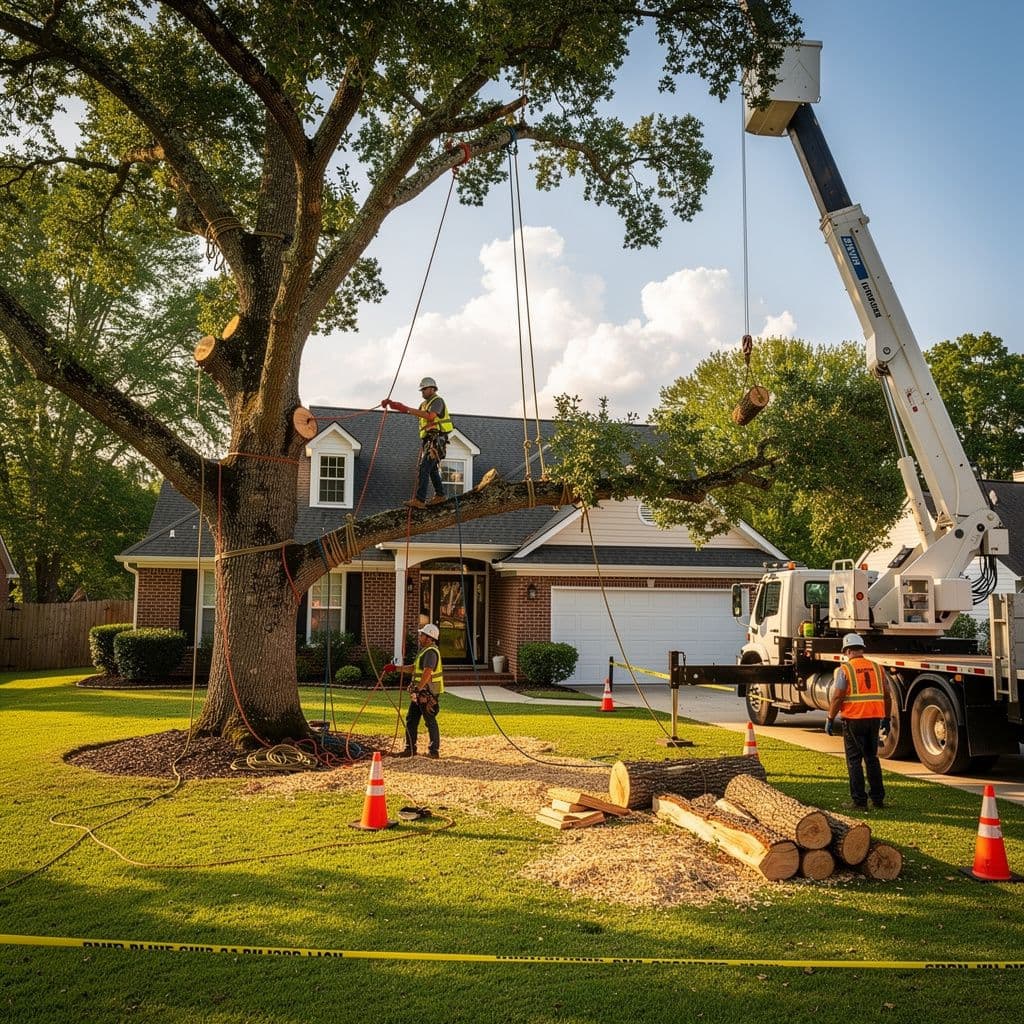
- Assessment and planning — determining the safest removal method based on the tree's location, condition, and surrounding targets
- Proper equipment — bucket trucks, cranes for large trees near structures, rigging equipment for controlled dismantling
- Ground crew protection — roping and lowering branches to prevent damage to your lawn, landscaping, and structures
- Stump grinding — we grind the stump below ground level so you can replant or landscape over the area
- Debris cleanup — full cleanup of branches, logs, and sawdust, leaving your property clean
- Hauling and disposal — all material removed from your property
What It Costs
Tree removal costs in Henry County vary based on tree size, species, condition, location (proximity to structures), and whether crane service is needed. General ranges:
- Small trees (under 30 feet): $300-800
- Medium trees (30-60 feet): $700-1,800
- Large trees (60-80 feet): $1,200-3,000
- Very large or hazardous trees: $2,000-5,000+
These are estimates — every tree is different. That's why we offer free on-site estimates so we can give you an accurate price based on your specific situation.
Don't Ignore the Signs — Protect Your Henry County Property
A tree in decline is not a problem that fixes itself. It gets worse, it gets more dangerous, and it gets more expensive to address. The homeowners who spend the least on tree issues are the ones who act early — addressing problems with targeted trimming before they require emergency removal.
If you've noticed any of the warning signs in this guide — dead branches, trunk damage, lean, fungal growth, or root issues — don't wait for the next thunderstorm to make the decision for you. Our team at Hedgecoth Property Solutions has been helping Henry County homeowners manage their trees safely for years. We serve Locust Grove, McDonough, Stockbridge, Jonesboro, Morrow, Hampton, and all surrounding communities.
Call us at 770-490-9519 or contact us online for a free tree assessment. We'll give you an honest evaluation and a straightforward recommendation — no upselling, no scare tactics. Just the information you need to protect your property and your family.
Frequently Asked Questions About Tree Removal in Henry County, GA
How do I know if my tree is dead or just dormant?
During growing season (April through October in Henry County), a dormant tree will not have leaves — but neither will a dead one. The difference is in the branches. Scratch a small section of bark on a few branches. If the tissue underneath is green and moist, the branch is alive. If it's brown and dry, that branch is dead. Check multiple branches at different heights and sides. If most show brown tissue, the tree is likely dead and should be evaluated for removal.
Can I remove a tree myself to save money?
Tree removal is consistently ranked among the most dangerous jobs in America for a reason. Without proper training, equipment, and insurance, attempting tree removal puts you at serious risk of injury or death — and puts your property at risk of catastrophic damage. A large branch falling the wrong direction can crush a roof, take down power lines, or cause fatal injuries. Professional tree removal is an investment in safety, not just a service.
Do I need a permit to remove a tree in Henry County?
In most cases, no — Henry County does not require a permit for tree removal on single-family residential property. However, there are exceptions for properties in protected areas, subdivisions with HOA tree policies, and commercial properties. Some cities within Henry County may also have their own regulations. When you call us for an assessment, we'll help you determine if any permits or approvals apply to your situation.
How long does tree removal take?
Most residential tree removals in Henry County are completed in a single day. Small to medium trees typically take 2-4 hours. Large trees near structures that require crane-assisted removal may take a full day. Stump grinding is usually completed at the same time. Emergency storm-related removals may take longer depending on conditions and access.
What should I do after a tree is removed?
After removal, you'll have an open area where the tree once stood. We grind the stump 6-12 inches below ground level, and you can choose to fill the area with topsoil and replant grass, install a new landscape feature, or plant a replacement tree in a better location. We can also help with landscaping and property maintenance to restore the area.
How often should I have my trees inspected?
We recommend a professional tree inspection at least once a year for properties with large trees near structures, and immediately after any major storm event. Spring is ideal for inspection — trees are leafing out so health issues are visible, and you have time to address problems before peak storm season arrives. Properties with mature trees, trees near construction zones, or trees showing any of the warning signs in this guide should be inspected more frequently.