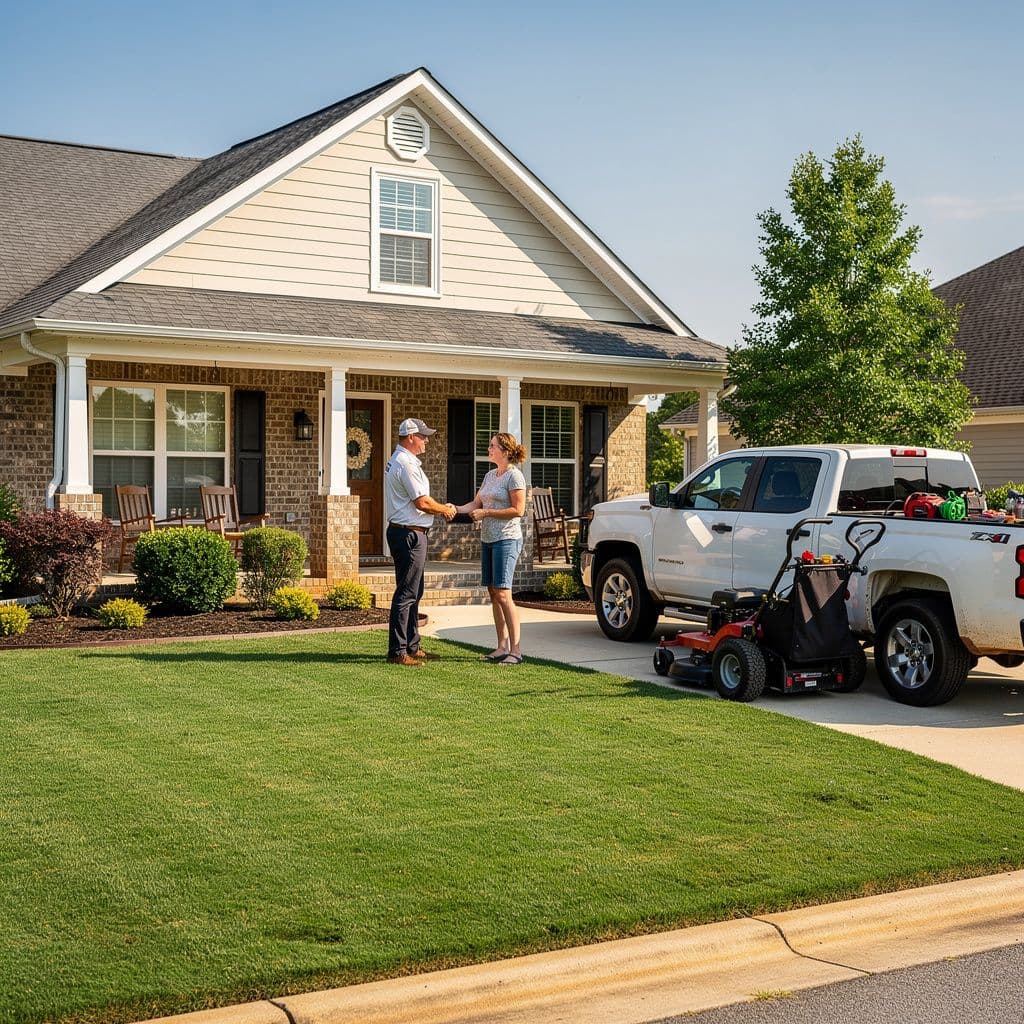
10 Questions to Ask Before Hiring a Lawn Care Company in Henry County GA
Published: June 26, 2026
Every spring and summer, homeowners across Henry County go through the same ritual: realizing their lawn needs professional help and trying to figure out which lawn care company to trust.
Maybe you just moved into a new home in McDonough and the builder left you with a yard full of red clay and construction debris. Maybe your lawn in Stockbridge has been slowly declining and you're tired of fighting weeds on your own. Or maybe you've been in Locust Grove for years and the teenage neighbor who used to cut your grass just went off to college.
Whatever brought you here, you're researching lawn care companies — and that's the right first step. But here's what most homeowners don't realize: not all lawn care companies are created equal. In Georgia, anyone with a mower and a truck can print up business cards and start charging for service. No license required for basic mowing. No training mandatory for fertilizer application. No oversight for most of the work happening on your property.
That means the burden is on you to separate the professionals from the amateurs. And the best way to do that is by asking the right questions before you sign anything.
Whether you're getting your first quote or evaluating whether to switch from your current provider, these ten questions will tell you everything you need to know about whether a lawn care company deserves your business.
Question 1: Are You Licensed and Insured in the State of Georgia?
This is the absolute minimum requirement — and you'd be shocked how many lawn care companies operating in Henry County can't answer it with a straight yes.
What to Listen For
A legitimate lawn care company should carry:
- General liability insurance (minimum $1 million coverage) — protects you if a mower throws a rock through your window or a worker is injured on your property
- Workers' compensation insurance — covers any crew member hurt while working on your lawn
- Georgia Department of Agriculture pesticide license — legally required for ANYONE applying fertilizer, herbicide, pesticide, or fungicide to your property
If a company applies weed-and-feed without a pesticide license, they're breaking Georgia law. If they damage your property and don't have insurance, you're the one paying for it.
Red Flag Answers
- "We're working on getting licensed" — means they're not licensed
- "We don't need insurance for basic mowing" — means if something goes wrong, you're on the hook
- "Our guys are contractors, not employees" — often used to avoid workers' comp requirements
- Silence or subject changes — the answer is no
What a Professional Says
A reputable company will provide their license number, insurance certificate, and proof of workers' comp without hesitation. At Hedgecoth Property Solutions, we carry full liability coverage and hold current Georgia pesticide applicator licenses. When you call 770-490-9519, we'll provide documentation before we ever set foot on your property.
Question 2: What Specific Services Are Included in Your Base Price?
This is where most homeowners get burned. You see a low monthly rate, sign up, and discover that "lawn care" only means mowing. Weed control costs extra. Fertilization is a separate program. Edging and blowing are "add-ons." Suddenly that $35-per-visit quote becomes $120 per visit.
What to Listen For
Ask for a written breakdown of exactly what's included. A transparent lawn care service should clearly state whether the base price includes:
- Mowing and string trimming
- Edging along sidewalks, driveways, and beds
- Blowing of clippions from hard surfaces
- Fertilization and soil amendments
- Pre-emergent and post-emergent weed control
- Fungicide and insecticide applications
- Soil testing and pH adjustment
- Aeration and overseeding
- Leaf removal (seasonal)
The Henry County Reality
In our area, warm-season grasses (Bermuda, Zoysia, Centipede) need fertilization from March through October, pre-emergent in both spring and fall, and fungicide during the humid summer months. If your "lawn care" company only mows, your lawn will slowly deteriorate regardless of how short the grass looks on cutting day.
Red Flag Answers
- "We handle everything" without providing a specific list
- "Fertilization is included but there's a separate materials charge"
- "Weed control is part of our premium tier" (after quoting you the basic tier)
- Quotes that seem too good to be true — they are
Question 3: How Do You Handle Henry County's Clay Soil?
This is the question that separates local experts from national chains and newbies. Georgia's red clay is legendary — and not in a good way for lawns.
Why This Matters
Henry County soil presents specific challenges that a generic lawn care approach won't solve:
- Compaction — clay particles are tiny and pack tightly, restricting root growth and water infiltration
- Poor drainage — water sits on the surface or pools in low areas, promoting fungal disease
- Nutrient tie-up — clay soil binds to certain nutrients, making them unavailable to grass roots
- pH imbalance — local soil tends to be acidic, requiring lime applications to adjust pH for optimal nutrient availability
- Low organic matter — new construction sites in particular are stripped of topsoil, leaving pure clay behind
What to Listen For
A company that knows Henry County should mention:
- Soil testing as a standard practice (not an upsell)
- Core aeration as part of an annual program
- Lime applications based on soil test results
- Gypsum or organic amendments to improve clay structure over time
- Specific fertilizer formulations designed for clay soil conditions
- Knowledge of local grass types and their nutrient requirements
Red Flag Answers
- "Clay soil is the same as any other soil" — it absolutely is not
- "We use the same fertilizer on every lawn" — red clay requires specific nutrient ratios
- "You just need to water more" — poor drainage from clay makes overwatering worse
- No mention of soil testing or pH management
Question 4: What's Your Approach to Weed Control?
Weed control is not one-size-fits-all, and in Henry County, the variety of weeds is staggering. Crabgrass, dandelions, nutsedge, clover, dallisgrass, spurge, and Virginia buttonweed all require different treatments at different times of year.
What to Listen For
A professional company should explain:
- Pre-emergent strategy — when they apply, what products they use, and how timing relates to soil temperature (not just calendar dates)
- Post-emergent approach — how they handle weeds that break through, including spot treatment vs. blanket spraying
- Weed identification — they should be able to name the common weeds in your yard and explain their life cycles
- Organic vs. synthetic options — they should offer choices based on your preferences for pets, children, and environmental concerns
- Seasonal adjustments — spring weeds, summer weeds, and winter weeds all require different approaches
The Timing Question
In Henry County, pre-emergent applications are time-critical. For summer annuals like crabgrass, the application must go down before soil temperatures reach 55°F — usually late February to mid-March. For winter annuals like annual bluegrass, the application goes down in early fall. A company that misses these windows will be fighting weeds all year with post-emergent sprays instead of preventing them.
Red Flag Answers
- "We spray for everything" — means they're applying chemicals without targeting specific weeds
- "Weed control costs extra" — should be integrated into a comprehensive program
- No mention of pre-emergent — they're only reacting to weeds, not preventing them
- "We use Roundup on everything" — that kills grass too; indicates a fundamental lack of knowledge
Question 5: Who Actually Shows Up to Service My Lawn?
This question reveals more about a company's consistency and quality control than almost anything else.
What to Listen For
- Dedicated crews — the same team services your property each visit, learning your lawn's quirks
- Employees vs. subcontractors — employees are trained and supervised by the company; subcontractors may have different standards
- Background checks — you're trusting people with access to your property
- Uniform and branded vehicles — indicates a real business, not a side hustle
- English-speaking crew leads — you need to be able to communicate about your property
Why This Matters in Practice
In Henry County's fast-growing subdivisions — from Eagles Brooke in Locust Grove to Eastlake in McDonough to Avalon in Stockbridge — lawn care companies service dozens of homes in the same neighborhood. The companies that send the same crew to the same route produce noticeably better results because the crew learns which sections drain slowly, where the sprinkler heads are, which areas need higher mowing heights, and which spots are prone to weeds.
When companies rotate crews daily, your lawn gets treated like a stranger's property every visit. Missed spots, inconsistent cut heights, and damaged sprinkler heads are the inevitable result.
Red Flag Answers
- "Whoever is available that day" — zero consistency
- "We use subcontractors but they're all good" — you can't quality-control someone else's employees
- "The owner does all the estimates but the crew handles the work" — the person who sold you the service isn't the person doing the work
- Crew shows up in an unmarked vehicle with no uniforms — this is a side gig, not a business
Question 6: How Do You Price Your Services?
Pricing transparency is critical. You need to understand exactly what you're paying for and how the company arrives at their numbers.
What to Listen For
- Square footage-based pricing — the most accurate method; larger lawns cost more because they require more time and materials
- Flat-rate vs. per-visit — know whether you're paying monthly (which may include visits that don't happen due to weather) or per-visit (which means you only pay for work completed)
- Annual program vs. à la carte — comprehensive annual programs typically offer better value than piecemeal services
- Written estimates — verbal quotes are meaningless; get everything in writing
- Price lock guarantees — some companies raise prices after the first year; ask about long-term pricing
Realistic Henry County Pricing
For reference, here's what professional lawn care services typically cost in Henry County:
Mowing Services:
- Small yard (under ¼ acre): $35-50 per visit
- Medium yard (¼ to ½ acre): $50-80 per visit
- Large yard (½ to 1 acre): $80-150 per visit
- Acreage (1+ acres): $150-300+ per visit
Comprehensive Programs (mowing + treatment):
- Basic program: $120-200 per month
- Standard program: $180-300 per month
- Premium program: $250-450+ per month
If a quote comes in well below these ranges, something is being cut — usually insurance, training, equipment quality, or service frequency.
Red Flag Answers
- "We'll beat any price" — they're competing on price, not quality
- No written estimate — get it in writing or it doesn't exist
- "The price may go up after the first few months" — bait-and-switch
- Can't explain how they arrived at the number — they made it up based on what they think you'll pay
Question 7: What Happens When There's a Problem With My Lawn?
Lawn care isn't set-and-forget. Things go wrong — fungal outbreaks after weeks of rain, armyworm invasions in late summer, brown patch in July, irrigation breaks, mole damage. How a company responds to problems tells you more than how they handle routine visits.
What to Listen For
- Service guarantees — what happens if weeds come back after treatment? Do they re-treat for free?
- Response time — how quickly will someone come out if you report a problem?
- Diagnostic capability — can they identify diseases, pests, and nutrient deficiencies on-site?
- Communication — will they proactively notify you if they notice an issue during a routine visit?
- Corrective action costs — are problem treatments included in your program or billed separately?
Henry County-Specific Problems
Our area has recurring issues that any local company should be prepared for:
- Brown patch fungus — thrives in our humid summers, especially on tall fescue
- Armyworms — major outbreaks in late summer that can destroy a lawn in days
- Grub worms — root-feeding larvae that attract moles and create dead patches
- Nutsedge — aggressive weed that thrives in poorly drained clay soil
- Drought stress — Georgia summers can bring extended dry spells that stress even healthy lawns
- Iron chlorosis — yellowing caused by iron deficiency in high-pH clay soil
A company worth hiring should know all of these by name and have a plan for each.
Red Flag Answers
- "Just call us if something comes up" with no specific guarantee — they have no system for problem resolution
- "Problems are billed separately" — nickel-and-diming for issues that should be covered
- "We don't handle pest problems" — then they're not a full-service lawn care company
- No proactive communication about lawn health — they're just cutting grass and collecting checks
Question 8: Do You Have References or Reviews from Customers in My Area?
A company can tell you they're great all day long. What matters is what their actual customers say — specifically, customers who live near you and have similar lawn conditions.
What to Listen For
- Verifiable online reviews — Google Business, Facebook, and Better Business Bureau reviews from real customers
- Specific neighborhood references — they should be able to name subdivisions or streets where they work
- Before-and-after photos — visual proof of their work, not just stock photos
- Long-term customers — reviews from people who have used them for 2+ years show sustained quality
- Response to negative reviews — how a company handles criticism reveals their character
Checking References Yourself
Don't just take the company's word for it. Do your own research:
- Google the company name + "reviews" or "complaints"
- Check their Google Business listing for recent reviews with photos
- Ask neighbors — in Henry County's tight-knit communities, someone on your street has probably used them
- Drive by properties they currently service — a good company should be proud to show off their work
- Check their Better Business Bureau rating — look for resolved vs. unresolved complaints
Red Flag Answers
- "We have lots of happy customers" but can't provide specifics
- Only reviews are from years ago — quality may have declined
- No online presence at all — not a real business
- Defensive or angry responses to legitimate negative reviews
- Reviews mention "showed up late," "damaged property," or "couldn't reach anyone"
Question 9: What Equipment Do You Use, and How Well Do You Maintain It?
Equipment quality directly affects the quality of your lawn. Dull mower blades tear grass instead of cutting it, creating ragged edges that turn brown and invite disease. Uncalibrated spreaders apply uneven fertilizer, causing stripes of dark green and pale yellow across your yard.
What to Listen For
- Commercial-grade equipment — brands like Scag, Exmark, Wright, or Husqvarna commercial lines
- Blade sharpening schedule — at minimum weekly, ideally daily during peak season
- Calibrated spreaders and sprayers — checked regularly for accurate application rates
- Backup equipment — if a mower breaks, they have another ready (your lawn doesn't wait)
- Clean, organized trucks and trailers — sloppy equipment means sloppy work
Why This Matters for Your Lawn
Dull blades are the #1 cause of lawn stress after improper watering. Torn grass blades lose moisture faster, are more susceptible to fungal infections, and give the lawn a brownish cast even when it's healthy underneath. In Henry County's already-challenging climate, adding unnecessary stress through poor equipment maintenance is a recipe for decline.
Red Flag Answers
- "We sharpen blades when they get dull" — by then it's already too late; the damage is done
- Residential-grade mowers (Home Depot/Lowe's brands) — not built for daily commercial use
- Rusty, dirty, or disorganized equipment in the truck — if they don't care for their tools, they won't care for your lawn
- No backup equipment — one breakdown and your lawn goes two weeks without service
Question 10: What's Your Cancellation Policy?
Nobody starts a lawn care relationship expecting to cancel. But life changes — you might move, sell the house, switch to DIY, or simply be unhappy with the results. Knowing the exit terms before you sign prevents headaches later.
What to Listen For
- Month-to-month flexibility — you shouldn't be locked into a year-long contract for residential lawn care
- Written cancellation process — email or written notice, not just a phone call
- No cancellation fees — for standard residential service, there should be no penalty for ending service
- Prorated refunds — if you've prepaid for a season and cancel midway, you should get unused funds back
- Notice requirements — reasonable (3-7 days before next service), not punitive
The Contract Trap
Some companies in Henry County push annual contracts that auto-renew. These contracts often include:
- Early termination fees ($100-500+)
- Auto-renewal clauses that lock you in for another year unless you cancel in writing within a narrow window
- Bundled services that can't be individually canceled
- Price increase clauses that allow mid-contract rate hikes
There's nothing wrong with an annual agreement that offers a discount for commitment — as long as the terms are transparent and the exit is clean. The problem is when contracts are designed to trap unhappy customers rather than reward loyal ones.
Red Flag Answers
- "It's a one-year commitment with a cancellation fee" — they're confident you'll want to leave
- Auto-renewal without explicit notification — predatory practice
- "Just call and we'll cancel it" with no written policy — verbal promises don't hold up
- Refuses to provide the contract terms before the first service — what are they hiding?
How to Use These Questions Effectively
Don't rapid-fire all ten questions in the first phone call. Use them strategically throughout the evaluation process:
Initial Phone Call (Questions 1, 2, 6)
When you first contact a company, ask about licensing, services, and pricing. These are deal-breakers — if they can't answer clearly, save yourself time and move on.
On-Site Estimate (Questions 3, 4, 5, 9)
When someone visits your property for an estimate, ask about soil expertise, weed control strategy, crew consistency, and equipment. These answers reveal operational quality that you can observe in person.
Reference Check (Question 8)
Do this on your own time. Research reviews, drive by properties, and talk to neighbors. The company's marketing will always sound great — real customer experiences tell the actual story.
Before Signing (Questions 7, 10)
Once you're seriously considering a company, nail down problem resolution and cancellation policies. Get these in writing as part of your service agreement.
The Bonus Question Most People Forget
"Do you actually want to work with this company?"
Beyond all the technical questions, pay attention to how you feel about the interaction. Did they show up on time for the estimate? Did they listen to your concerns? Did they explain things clearly without talking down to you? Did they seem genuinely interested in helping your lawn — or just closing a sale?
In Henry County, where word-of-mouth drives a huge portion of local business, reputation matters. A company that treats you well before you're a customer will likely treat you well after you've signed up. A company that's pushy, dismissive, or vague during the sales process will only get worse once they have your money.
Why Henry County Homeowners Choose Hedgecoth Property Solutions
We built our company around answering these questions the right way — with transparency, local expertise, and genuine care for every property we service.
Our Answers to the 10 Questions
- Licensed & Insured: Full general liability ($1M+), workers' comp, and Georgia pesticide applicator licenses
- Clear Service Pricing: Written estimates detailing exactly what's included — no hidden fees or surprise charges
- Henry County Soil Experts: Soil testing, clay-specific programs, lime applications, and core aeration as standard practice
- Comprehensive Weed Control: Pre-emergent and post-emergent programs timed to Georgia's growing season
- Dedicated Crews: Same team on your route every visit, trained and supervised by company leadership
- Square Footage Pricing: Fair, transparent rates based on your property's actual size and needs
- Problem Resolution: Free re-treatments for weed breakthrough, proactive issue alerts, and rapid response to lawn problems
- Verified Reviews: Dozens of Google reviews from real Henry County homeowners, with photos of actual work
- Commercial Equipment: Scag and Exmark mowers, daily-sharpened blades, calibrated spreaders and sprayers
- No-Contract Freedom: Month-to-month service with simple cancellation — we earn your business every visit
Our Service Area
We proudly serve homeowners throughout Henry County and surrounding areas:
- Locust Grove — Weekly and bi-weekly lawn care for subdivisions and rural properties
- McDonough — Full-service lawn programs from new construction to established estates
- Stockbridge — Lawn care, weed control, and fertilization programs
- Jonesboro — Property maintenance and lawn services
- Morrow — Residential and commercial lawn care
- Hampton — Lawn maintenance and landscaping services
Ready for a Lawn Care Company That Answers Your Questions?
Don't settle for a lawn service that can't explain what they're doing on your property. You work hard for your home, and your lawn should reflect that. Whether you're switching from a disappointing provider or starting professional service for the first time, we're ready to show you what quality lawn care looks like.
Call Hedgecoth Property Solutions today at 770-490-9519 or reach out through our contact page to schedule your free property evaluation. We'll answer every question on this list — and any others you have — with straight answers and zero pressure.
Your lawn deserves a company that knows what it's doing. Let us prove we're that company.
FAQ: Hiring a Lawn Care Company in Henry County
How do I know if a lawn care company is reputable?
Check for three things: valid Georgia licensing (pesticide applicator license for any chemical applications), general liability insurance ($1M+), and verifiable online reviews from customers in your area. A reputable company provides documentation without hesitation and has a track record of consistent service. Ask for references from homeowners in your specific neighborhood — in Henry County's subdivisions, someone nearby has likely used them.
What should a lawn care contract include?
A proper contract should clearly list all included services, the service schedule (weekly, bi-weekly, monthly), pricing breakdown, cancellation policy, service guarantee terms, and what happens if weather delays service. Avoid contracts with auto-renewal clauses, early termination fees for residential service, or vague language about what's included. Get everything in writing — verbal promises are unenforceable.
How much does lawn care cost per month in Henry County?
Monthly costs range from $120-450+ depending on property size, service level, and program type. Basic mowing-only service runs $35-80 per visit for typical Henry County lots. Comprehensive programs including fertilization, weed control, and pest management range from $180-300 per month. Premium programs with soil testing, aeration, and disease management can reach $400+ monthly. Always get per-visit and monthly rates in writing.
Should I hire a local or national lawn care company?
Local companies almost always provide better results in Henry County. National chains use standardized programs that don't account for local soil conditions, micro-climates, or specific weed pressures. Local companies know the difference between soil in McDonough vs. Stockbridge, understand which grass types thrive in which neighborhoods, and can respond same-week when armyworms hit or fungal disease breaks out. You're also supporting your local economy — and dealing with decision-makers who live in your community.
What's the difference between lawn care and lawn maintenance?
Lawn maintenance typically refers to physical tasks: mowing, edging, blowing, leaf removal, and debris cleanup. Lawn care is broader, encompassing maintenance plus treatments like fertilization, weed control, aeration, overseeding, pest management, and disease prevention. Some companies offer only maintenance; others offer comprehensive care. Make sure you know which you're getting and that your quote covers everything your lawn actually needs.
Can I switch lawn care companies mid-season?
Yes — and many Henry County homeowners do. If your current company isn't delivering results, you can switch at any time. Provide written cancellation notice per your agreement terms, request any records of treatments applied (important so your new company knows what's already been done), and don't feel guilty about leaving. A company that's doing good work won't need contract traps to keep you. At Hedgecoth Property Solutions, we make mid-season transitions seamless — we'll review prior treatments, assess your lawn's current condition, and pick up the program without interruption.
About Hedgecoth Property Solutions:
Serving Henry County homeowners with comprehensive lawn care, property maintenance, and landscaping services. Our team of certified professionals combines local expertise with industry-leading techniques to deliver exceptional results for properties throughout Locust Grove, McDonough, Stockbridge, Jonesboro, Morrow, and Hampton.
Contact:
- Phone: 770-490-9519
- Contact Page
- Service Area: Locust Grove, McDonough, Jonesboro, Stockbridge, Morrow, Hampton & Henry County, GA